Basic Information
Scientific classification
- Chinese name: Swift Spider
- Scientific name: Nyssus coloripes (representative of the Swift Spider group, including the Orange-legged Swift Spider)
- Classification: Arthropoda
- Family: Nyssus coloripes
Vital signs data
- Body length: Adult spiders are about 6–12 mm in length, with females slightly larger than males and a leg span of less than 2 cm.
- Weight: Small terrestrial spiders, mostly weighing tens to hundreds of milligrams.
- Lifespan: Generally 1–2 years, depending on climate conditions and food resources.
Significant features
Small, fast-running active predators that do not weave large predatory nets, relying on sight and speed to hunt insects, are important natural enemies and beneficial insects in gardens and fields.
Distribution and Habitat
They are mainly distributed in Australia and surrounding areas, and are active on a variety of substrates such as urban gardens, rural courtyards, bushes, forest edges, walls, and fences. They prefer dry or slightly damp surface environments.
Appearance
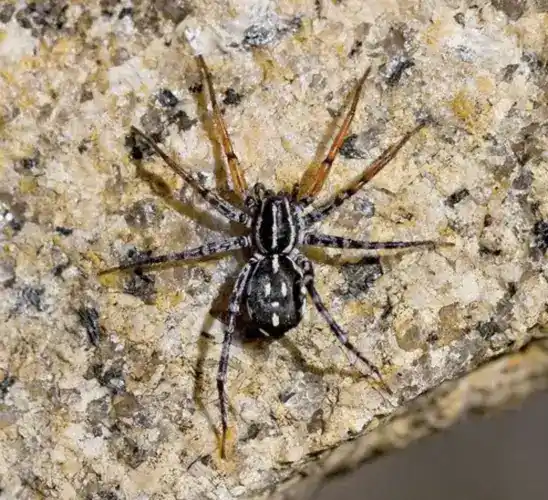
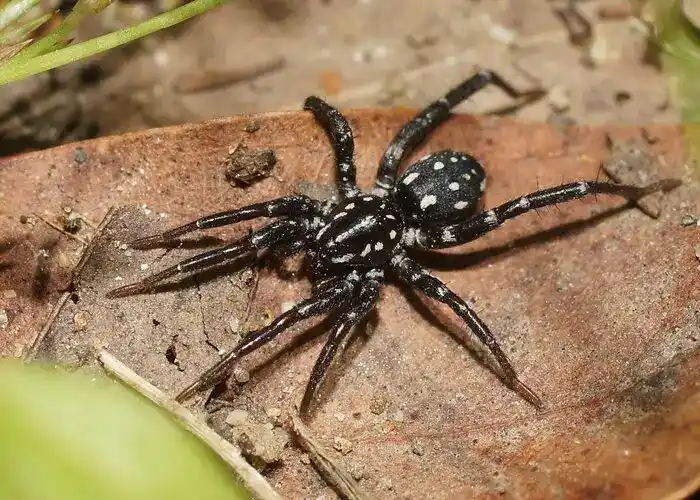
They have slender bodies, with their cephalothorax and abdomen mostly dark brown to black, and their feet or abdomens marked with orange or yellow spots. Some species have a slightly ant-like appearance.
Detailed introduction
Swift spiders are a group of small, terrestrial spiders known for their rapid running. Common examples include the orange-footed swift spider ( Nyssus coloripes ) of Australia and closely related species. They belong to the family Corinnidae, genus Nyssus , and resemble small hunter spiders in appearance. They do not rely on webs but actively hunt insects by running nimbly on the ground and tree trunks.
Classification and nomenclature
Common Chinese names: Swift Spider, Agile Spider, Swift Spiders (a collective term for groups such as Orange-legged Swift Spider)
English names: Swift Spiders, Nyssus Spiders, Orange-legged Swift Spider (representative species)
Representative scientific name: Nyssus coloripes (Orange-footed Swift Spider)
Belongs to: Phylum Arthropoda → Class Arachnida → Order Araneae → Family Corinnidae → Genus Nyssus
Appearance and Identification Features
The swift spider is small in size, agile in movement, and comes in a variety of colors, but overall gives an impression of being lean and sturdy.
Size: Adult spiders are about 6–12 mm long, with females being slightly larger than males. Their leg span is less than 2 cm, classifying them as small to medium-sized spiders.
Body color: Most species have dark brown to black cephalothorax and abdomen, with orange or yellow rings on the ventral surface and some segments of the legs. The orange and black segments of the legs of the orange-footed spider are very conspicuous.
Body type: The body is slightly slender with well-developed legs, especially the forelegs, which are thick and suitable for fast running and pouncing;
Eye arrangement: It has eight eyes, with the front row of eyes being larger. Its vision is relatively better than that of small terrestrial spiders, which helps it to hunt by sight.
Mimicry characteristics: Some venomous spiders have a body shape and gait somewhat similar to ants, which allows them to achieve a certain camouflage effect on fallen leaves and tree bark.
Distribution range and habitat
Swift spiders are mainly distributed in Australia and surrounding areas , with the orange-footed swift spider being very common in urban and rural environments in eastern and southern Australia. Closely related groups are widely found in temperate and subtropical regions.
Common habitats include:
On the ground in urban and rural gardens, along lawn edges, and in piles of stones and fallen leaves;
Tree trunks, bark crevices, and the surface of fallen logs and dead branches;
Open scrubland, forest edges, and roadside vegetation;
Human-built surfaces such as exterior walls, fences, and courtyard steps.
They prefer dry to slightly damp, open substrates that allow them to run freely , such as soil, gravel, wood planks, and stone slabs, and are often active in sunny or semi-shaded environments.
Lifestyle and Diet
Swift spiders are a type of active, searching ground hunter , unlike web-weaving, ambush-type spiders:
They typically do not weave large predatory nets, but simply tie silk in secluded places to build small nests for rest and shelter;
During the day or at dusk, they move swiftly across the ground, tree trunks, and walls, relying on sight and touch to find their prey.
It mainly preys on small insects and other arthropods, such as ants, aphids, small beetles, small flies and their larvae;
Once it spots its prey, it will suddenly accelerate and approach, using its forelegs to control the prey and bite it with its venomous fangs, then drag it to a safer location to eat.
The high mobility and proactive hunting strategies of the raptor spider enable it to play an important controlling role in terrestrial arthropod communities.
Reproduction and life history
The reproductive behavior of the raptor spider is similar to that of many small terrestrial spiders:
Once male spiders reach maturity, they will leave their original range and actively seek out the nests or activity areas of female spiders.
During courtship, male spiders often communicate with females through limb vibrations and body postures to reduce the risk of being mistaken for prey.
After mating, the female spider will spin a silken egg sac containing multiple eggs in a secluded place and guard it for a period of time;
After hatching, the spiderlings initially stay near the nest before gradually dispersing to hunt independently on the surrounding ground.
Toxicity and its impact on humans
Although venomous spiders are active predators, they are relatively small, and their venom is mainly targeted at small prey such as insects. There is currently no evidence that they pose a significant medical hazard to humans.
If bitten accidentally, in most cases only mild local pain and brief redness and swelling :
The wound usually does not show obvious necrosis or large-area swelling;
Sensitive individuals may experience more pronounced itching or localized allergic reactions;
Generally, wash the wound with clean water and soap, keep it dry, and apply a cold compress if necessary.
If you experience persistent, severe pain, widespread rash, or difficulty breathing, seek medical attention immediately.
Relationship with humans and ecological role
In gardens and farms, velociraptor spiders often play the role of beneficial predators , indirectly helping humans control some pest populations by preying on ants, small pests, and sap-sucking insects.
Because they don't weave large webs, don't occupy obvious space, and pose very little threat to people, they usually don't need to be deliberately removed from living environments. If you don't want them indoors, simply seal the gaps in doors and walls and keep the environment clean and dry.
References
Raven, RJ 2015. Revised version of the Western Pacific ant-like spider (Corinnidae, Arachnida). Zootaxa 3958(1): 1-258. doi:10.11646/zootaxa.3958.1.1
Framenau, VW, Baehr, BC & Zborowski, P. 2014. *The Australian Spider Guide*, Reed New Holland Publishing.
Whyte, R. & Anderson, G. 2017. *Australian Spider Field Guide*, CSIRO Publishing.
Frequently Asked Questions
Q1: Do spiders attack people?
They generally do not attack humans unprovoked. Swift spiders are relatively small and usually choose to flee quickly when they encounter humans.
It may bite in self-defense only if it is held down, clamped, or accidentally touched.
Q2: Do I need to see a doctor if I get bitten by a spider?
In most cases, it will only cause mild local symptoms. Cleaning the wound and observing it for a period of time will suffice.
If you are a child, have allergies, or experience significant general discomfort, it is recommended to consult a doctor.
Q3: Why is it called "Swift Spiders"?
"Swift" refers to the speed and agility of these spiders as they run on the ground.
They often flash by quickly and rarely stay in the same spot for long.
Q4: What benefits does the Swift Spider bring to the garden?
The raptor actively preys on small insects and other arthropods, helping to reduce the number of pests.
It is a typical natural pest controller and plays a positive role in ecological balance.