Basic Information
Scientific classification
- Chinese name: St. Andrew's Cross Spider
- Scientific name: Argiope keyserlingi (and closely related cruciform spiders)
- Classification: Arthropoda
- Family: Argiope keyserlingi
Vital signs data
- Body length: Female spiders are about 10–16 mm long, while male spiders are about 3–4 mm long. Female spiders are significantly larger than male spiders, and their leg span can reach several centimeters.
- Weight: Weight typically ranges from tens to hundreds of milligrams, depending on the individual and their nutritional status.
- Lifespan: Most individuals complete a life history of about 1 year, but in warmer regions this can be extended to span 1–2 breeding seasons.
Significant features
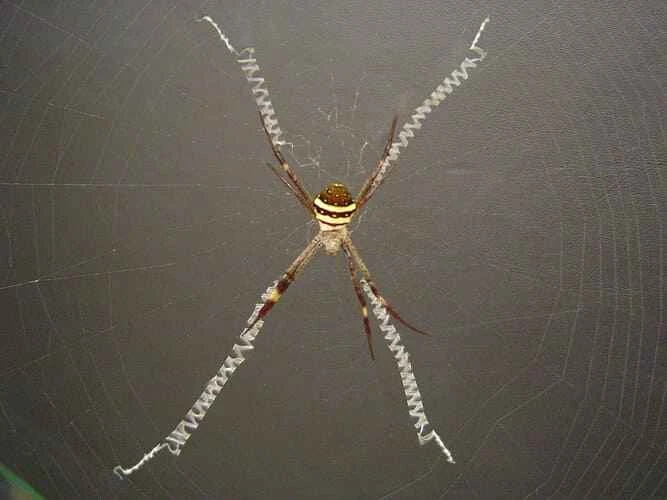
It weaves an "X"-shaped white stabilizing line in the center of the orb and extends its four pairs of legs to the four ends of the cross, making its posture highly recognizable. It mainly preys on flying insects and has relatively low toxicity to humans, making it an important beneficial insect in gardens.
Distribution and Habitat
It is mainly distributed in eastern Australia and surrounding areas, and is commonly found in vegetation around gardens, farmland, forest edges and wetlands. It is adept at taking advantage of flying insect resources near streetlights and flowering plants.
Appearance
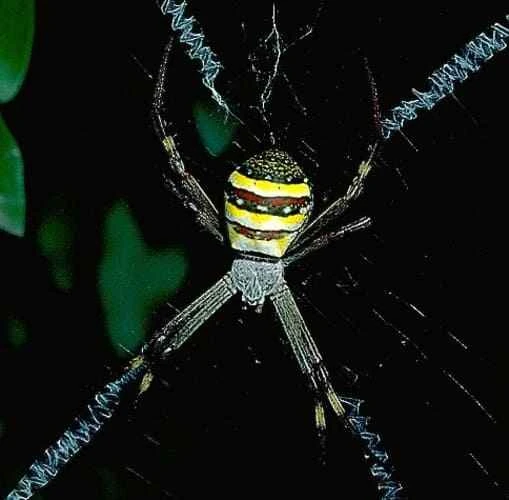
The cephalothorax is brown to dark brown, and the abdomen has silver, yellow and black stripes. The female spider has a full abdomen and bright colors, while the male spider is smaller and duller.
Detailed introduction
The St Andrews Cross Spider is a highly recognizable group of orb-weaving spiders in the family Araneidae. The most representative species is * Argiope keyserlingi* , but it also includes some closely related species (such as * Argiope aetherea *). Adult spiders weave a striking white "X" shaped ribbon in the center of their web, extending their four pairs of legs in the four directions of the cross. From a distance, it resembles the diagonal cross of St. Andrew, the patron saint of Scotland, hence its name.
Classification and nomenclature
Common Chinese names: St. Andrew's Cross Spider, St. Andrew's Cross Spider
English Name: St Andrews Cross Spider
Representative scientific name: Argiope keyserlingi (and some closely related species, "Cross-shaped Spider")
Belongs to: Phylum Arthropoda → Class Arachnida → Order Araneae → Family Araneidae → Genus Argiope
Appearance and Identification Features
The St. Andrew's Cross garden spider, with its vibrant colors and unique patterns, is a very eye-catching garden spider in gardens and lawns.
Size: Female spiders are about 10–16 mm long, with a larger abdomen and a rounded body; male spiders are only about 3–4 mm long, much smaller, and often perch on the edge of the female spider's web;
Body color: The cephalothorax is mostly brown to dark brown, and the back of the abdomen has stripes or patches of yellow, white, silver and black.
Cross posture: The female spider usually lies still in the center of the web, with her four pairs of legs brought together in pairs and extended to the four ends of the "X" shaped ribbon, forming the typical "St. Andrew's Cross" posture.
Sexual dimorphism: Female spiders are significantly larger and more conspicuous, while male spiders are darker in color and hide in small corners near the web.
Round mesh and St. Andrew's Cross stabilizing line
The St. Andrew's Cross Spider is a typical orb-weaver , but its most distinctive feature is the "stabilizing line" structure in the center of its web:
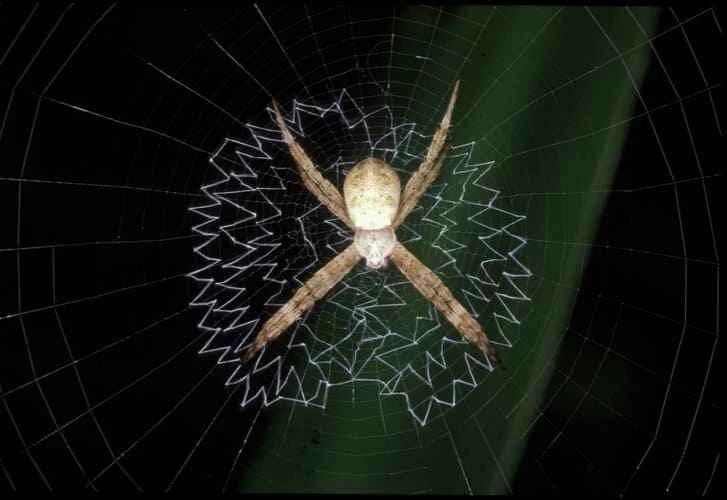
At the center of the wheel-shaped circular net, it will weave one or four thick white ribbon-like patterns , in the shape of an "X" or a partial "+";
When the spider lies still on it, its body is exactly in the center of the cross, and its four pairs of legs extend along the direction of the "white cross" ribbon;
This stabilizing line may serve multiple purposes, such as camouflage, obscuring outlines, reflecting ultraviolet light to attract insects, or alerting birds to avoid the net.
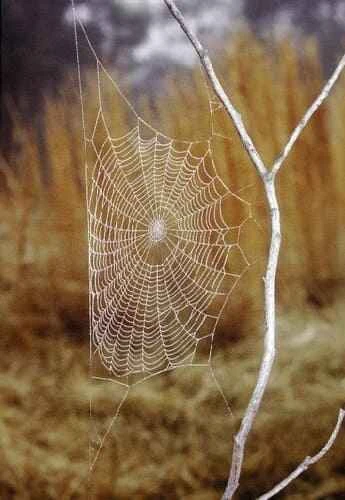
The orb net itself consists of radial support wires and spiral adhesive wires, and is often suspended between shrubs, grass, fences, or building components. The orb net, glistening with dew in the morning light, is particularly striking in the sunlight and is a popular subject in nature photography.
Distribution range and habitat
The St Andrews Cross Spider is widely distributed in eastern Australia and surrounding areas , including New South Wales, Queensland, and Victoria. It also has a closely related species known as "St Andrews Cross Spider" in New Guinea and parts of the Pacific region.
Typical habitats include:
Flower beds, bushes, and grasses in urban and rural gardens;
Grasslands and fences along the edges of farmland and pastures, and along roadsides;
Vegetation around forest edges, forest clearings, streams, and wetlands;
The area around the railings, fences, and streetlights in the front yard and near the balcony.
They often choose locations with some light and frequent insect flight to weave their webs, such as near streetlights or areas with dense flowers, in order to improve their predation efficiency.
Lifestyle and Diet
The St. Andrew's Cross spider is primarily active during the day and at dusk, and is an ambush predator that relies on orb-webs to capture flying insects .
During the day, they lie in wait at the cross in the center of the net, waiting for their prey to collide with the net.
Their prey consists mainly of mosquitoes, moths, bees, small wasps, leafhoppers, and various small flying insects.
When the prey gets entangled in the sticky silk and causes the web to vibrate, the spider quickly crawls to the prey, bites it, and wraps it in silk.
At night, they sometimes move to a secluded spot next to the net to rest, or to repair or rebuild the net.
As an efficient insect predator, the St. Andrew's Cross Spider is a very important beneficial insect predator in garden and farmland ecosystems.
Toxicity and its effects on humans
Like most members of the garden spider family, the venom of the St. Andrew's cross garden spider is primarily used to paralyze insects and is relatively weakly toxic to humans. It is docile and usually only bites when strongly provoked, grasped, or cornered.
In rare cases of bites, the symptoms are usually as follows:
A brief stinging or dull pain at the bite site;
Mild redness, swelling, itching, or burning sensation in the affected area;
The symptoms gradually subside within a few hours to one or two days.
Severe systemic reactions are extremely rare. Generally, simply cleaning the wound with soap and water and applying a cold compress if necessary is sufficient.
Relationship with humans
Because of its striking appearance and low threat to humans, the St. Andrew's Cross spider is a common teaching example in nature education, popular science books, and insect exhibitions. It not only helps people recognize "stabilizing lines" and orb-like web structures but also raises awareness of the positive role spiders play in insect control.
If you find its cross-shaped web in your garden, it's generally advisable to preserve it , just make sure the web isn't directly facing the main path. The spider and the orb will disappear naturally as the season ends or the weather cools, requiring no further action.
References
Craig, LC and Bernard, GD (1990). Insect attraction to ultraviolet-reflective spider webs and their ornamentation. Ecology 71(2): 616-623.
Eisner, T. and Novicki, S. (1983). Protecting spider webs through visual advertising: the role of stabilizing silk. Science 219: 185-187.
Elgar, MA (1991). Sexual cannibalism, body dimorphism, and courtship behavior in web-weaving spiders (Orb-weaving spiders). Evolution 45 (2): 444-448.
Elgar, MA, Allen, RA, and Evans, TA (1996). Foraging strategies of web-weaving spiders: the use of ambient light and silk ornamentation in the silver spider (Argiope aetherea Walckenaer) (Arachnidae). Australian Journal of Ecology 21: 464-467.
Main, BY (1973). Spiders. Australian Naturalist Library. Collins Publishing, Sydney.
McKeown, K. (1963). The Australian Spider. Angus and Robertson Publishing, Sydney.
Frequently Asked Questions
Q1: Are St. Andrew's Cross spiders dangerous to humans?
It is generally considered to pose a very low risk. Its venom primarily affects insects, and in humans it usually only causes mild localized pain and swelling.
Unless you are extremely sensitive to spider venom or insect bites, there is no need to worry excessively.
Q2: Why are there "X" shaped white threads in the middle of its net?
This thick white silk, known as the "stabilization line," may serve multiple functions, such as camouflage, disrupting the outline, reflecting ultraviolet light to attract insects, or preventing birds from colliding with the web. It is also the most representative feature of the St. Andrew's Cross Spider.
Q3: Is the St. Andrew's Cross Spider a pest or a beneficial insect?
It is a typical natural enemy of beneficial insects, preying on large numbers of mosquitoes, moths and other small flying insects, helping to reduce the number of pests in gardens and farmlands.
Q4: What if the cross netting happens to block the pedestrian walkway?
You can choose to do this in the early morning or late afternoon when spiders are less active, gently disturbing the web or using a twig to move the spider and web to a more suitable location on the side of the garden.
No pesticides are needed.