Basic Information
Scientific classification
- Chinese name: Blue-lipped Duck
- Scientific name: Mountain duck, blue duck, *Hymenolaimus malacorhynchos*
- Classification: Waterfowl
- Family and genus: Anseriformes, Anatidae, Blue Duck
Vital signs data
- Body length: Approximately 53 cm
- Weight: 800-1000g
- Lifespan: Approximately 8 years
Significant features
It has darker blue-grey feathers and a distinctive chestnut-colored marking on its chest.
Distribution and Habitat
The Mountain Blue Duck is a species endemic to New Zealand, primarily found on the South Island. It inhabits and exists only along rivers and streams, preferring clean water and lush vegetation. A rare species endemic to New Zealand, it is a formidable swimmer in the fast-flowing mountain streams, refusing to fly away even in strong currents. It is difficult to find and spot.
Appearance
The Mountain Blue Duck is 53cm long, with males weighing 1000g and females 800g. As its name suggests, the Mountain Blue Duck has dark blue-grey plumage and a distinctive chestnut-colored marking on its chest. It has yellow eyes and a light pink bill; juveniles have grey bills and eyes. Thick flaps of skin hang from the sides of its tip.
Detailed introduction
The blue duck, scientifically known as *Hymenolaimus malacorhynchos*, has two subspecies.
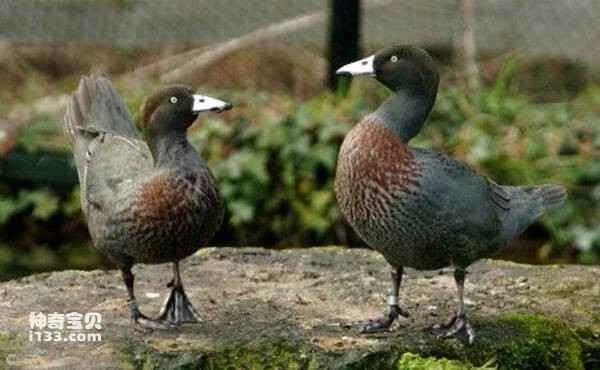
The male Mountain Blue Duck's call sounds like a whistle, while the female's is more like a tense roar. Mountain Blue Ducks inhabit only riverbanks and streams, preferring clean water and lush vegetation. Endemic to New Zealand, they are a rare type of water duck, proving themselves strong swimmers in the fast-flowing mountain streams, refusing to fly away even in strong currents. They are quite difficult to find and spot.
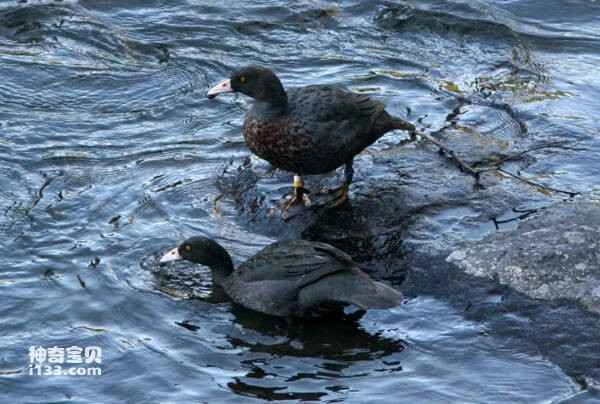
Mountain blue ducks nest in burrows and crevices along riverbanks. Females typically lay one clutch of eggs per year, averaging six. The ducklings are fed invertebrates, particularly caddisflies and fly larvae. Their average lifespan is eight years.
The primary reason for the endangered status of the Mountain Blue Shelduck is habitat loss. Additionally, water pollution caused by grazing along riverbanks and the drying up of many rivers have limited the Blue Shelduck's survival to a precarious existence in mountainous areas. Furthermore, predatory mammals such as the Yellow Weasel have also contributed to reducing the species' distribution range and population growth.
Listed as Endangered (EN) in the International Union for Conservation of Nature (IUCN) Red List of Birds, 2009 ver 3.1.
Protect wild animals and ban the consumption of wild game.
Maintaining ecological balance is everyone's responsibility!