Basic Information
Scientific classification
- Chinese name: Black-headed duck
- Scientific name: Heteronetta atricapilla, Black-headed Duck
- Classification: Waterfowl
- Family and genus: Anseriformes, Anatidae, Black-headed Duck
Vital signs data
- Body length: No verification information available.
- Weight: No verification information available.
- Lifespan: No verification data available.
Significant features
They are considered the only birds that purely roost in their eggs, as no nests they have built themselves have ever been found.
Distribution and Habitat
It is distributed in Argentina, Bolivia (a multi-ethnic country), Brazil, Chile, Paraguay, and Uruguay.
Migratory birds: Falkland Islands (Malvinas Islands).
They inhabit ponds, lakes, reservoirs, and other bodies of water, as well as forest edges, marshes, and ponds and streams surrounded by vegetation. They prefer to hide in tall grass or under lotus leaves, and also live in groups on the water surface.
Appearance
The Black-headed Duck is a member of the subfamily Dalmatinae. It has long, stiff tail feathers that can be submerged in water while swimming, and sometimes they can be held upright. Although related to Dalmatians, it resembles a common duck in appearance. It lacks the swollen bill of the Dalmatian and is very similar to a typical pochard. Its plumage is unremarkable; it is a dark-colored duckling. The male has a black head and wattle, with slightly pale sides and belly, while the female has light brown plumage overall.
Detailed introduction
The Black-headed Duck (scientific name: Heteronetta atricapilla) has no subspecies.
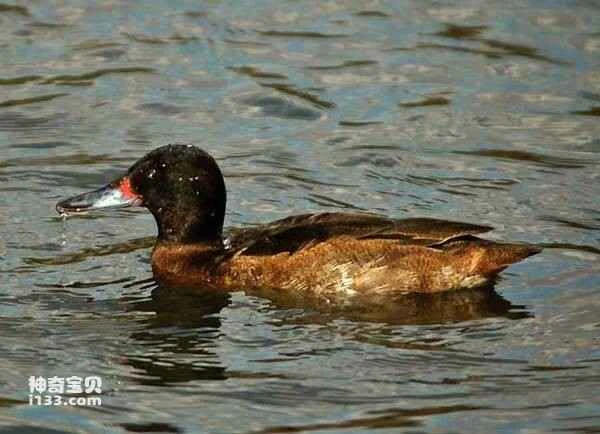
Black-headed ducks can forage on the water's surface and underwater, and sometimes they also forage for grass on the water's edge. Their diet mainly consists of plant-based foods such as rice, crop seedlings, grass, and aquatic plants, but they also eat animal-based foods such as insects, snails, molluscs, frogs, and small fish.
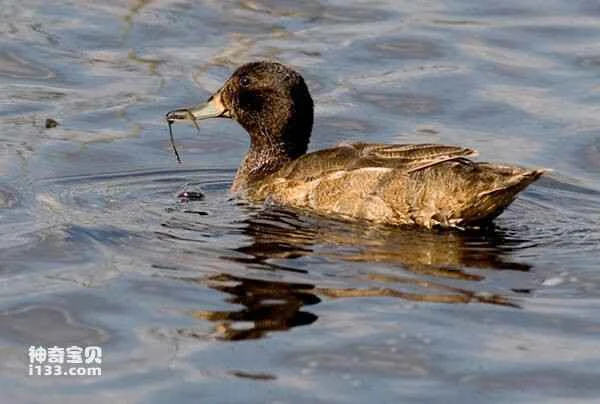
The breeding method of the Black-headed Duck is unique. It is a brood parasite, laying its eggs in the nests of pochards or coots instead of incubating them itself. Unlike other brood parasitic birds such as cuckoos, the Black-headed Duck only uses other birds for incubation, without harming their eggs or chicks. It also doesn't require other birds to raise their chicks; the ducklings are completely independent immediately after hatching, requiring no care from adult birds. (The heartwarming mother-and-duckling picture in Figure 6 shows that the ducklings still need to live with their mother, but that mother is likely a foster mother.) This breeding habit is unique among birds.
Listed as Least Concern (LC) on the IUCN Red List of Threatened Species 2012 ver3.1.
Protect wild animals and ban the consumption of wild game.
Maintaining ecological balance is everyone's responsibility!