Basic Information
Scientific classification
- Chinese name: Elegant Tree Frog
- Scientific name: Litoria gracilenta
- Order: Anura
- Family: Litoria gracilenta Graceful tree frog Dainty tree frog
Vital signs data
- Body length: Adults typically measure about 3–4 cm in length, making them small and slender tree frogs.
- Weight: Individual weight is only a few grams, and varies with sex, body condition, and environmental conditions.
- Lifespan: It is estimated that they can survive for several years in the wild, and can experience multiple breeding seasons in suitable habitats.
Significant features
The small green tree frog, common in eastern Australia, is slender with a bright green back and often has golden stripes on its sides. It is often found in the vegetation around ponds, swamps, and garden water features, and it makes a clear and melodious call on summer nights.
Distribution and Habitat
Native to warm and humid regions of eastern Australia, including Queensland and northern New South Wales, it inhabits various water-adjacent environments such as reed beds along ponds, swamps, lakes, streams, wetland meadows, urban gardens, and farmland dams.
Appearance
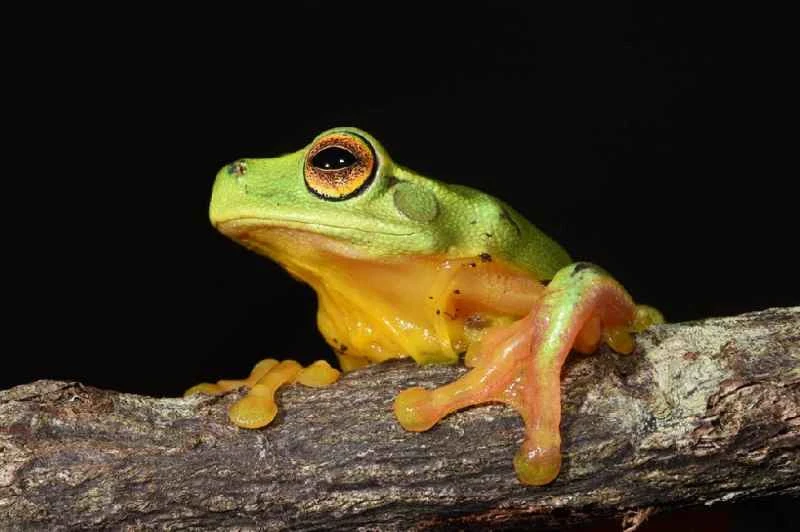
Small in size, with a bright green or yellowish-green back, narrow golden or bronze stripes on the sides, a white or cream-colored belly, large eyes, and fingers and toes with prominent suction cups and partial webbing, making them suitable for climbing on leaves and reeds.
Detailed introduction
The Graceful Tree Frog ( Litoria gracilenta ) is a small, brightly colored native Australian tree frog. It is also commonly known as the Dainty Tree Frog. It is found in the warm, humid regions of eastern Australia, often around ponds, swamps, and garden water features, and is a very popular small tree frog in the area.
Classification and nomenclature
Commonly used Chinese translations: Elegant Tree Frog, Slender Tree Frog, etc. (all are common transliterations based on sound and meaning).
English name: Graceful Tree Frog, Dainty Tree Frog
Scientific name: Litoria gracilenta
Family and genus: Australian tree frogs → Litoria
Appearance and Identification Features
The elegant tree frog is small in size and bright green in color, making it a typical tree frog that is "very visually appealing."
Size: Adults are typically 3–4 cm long, with females being slightly larger than males, and are generally slender.
Body color: The back is mostly bright green or yellowish-green, sometimes with a slight bluish-green tint. The color varies slightly between individuals depending on the environment and body temperature.
Lateral stripes and markings: Narrow golden or bronze stripes are often present on the sides of the body, and some individuals have small orange spots on the sides or legs;
Underside: The abdomen is mostly white or cream-colored, while the throat may appear slightly yellow in calling male frogs;
Eyes: Large eyes, irises usually gold or copper, black pupils contrasting with bright body color;
Fingertip structure: The tips of the fingers and toes have obvious suction cups, and there is a certain amount of webbing between the toes, which facilitates climbing on plants and smooth surfaces.
Compared to other small green tree frogs, the elegant tree frog often appears more "slender and delicate," and its golden stripes on its sides and lively posture also help in its identification in the wild.
Distribution range and habitat
The elegant tree frog is a native species of the eastern coastal and near-inland regions of Australia .
It is mainly distributed in warm and humid regions such as eastern Queensland and northern New South Wales;
Its presence can be found in everything from coastal lowlands to hilly areas.
It prefers environments near water and with abundant vegetation.
Natural habitats include swamps, ponds, lake edges, reed beds, stream banks, and wetland forest edges;
In human environments, they are commonly found in garden ponds, farmland dams, roadside ditches, artificial wetlands, and urban parks;
There is a chance to find the elegant tree frog if there is long-term or seasonal standing water and reeds, herbs or shrubs around it for habitat.
Habits and calls
The elegant tree frog is a nocturnal arboreal/grass-dwelling frog .
During the day, they mostly perch on reeds, grass, shrub branches, or tree trunks near the water, and sometimes hide on the back of leaves or in crevices.
They are most active at dusk and night, especially on warm and humid summer nights;
During the breeding season, male frogs will call out on the vegetation near the water. Their calls are mostly a series of short and crisp "reek... reek" or "trik... trik" sounds, which are very noticeable when multiple male frogs sing together.
In some residential areas in eastern Australia, where the environment is humid enough and the vegetation is abundant, the chorus of elegant tree frogs and other small tree frogs can often be heard on summer nights.
feeding habits
Like most tree frogs, the elegant tree frog primarily feeds on small invertebrates:
Flying insects such as mosquitoes, small flying insects, and moths;
Small beetles, aphids, ants, and other insects that inhabit plants;
Small spiders and other arthropods that inhabit leaves and stems.
They typically crouch on leaves or branches, and when prey approaches, they suddenly extend their sticky tongues to capture it.
Reproduction and Development
The reproduction of the elegant tree frog is closely related to temperature and rainfall:
The breeding season is mostly in the warm, rainy months, especially in summer and after rain;
Male frogs gather on the vegetation around ponds, swamps, and puddles, calling out to attract female frogs;
Female frogs lay their eggs in still or slow-moving water, and the egg clusters often adhere to plants near the water surface or in shallow water.
Tadpoles develop in water and are quite sensitive to water temperature and quality. They need to complete their metamorphosis before the temporary water body dries up.
After metamorphosis, the tadpoles leave the water and climb onto the shore and into the grass, gradually transitioning to an arboreal/grass-dwelling lifestyle.
Protecting the status quo and threats
The elegant tree frog is currently assessed as Least Concern (LC) on the International Union for Conservation of Nature (IUCN) Red List, indicating that its population is relatively stable and its numbers are acceptable in most of its distribution areas.
However, in some areas, the elegant tree frog may still face the following threats:
Wetland reclamation, pond clearing, and riverbank hardening have led to a reduction in small water bodies and aquatic plants;
Urban expansion and farmland development have fragmented waterside vegetation;
Pesticides and pollutants entering water bodies can negatively impact the health of tadpoles and adult frogs.
Climate change, leading to extreme droughts or altered rainfall patterns, may also affect reproductive success rates.
By preserving and restoring small wetlands, planting native aquatic and riparian plants, and reducing the use of chemical pesticides, not only can the elegant tree frog benefit, but many native amphibians and aquatic organisms can also be helped.
Frequently Asked Questions
Q1: How can the elegant tree frog be distinguished from other green tree frogs?
The elegant tree frog is small and slender, with a bright green back and narrow golden or bronze stripes commonly found on its sides.
Some of the larger green tree frogs have a more robust build and a wider head.
Specific identification requires a comprehensive judgment based on the distribution area and the call.
Q2: Is the elegant tree frog dangerous to humans?
It is a small, insectivorous tree frog that does not have strong venom glands like the cane toad and is generally not considered dangerous to humans.
If a short observation period is required, gently lift it with damp hands to avoid squeezing, and wash your hands afterward.
Q3: Why can you see elegant tree frogs in city gardens?
As long as there are small ponds, water tanks, artificial wetlands, or other bodies of water in the garden or park, along with appropriate aquatic and shoreline plants,
The elegant tree frog has the opportunity to settle, forage, and reproduce in these "artificial habitats."
Therefore, in some well-greened urban areas, they have adapted to coexisting closely with humans.
Q4: What role does the elegant tree frog play in the ecosystem?
The elegant tree frog feeds on a large number of small insects, which helps control the population of arthropods such as mosquitoes;
At the same time, it is a food source for birds, snakes and some fish, and is an important part of the food web of wetland and aquatic ecosystems.


