Basic Information
Scientific classification
- Chinese name: Giant Hole Frog
- Scientific name: Heleioporus australiacus
- Order: Anura
- Family: Myobatrachidae Heleioporus australiacus
Vital signs data
- Body length: Adults are about 7–10 cm in length, making them relatively large terrestrial frogs. Females are usually slightly larger than males.
- Weight: Individual weight can reach tens of grams or even higher, depending on gender, physical condition and region.
- Lifespan: It is estimated that they can live for many years in the wild and can participate in reproduction repeatedly in multiple breeding seasons; their lifespan may be even longer under suitable conditions.
Significant features
The large burrowing frog, endemic to eastern Australia, is robust with prominent marbled markings on its abdomen. It lives in burrows near streams and reproduces using foam nests and temporary bodies of water during the rainy and flood seasons.
Distribution and Habitat
It is native to parts of New South Wales and Victoria in eastern Australia, and is often found in eucalyptus forests, scrublands and valleys with high rainfall. It usually burrows and hides in loose soil near streams, seasonal waterholes and mountain drainage ditches.
Appearance
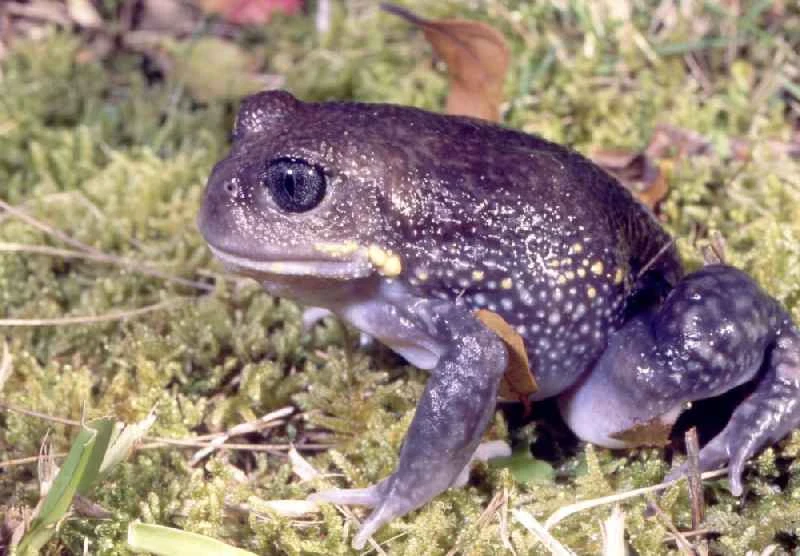
The body is broad and robust, with a grayish-brown or olive-brown back dotted with dark spots and warts, and a white belly with black or dark marble-like markings; the eyes are large, the hind limbs are strong, and the toes have obvious webs and well-developed "digging tubercles".
Detailed introduction
The Giant Burrowing Frog ( Heleioporus australiacus ) is a large native Australian frog, belonging to the Australian terrestrial frog family. As its name suggests, it is an excellent burrower, spending most of its time underground and only emerging to be active and reproduce during suitable humid seasons and at night.
Classification and nomenclature
Common Chinese name: Giant Burrowing Frog (the Chinese name is not yet fully standardized)
English name: Giant Burrowing Frog
Scientific name: Heleioporus australiacus
Family and genus: Myobatrachidae → Heleioporus
Appearance and Identification Features
The giant cave frog is a robust species and one of the largest terrestrial frogs in Australia.
Size: Adults can typically reach 7–10 cm in length, with some females even larger;
Body shape: The body is broad and the head is large, giving an overall impression of being "solid and powerful";
Back color: mostly grayish brown, olive brown or dark brown, often covered with dark spots or cloud-like patterns;
Skin texture: The skin on the back is slightly rough, with scattered small warts, and prominent glandular bulges are visible on the sides and limbs;
Abdomen: The abdomen is usually white or grayish-white with distinct black or dark marble-like markings;
Eyes: The eyes are relatively large, and the irises are mostly gold or copper. Some individuals have a slightly dark ring around their eyes.
Limbs and feet: The hind limbs are strong, with obvious webbing between the toes of the hind feet and well-developed keratinous "digging tubercles" on the inner side, used for digging holes backward.
A robust body, patterned abdomen, large eyes, and strong hind limbs are the main characteristics that allow you to identify the giant cave frog in the wild.
Distribution range and habitat
The giant cave frog is a species endemic to eastern Australia .
They are mainly distributed in parts of the coastal hills and inland mountains of New South Wales and Victoria;
It is commonly found in forests, shrublands, and river valleys with abundant rainfall.
It prefers environments that simultaneously possess suitable soil for digging and have nearby streams or temporary bodies of water :
They inhabit the soil in eucalyptus forests, moist thickets, valleys, hillsides, and among rocks;
They often dig holes and lurk near streams, seasonal waterholes, and mountain drainage ditches;
Reproduction activities are mostly associated with temporary shallow water bodies and rising stream water levels.
Habits: Digging and Hiding
The giant burrowing frog is a typical nocturnal frog that digs its own burrows .
During the day, they usually hide in self-dug burrows, with the entrances often concealed near fallen leaves, grass roots, or rock crevices.
Caves are usually located on slightly elevated earthen slopes next to streams or water pits, where the loose soil is conducive to digging.
They emerge from their burrows at dusk and night, moving about and foraging on the ground or near water.
During dry or unfavorable seasons, they will stay in caves for extended periods to keep their bodies moist and reduce their metabolism.
Cry
Male giant cave frogs emit a deep, resonant call during the breeding season:
The call is often described as a drawn-out "whooomp" or a low "oomp" sound, and it is quite loud.
It usually occurs on rainy nights or when the water level of a stream rises, emanating from caves near water or the water's edge.
When multiple male frogs call at the same time, the entire valley will echo with a low and slow croaking.
feeding habits
Giant cave frogs are carnivorous, feeding mainly on various terrestrial invertebrates.
Ground-dwelling insects such as beetles, crickets, and cockroaches;
Spiders, slugs, and other arthropods and mollusks;
They may occasionally prey on smaller frogs or other palatable small vertebrates.
They mostly emerge from their burrows at night, moving slowly across the damp ground. Once they spot prey, they swiftly pounce and swallow it whole.
Reproduction and Development
The reproduction of the giant cave frog is closely related to heavy rainfall, rising stream levels, and temporary bodies of water .
The breeding season usually occurs during warm and rainy periods, and is often most concentrated before and after heavy rainfall;
Male frogs often call out near the entrance of burrows close to streams or puddles to attract female frogs into the burrows for mating;
The female frog lays her eggs in the cave or at the edge of a very shallow body of water, and together with the male frog, they "stir" the water to form a foam nest containing a large number of bubbles.
When rainwater rises or stream water levels rise, foam nests will be submerged or washed into shallow water areas, and tadpoles will then enter the water to continue developing.
Tadpoles mostly grow in slow-moving areas of streams or temporary water pits. After metamorphosis, the small frogs climb onto the bank, look for suitable soil to dig burrows, and begin their terrestrial life.
Protecting the status quo and threats
The giant cave frog is currently assessed as Vulnerable (VU) on the International Union for Conservation of Nature (IUCN) Red List, indicating that its wild population faces a certain degree of long-term threat and decline risk.
Key threat factors include:
Deforestation, road construction, and urban sprawl have led to the fragmentation of valley forests and shrub habitats;
Stream diversion, dam construction, and drainage projects have altered the natural flood rhythm, affecting the temporary water bodies on which they depend for reproduction;
Pesticides, sediments, and other pollutants enter the stream, stressing eggs, tadpoles, and adult frogs.
It may also be affected by fungal chytriditis and long-term climate change.
The key to protecting the giant cave frog lies in maintaining natural streams and the forest belts on both sides, preserving seasonal waterholes and wetlands, and reducing pollution and damage to water and soil.
Frequently Asked Questions
Q1: Why is it called "Giant Burrowing Frog"?
The name "Giant" comes from its relatively large size; it is one of the larger terrestrial, burrowing frogs.
The term "Burrowing Frog" emphasizes its ability to burrow and its long-term underground living habits.
Q2: Is it normal that giant cave frogs are hard to see during the day?
Yes. Giant cave frogs rely heavily on underground burrows for humidity and a sense of security, spending most of their daytime inside.
They usually only come out of their burrows to move around and forage at night, especially on rainy nights.
Q3: Are giant cave frogs dangerous to humans?
Unlike the cane toad, the giant cave frog does not possess potent venom glands and is generally not considered a serious danger to humans.
However, all wild frogs may secrete a mild irritant when captured.
If a brief observation period is required, it is recommended to handle the item gently and wash your hands afterwards.
Q4: Why is the giant cave frog listed as a vulnerable species?
The main reason is that its habitat is relatively limited, and it is highly dependent on the original valley forest and natural water rhythm.
These environments are vulnerable to damage from deforestation, roads, agricultural and pastoral development, and water conservancy projects.
Habitat fragmentation and changes in hydrological conditions can both affect the long-term reproductive success rate and population stability of the giant cave frog.