Basic Information
Scientific classification
- Chinese name: Frey frog
- Scientific name: Austrochaperina fryi
- Order: Anura
- Family: Microhylidae Austrochaperina fryi
Vital signs data
- Body length: Adults are about 2–3 cm in length, belonging to small terrestrial frogs.
- Weight: Individual body weight is only a few grams, and is affected by gender, body condition and environment.
- Lifespan: It is estimated that it can survive for several years in the wild and participate in reproduction during multiple rainy seasons.
Significant features
The small, brownish-brown woodland frog mainly lives in the humid mountain rainforests and leaf litter of New Guinea. It is highly concealed and is usually active at night and during the rainy season.
Distribution and Habitat
They are mainly distributed in the humid mountain rainforests and high-rainfall forests of New Guinea and neighboring regions, and are mostly active in thick leaf litter, fallen logs and moss-covered tree roots, as well as in humid areas near stream valleys and seasonal puddles.
Appearance
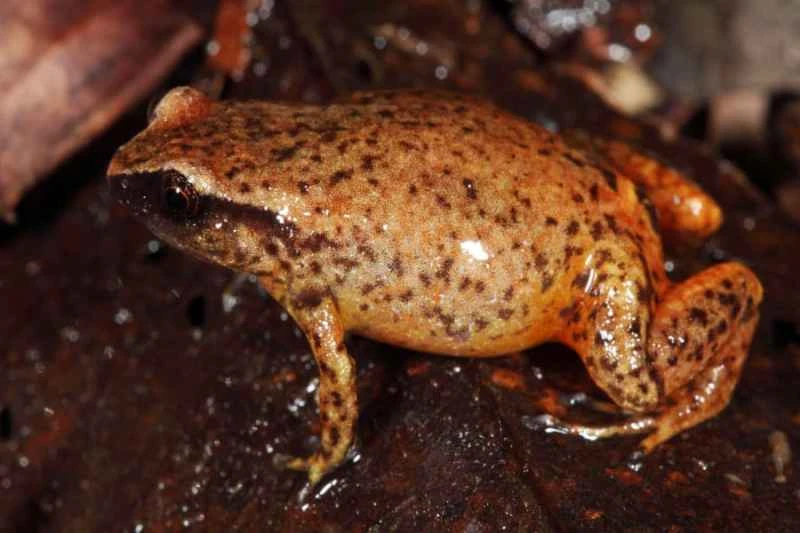
The body is relatively small and slightly spindle-shaped, with a brown or grayish-brown back with darker spots or cloud-like patterns, and a lighter ventral surface; the skin is relatively smooth, the limbs are relatively short, the toes are slightly swollen but the webbing is not obvious, and it is adapted to move in the leaf litter and soil surface.
Detailed introduction
Fry's Frog ( Austrochaperina fryi ) is a small, highly camouflaged frog, usually classified in the family Microhylidae. It is primarily found in the mountain rainforests and humid woodlands of New Guinea and neighboring regions, and is a typical terrestrial small frog .
Classification and nomenclature
Commonly used Chinese translation: Fry Frog (transliterated from the person's name Fry, also written as 弗赖蛙)
English name: Fry's Frog, Fry Frog
Scientific name: Austrochaperina fryi
Family: Microhylidae → Genus: Austrochaperina
Appearance and Identification Features
The Frei frog is inconspicuous and has excellent camouflage, making it a typical woodland frog.
Size: Adults are typically about 2–3 cm in length, and individuals are relatively small;
Body shape: The body is slightly spindle-shaped or rounded, the head is not very prominent, and the limbs are relatively short;
Back color: mostly brown, grayish-brown or olive brown, often with darker spots or fine cloud-like patterns. Some individuals may have light-colored lines or irregular spots on their backs.
Abdomen: The abdomen is usually lighter in color, grayish-white, pale yellow, or with small spots;
Skin texture: The skin on the back is relatively smooth or has a slightly grainy texture;
Limbs and toes: The limbs are small, and the toes are slightly enlarged but not as obviously as those of tree frogs. The webbing between the toes is rare or inconspicuous, making them more suitable for activities in the leaf litter and soil surface than for climbing trees.
Overall, the Frey frog belongs to the "camouflage" woodland frogs, which do not rely on bright body colors, but rather blend into the fallen leaves and soil through brown tones.
Distribution range and habitat
The Fry frog is mainly distributed in the mountainous rainforests of New Guinea and its surrounding areas , and in some areas it may extend to nearby islands or high-rainfall mountainous regions.
Commonly found in humid forests, mountain rainforests, and forest edges from low to mid-altitude areas;
They are mostly found in valleys, hillsides, mossy forests, and perpetually damp leaf litter.
It prefers environments with moist ground, good vegetation cover, and abundant fallen leaves and humus.
Typical habitats include thick leaf litter on the forest floor, between moss-covered tree roots, under fallen logs, and around rocks;
During the rainy season or when the climate is humid, their range of activities can be extended to areas closer to water sources, such as streamsides and small puddles in the forest.
Lifestyle
The Frei frog is a small, terrestrial frog that is highly secretive .
During the day, they mostly hide deep in the leaf litter, under fallen trees, in tree root crevices, and in moss clumps to maintain humidity and avoid predators;
They are more active at dusk and night, especially when humidity is high or before and after rain.
Their locomotion mainly consists of short jumps and crawling on the ground, and they rarely climb high places like tree frogs.
Due to their small size and excellent camouflage, even in suitable habitats, the Frei frog is often difficult for ordinary observers to spot directly.
feeding habits
The Frey frog primarily preys on various small invertebrates:
Small insects, such as small beetles, ants, springtails, and small flying insects;
Small spiders and other arthropods that inhabit the leaf litter layer;
They occasionally feed on other tiny invertebrates in the soil and fallen leaves.
It detects prey moving in the leaf litter by sensing slight vibrations and movements on the ground, as well as having vision at close range, and then quickly captures it with its sticky tongue.
Reproduction and Development
Details about the reproduction of the Frei frog are relatively limited in publicly available information, but it is generally similar to many woodland narrow-mouthed frogs:
Their breeding season often corresponds to the local rainy season and high humidity conditions.
Male frogs call out on damp nights to attract female frogs to temporary bodies of water or particularly damp areas of the ground.
Eggs are mostly laid near moist fallen leaves, small depressions in the soil, or temporary water accumulation. Some narrow-mouthed frogs even have a high degree of terrestrial developmental adaptation.
Tadpole development may take place in small puddles or thin layers of water, or it may rapidly develop and transform into a tadpole in an extremely humid microenvironment.
Specific reproductive methods may vary slightly depending on microhabitat and regional environment, but in general they are closely related to the high humidity environment of the forest floor.
Protecting the status quo and threats
The Frei frog is currently assessed as Least Concern (LC) on the International Union for Conservation of Nature (IUCN) Red List, meaning that the population as a whole has not yet shown a significant trend of large-scale decline within its known distribution area.
Potential threats include:
Deforestation and fragmentation of tropical rainforests and montane forests have reduced continuous forest habitats;
Road construction and human development activities alter surface hydrology and soil moisture;
Climate change is causing changes in rainfall patterns, which in turn affects forest humidity and microhabitat stability.
The key to protecting the Frei frog lies in maintaining primary or secondary forests, preserving a thick layer of leaf litter and natural valley wetland environments, while reducing overexploitation of mountain rainforests.
Frequently Asked Questions
Q1: Why is it called "Fry's Frog"?
The frog's English name comes from the surname Fry, the scientist who first described the species.
In Chinese, it is often directly transliterated as "弗赖蛙" or "漾蛙".
Q2: Are the Frei frogs common? Are they easy to spot in the wild?
In suitable mountain rainforests and humid woodlands, the Frey frog can be a member of the local frog community.
However, due to their small size, strong camouflage, and activity mostly in leaf litter and at night, they are not easily seen by the average person.
Q3: Is the Frei frog dangerous to humans?
It is a small, narrow-mouthed frog, unlike some poisonous frogs that are highly toxic, and there is currently no evidence that it poses a significant danger to humans.
If you need to observe the item briefly, handle it gently and wash your hands afterwards.
Q4: What is the role of the Frey frog in the ecosystem?
The Frey frog preys heavily on small invertebrates in the woodland leaf litter, helping to regulate the populations of insects and other arthropods.
It also provides food for reptiles, birds, and small mammals, making it a part of the mountain rainforest food web.