Basic Information
Scientific classification
- Chinese name: Hook-billed Copper Hummingbird
- Scientific name: Glaucis dohrnii, Hook-billed Hermit
- Classification: Climbing birds
- Genus and family: Apodiformes, Hummingbirdidae, Copper Hummingbird
Vital signs data
- Body length: 12-13.7 cm
- Weight: No verification information available.
- Lifespan: No verification data available.
Significant features
The body is mostly dark, with metallic copper-green feathers on the upper body (including the upper part of the head), and yellowish-brown underparts.
Distribution and Habitat
Native to Brazil, it is mainly distributed in eastern Brazil. It is found sporadically in Bahia and Espírito Santo states, and has also been recorded in Minas Gerais, the easternmost state.
It inhabits humid tropical lowland evergreen forests. It is mainly distributed below 500 meters in altitude, along riverbeds in densely populated thickets of flowering Helianthus species. This bird is often found deep in the forest, but it will also visit ornamental flower areas in neighboring forests.
Appearance
It has a long, slender beak with a small hook at the tip; the upper mandible is black, and the lower mandible is yellowish-white. Its legs are yellow. The overall body is generally dark. The upperparts have metallic, copper-green feathers (including the upper part of the head), while the underparts are yellowish-brown.
The face is dark with white stripes extending from the lores and cheeks towards the shoulders. The tail is bronze-green with reddish-brown bases and black stripes near the tips. Adults are 12–13.7 cm in length. Females are slightly larger than males, except for the males, whose tail tips are white or greyish-white.
The similar species, the Saw-billed Hummingbird (Ramphodon naevius), is larger and has thicker stripes on its underparts. The Brown-breasted Copper Hummingbird (Glaucis hirsutus) has a slightly downward-curving beak and four reddish-brown bases on its outer tail feathers.
Detailed introduction
The Hook-billed Hermit (scientific name: Glaucis dohrnii) has no subspecies.
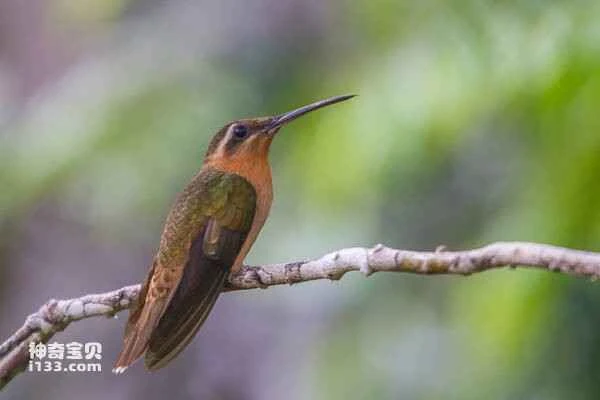
The Hook-billed Copper Hummingbird primarily feeds on the nectar of brightly colored, fragrant small flowers from trees, herbs, shrubs, and epiphytes. It particularly favors nectar with high sugar content (usually from red tubular flowers). As a route-fed hummingbird, it traverses vast areas of flowers (route up to 1 kilometer long), while most other hummingbirds are territorial foragers. The male demarcates its hunting territory (selecting areas with high sugar content flowers) and actively drives away intruders. Other males and large insects (such as bumblebees and hawk moths) that trespass on its territory are driven away. They protect their territory through aerial flight and intimidation behaviors.
They have long, retractable, straw-like tongues that can reach deep into flowers to collect nectar. While collecting nectar, they hover in mid-air with their tails raised, licking up to 13 times per second. Occasionally, they will perch on the flowers during feeding. Many native and cultivated plants rely heavily on birds that feed on their flowers for pollination. For example, most plants with tubular flowers reject pollination by bees and butterflies, but readily accept pollination from hummingbirds.
The hook-billed bronze hummingbird visits local hummingbird feeders that provide sugar water, hovering or standing on the edge of the trough or sprinkler to sip the sugar water. When drinking while standing, it behaves no differently than other birds, but only for a short time. They also prey on small spiders and insects to ensure a sufficient protein supply, especially during the breeding season, as this protein is essential for the normal development of the chicks. They typically ambush flying insects, but those perched on branches or trapped in spider webs are not spared either. During the nesting season, a female can catch up to 2,000 insects a day.
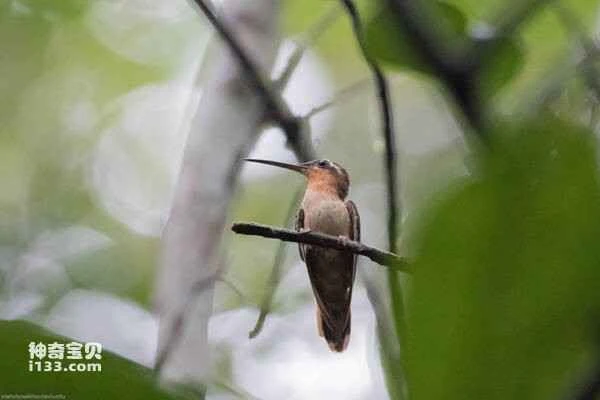
Based on a comprehensive assessment of known population records, abundance, and geographic distribution, the number of mature individuals is estimated to be between 250 and 999, consistent with population density estimates for similar-sized hummingbirds of the same genus or closely related species. The total population of the Hook-billed Copper Hummingbird is estimated to be between 350 and 1,500 individuals. Given ongoing habitat destruction and fragmentation, its population is presumed to be declining at a moderate rate.
It is listed in Appendix I of the 2019 edition of the Convention on International Trade in Endangered Species of Wild Fauna and Flora (CITES).
Listed as Vulnerable (VU) in the IUCN Red List of Threatened Species (ver 3.1: 2021).
Protect wild animals and ban the consumption of wild game.
Maintaining ecological balance is everyone's responsibility!