Basic Information
Scientific classification
- Chinese name: Black-necked Toucan
- Scientific name: Black-necked aracari (Pteroglossus aracari)
- Classification: Climbing birds
- Family and genus: Toucanidae, order Toucanidae, genus Toucan
Vital signs data
- Body length: No verification information available.
- Weight: No verification information available.
- Lifespan: No verification data available.
Significant features
Distribution and Habitat
The Black-necked Tufted Toucan is found in South America (including Colombia, Venezuela, Guyana, Suriname, Ecuador, Peru, Bolivia, Paraguay, Brazil, Chile, Argentina, Uruguay, and the Falkland Islands).
The Black-necked Toucan inhabits warm forests and edge areas, and prefers to perch on treetops.
Appearance
The Black-necked Toucan's long beak displays a two-tone color scheme: an ivory-white upper beak and a black lower beak. The beak edges are generally distinctly serrated, and its black or ivory exterior somewhat resembles teeth. Despite its large beak, the Black-necked Toucan weighs less than 30 grams. Its beak bone structure is unique; it is not a dense solid but rather has a thin outer shell with a porous, spongy tissue filled with extremely fine fibers running through it, allowing it to feel no pressure whatsoever.
Detailed introduction
The Black-necked aracari, scientifically known as *Pteroglossus aracari*, is a medium-sized climbing bird.
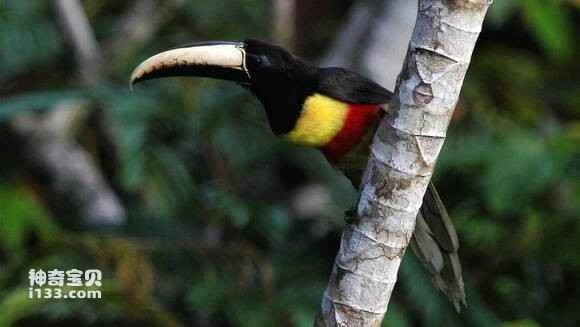
The Black-necked Toucan is also one of the noisiest forest birds, capable of producing booming, horn-like, and piercing cries. Its nest is built high in tree cavities. When eating, it first pecks at its food with the tip of its beak, then tilts its neck back, tosses the food upwards, and then opens its large beak to accurately swallow it, avoiding the time spent swallowing through its long beak. The Black-necked Toucan is omnivorous, feeding on fruits, seeds, and insects.
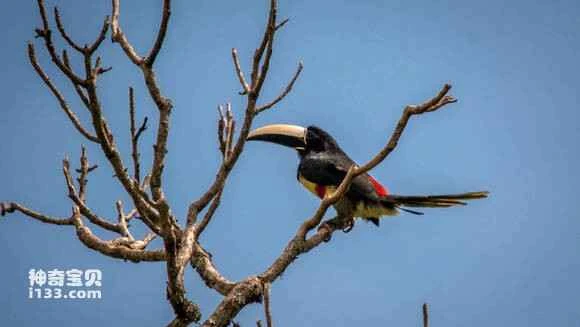
The Black-necked Toucan nests in tree cavities, sometimes raiding nests of smaller birds and eating the eggs and chicks. It lays 2-4 eggs at a time. The smooth, white eggs are laid in an unlined cavity and incubate for about 16 days. The hatchlings are completely naked and take at least 3 weeks to open their eyes. They begin their lives about 45 days after hatching.
Listed as Endangered (LC) in the IUCN Red List of Threatened Species 2016 ver 3.1.
It is listed in Appendix II of the 2019 edition of the Convention on International Trade in Endangered Species of Wild Fauna and Flora (CITES).
Protect wild animals and ban the consumption of wild game.
Maintaining ecological balance is everyone's responsibility!