Basic Information
Scientific classification
- Chinese name: Cluster-tailed raccoon
- Scientific name: Long-nosed Coon, South American Coon
- Order: Carnivora
- Genus and species: Long-nosed Coon, South American Coon
Vital signs data
- Body length: 41–69 cm
- Weight: 2-8kg
- Lifespan: 7–8 years
Significant features
Its tail is long and slender with dark rings, and it stands erect when moving.
Distribution and Habitat
Distributed in tropical and subtropical regions of the Americas
Appearance
It ranges in color from reddish-brown to black, and has a long nose.
Detailed introduction
The tufted-tailed raccoon ( Nasua ) is a clever little mammal and a relative of the raccoon. Their distinctive long nose and flexible tail make them instantly recognizable. Today, we'll talk about everything about the tufted-tailed raccoon in a lighthearted and fun way!
Table of contents
What is a tufted-tailed raccoon?
Physical characteristics of the tufted raccoon
Where do they live?
What do tufted raccoons eat?
The personality and behavior of the tufted raccoon
Reproduction and lifespan
Natural enemies and survival challenges
The relationship between raccoons and humans
What is a tufted-tailed raccoon?
The tufted-tailed raccoon, also known as the long-nosed raccoon , or coatimundi , is a member of the raccoon family. It resembles a raccoon with an "elongated nose." They primarily inhabit tropical regions of the Americas , and can be found from Mexico to Argentina.
These little creatures are highly adapted to the forest environment, excelling at climbing trees, foraging, and living in groups. They are omnivorous , eating fruit and catching insects, demonstrating exceptional survival skills.
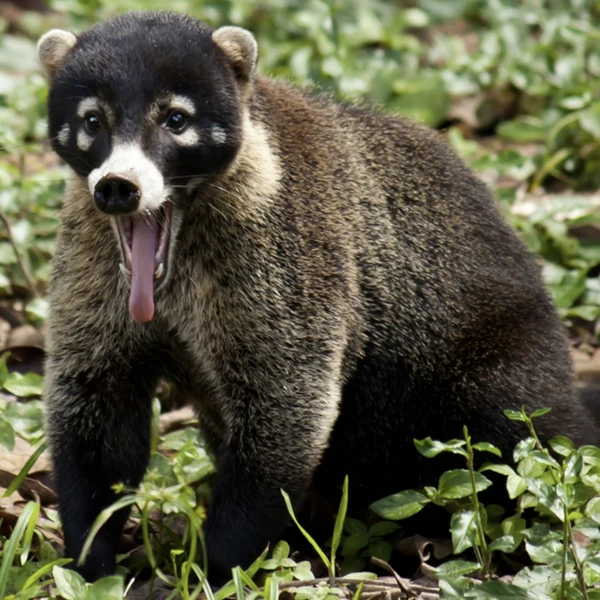
Physical characteristics of the tufted raccoon
The tufted-tailed raccoon has a distinctive appearance; here are some of its most prominent features:
Body type:
Height: 41–69 cm (approximately 16–27 inches).
Tail: The long tail is almost as long as the body and has ring-shaped stripes for balance.
Weight: 2–8 kg (4–18 lbs), small in size but muscular.
Hair:
The coat color ranges from reddish-brown to black , depending on the region and breed.
Its thick, coarse fur is perfect for camouflage in the forest.
Long nose:
The most striking feature of this face is its long nose , which is as flexible as a human finger, capable of finding food and sniffing out prey.paw:
Their sharp claws are their secret weapon for climbing trees and digging in the soil.
Where do they live?
The tufted-tailed raccoon's habitat is widely distributed in the tropical and subtropical regions of the Americas , and they prefer to live in:
Rainforest: Tropical rainforests are their preferred choice, with abundant trees and food.
Grasslands and shrublands: They can also be found on open plains.
Mountain forests: Trundle-tailed raccoons are also found in high-altitude areas, such as the forests of the Andes Mountains.
In short, they can settle down wherever the place is suitable.
What do tufted raccoons eat?
The tufted raccoon is an omnivore that eats whatever tastes good, making it a true "foodie" in the forest.
Commonly eaten foods include:
Fruits: Mangoes, berries, and bananas are their favorites.
Insects: Ants, beetles, spiders—catching insects is a piece of cake for them.
Small animals: mice, birds, frogs, and sometimes they hunt small prey to fill their bellies.
Plant tubers: Take a sniff and easily find the deliciousness buried in the soil.
The personality and behavior of the tufted raccoon
Clustered raccoons are lively, especially the females and cubs, who often form large groups of 10–30 individuals to explore and forage for food.
Behavioral characteristics:
Social animals: Females and cubs prefer to live in groups, while males tend to live alone, especially during the breeding season.
Diurnal activity: They are diurnal animals , busy finding food during the day and sleeping at night.
Climbing experts: Their claws and tails help them move easily up trees, and sometimes they can even hang upside down on branches to forage.
Highly curious: Full of interest in everything, always likes to sniff around.
Reproduction and lifespan
The tufted raccoon reproduces once a year, with the mother choosing a secluded place to build a nest and give birth to her babies.
Breeding Information:
Pregnancy period: approximately 70–77 days.
Number of cubs: 2–7 raccoons per litter.
Independent period: Raccoon babies will stay with their mothers for several months after birth, learning to forage and climb.
life:
In the wild : an average of 7–8 years.
In artificial environments : Because of the reduced threat of natural predators, tufted raccoons can live up to 14 years.
Natural enemies and survival challenges
Although tufted raccoons are intelligent and agile, they are not without threats in the wild.
Main natural enemies:
Large birds of prey, such as eagles and hawks, prey on young.
Carnivores: Leopards and ocelots are their main threats.
Survival Challenge:
Habitat loss: Deforestation leaves them homeless.
Illegal capture: In some areas, tufted raccoons are captured as pets, which disrupts the ecological balance.
Climate change: leading to a reduction in their food resources, making survival more difficult.
The relationship between raccoons and humans
Flocked raccoons sometimes venture into human settlements in search of food, such as garbage cans or orchards, and have a complex relationship with humans.
Humans and raccoons living together:
Positive impacts: They help control insect populations and act as "natural scavengers" of forests.
Negative impact: They sometimes steal crops, causing trouble for farmers.
However, tufted raccoons are wild animals and not suitable as pets. We need to protect their natural habitats and allow them to live freely in nature.
Conclusion
The tufted-tailed raccoon is a clever and lively little animal. They are not only "scavengers" of the forest but also an indispensable part of the ecosystem. By understanding them, we can better appreciate the wonders of nature and protect their habitat.
Hopefully, one day you can see these adorable little creatures in the depths of the rainforest!
Frequently Asked Questions
FAQ about tufted raccoons
1. Can tufted raccoons be kept as pets?
Although tufted raccoons may look cute, they are wild animals and not suitable as pets. They require a lot of space and have specific dietary needs. Furthermore, keeping wild animals as pets is illegal in many areas.
2. How long do tufted raccoons live?
In the wild, tufted raccoons have an average lifespan of 7-8 years . In captivity, without the threat of predators and diseases, their lifespan can be extended to around 14 years .
3. What are the natural enemies of the tufted raccoon?
Their main natural enemies include:
Large birds of prey (such as eagles and hawks), especially young ones, are easy targets.
Medium-sized carnivores , such as ocelots, jaguars, and pythons.
4. Do tufted raccoons attack humans?
Tufted-tailed raccoons are generally gentle and will not attack humans unless provoked. However, if they feel threatened or cornered, they may use their claws or teeth in defense. Therefore, it is best to keep a safe distance and not disturb them.
5. Where do tufted-tailed raccoons primarily live?
They are widely distributed in the tropical and subtropical regions of the Americas , especially in the forests, scrublands, and grasslands of Mexico, Central America, and South America. Where the environment is suitable, they can even survive at high altitudes, such as the Andes Mountains.


