Basic Information
Scientific classification
- Chinese name: Great Blue Heron
- scientific name:
- Classification: Wading birds
- Family and Genus: Great Blue Heron
Vital signs data
- Body length: 1.2 - 1.4 meters
- Weight: 2 - 2.5 kg
- life:
Significant features
It is one of the largest herons in North America, renowned for its elegant posture and exceptional hunting skills.
Distribution and Habitat
Mainly distributed in North America, in wetlands, lakes, estuaries and coastal mudflats.
Appearance
Its feathers are primarily greyish-blue, with dark blue vanes covering its back and wings, and white or light grey stripes on its chest and abdomen. It has a black crest on its head.
Detailed introduction
Table of contents
Morphological characteristics
Habitat
Lifestyle and Diet
Distribution range
Great Blue Herons' Migration Routes and Habits
Reproduction methods and lifespan
Subspecies differentiation
Main natural enemies
Preserve the status quo
Protection level
Population status
Arts and Culture
10 Interesting Facts About Great Blue Herons
References
The scientific classification of the Great Blue Heron is as follows:
Kingdom : Animalia
Phylum : Chordata
Class : Aves
Order : Pelecaniformes
Family : Ardeidae
Genus : Ardea
Species : Great Blue Heron ( Ardea herodias )
The Great Blue Heron is one of the largest herons in North America , known for its elegant posture and excellent hunting skills, and is an important species in wetland ecosystems.
1. Morphological characteristics
The Great Blue Heron is a large bird, standing about 1.2 to 1.4 meters tall and typically weighing 2 to 2.5 kilograms , with a wingspan exceeding 2 meters . Its plumage is primarily greyish-blue, with dark blue vanes covering its back and wings, and white or light grey stripes on its chest and abdomen. The black crest on its head is particularly striking, and the long decorative feathers add to its noble appearance.
Their beaks are yellow or orange, long and sharp, designed specifically for catching prey. Their long, slender legs are gray or pale yellow, allowing them to walk in shallow water without disturbing their prey.
2. Habitat
Great blue herons are widely distributed in various wetland environments, including rivers, lakes, marshes, coastal mudflats, and mangroves.
Freshwater wetlands , such as lakes, ponds, marshes, and streams, are their primary habitats.
Coastal areas : They also demonstrate strong adaptability in places such as salt marshes, mangroves, and sandbars.
Artificial environments : They can also often be seen in lakes near city parks and golf courses.
The key habitat conditions are abundant prey resources and quiet breeding grounds, especially safe nesting environments.
3. Lifestyle and Diet
Lifestyle
Great Blue Herons are primarily solitary birds, often hunting alone, especially when foraging. They move slowly and gracefully in shallow water, hunting prey through a stationary ambush tactic. Although they forage alone, they form large breeding colonies during the breeding season, exhibiting a degree of sociality.
Their low croaking is mainly used for warnings or communication, especially when fighting for territory between groups.
diet
The Great Blue Heron is a typical carnivorous bird with a diverse diet:
Main food : fish (such as bass, salmon, and small carp).
Other prey : frogs, salamanders, small reptiles (such as snakes and lizards), insects (such as dragonflies), and small mammals (such as voles and moles).
Food in coastal areas : crabs, shellfish and other mollusks.
They use their keen eyesight and powerful beaks to quickly capture prey, thus maintaining their energy needs in an efficient manner.
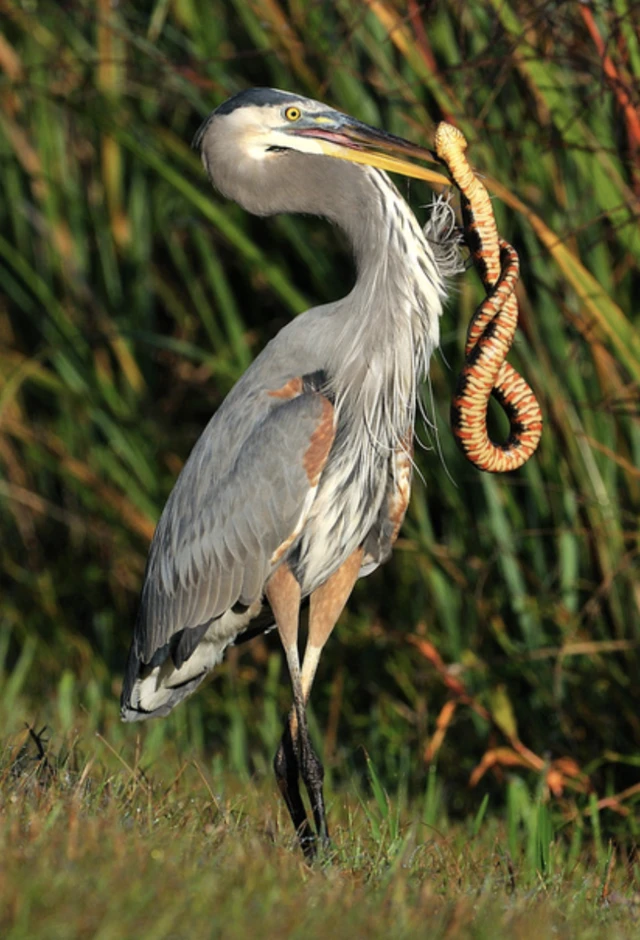
Great Blue Heron Preying on Snakes
4. Distribution range
The Great Blue Heron has a wide distribution, mainly concentrated in North America:
North America : From southern Canada to the continental United States.
Central America : extending to Mexico, the Caribbean islands, and other tropical regions.
In parts of South America , especially in coastal areas, it is occasionally distributed.
Seasonal migration : Northern populations migrate to warmer southern regions during the winter, while southern populations typically remain settled year-round. The primary driver of migration is the impact of cold climates on foraging environments.
5. The migratory routes and habits of the Great Blue Heron
The Great Blue Heron (Ardea herodias) is a highly adaptable bird whose migratory behavior varies depending on habitat climate, food resources, and the geographical location of individual populations. The following are the migratory routes of the Great Blue Heron and related habits:
1. Migration routes
(1) North American populations
Northern populations : Great blue herons living in Canada and the northern United States migrate south to the southern United States, Mexico and Central America during the winter to avoid cold weather and frozen waters.
Southern populations : Great blue herons in Florida, California, and the Caribbean are typically resident and do not require migration.
(2) Central and South American populations
Great blue herons, which live in tropical regions, usually stay in the same habitat year-round and rarely migrate long distances, but may make short trips in search of food and suitable breeding environments.
(3) Coastal populations
Coastal populations typically choose relatively warm coastlines as wintering habitats, such as the east coast of the United States and the Gulf Coast.
2. Migratory habits
(1) Seasonal migration
Autumn migration : Great blue herons usually begin their southward migration in the fall (September to November), flying alone or in small groups, moving along rivers, coastlines or wetland areas.
Spring migration : In spring (March to May), they return to their northern breeding grounds to take advantage of the abundant local resources.
(2) Migration distance
The distance typically ranges from hundreds to thousands of kilometers , depending on the distance between the origin and destination. For example, the migration distance from northern Canada to the Gulf Coast region can exceed 2,000 kilometers.
(3) Flight habits
Great blue herons fly at high altitudes during migration and typically use gliding to conserve energy.
They tend to migrate during the day and utilize ground-level thermals to enhance their flight efficiency.
(4) Adjustment of foraging habits
During their migration, great blue herons will make brief stops in wetlands, rivers, or coastal areas to replenish their energy and hunt for prey such as fish and small amphibians.
3. Migratory behavior of different populations
| Population location | Migration | Main migration directions |
|---|---|---|
| Canada and northern United States | Long-distance migration, migrating south in winter | Southern United States and Central America |
| Central and Eastern United States | Medium-distance migration, partial settlement or short-distance migration | Florida, Gulf Coast |
| Florida and the Caribbean | A settled species with no obvious migratory behavior. | - |
| Central America and tropical regions | Short-distance seasonal migration, adjusted according to changes in food resources. | Wetlands and coastal areas |
4. The ecological significance of migration
The migration of the Great Blue Heron helps to:
Population expansion : Expanding their distribution range through migration to ensure population diversity and health.
Resource optimization : Utilizing optimal food and habitat conditions in different seasons to improve survival and reproduction rates.
Ecological balance : During migration, they act as apex predators in wetland ecosystems, maintaining the stability of the food chain.
5. The Importance of Studying and Protecting Migratory Behaviors
Protecting key habitats along the Great Blue Heron's migratory route, such as wetlands, rivers, and lakes, is crucial for the health of its populations. By tracking its migration routes, we can better develop wetland conservation policies and help mitigate habitat destruction caused by human activities.
6. Reproduction methods and lifespan
Reproduction methods
The Great Blue Heron's breeding season typically begins in late winter to early spring.
Nest building : The male bird collects twigs to build a nest in tall trees or shrubs, attracting female birds to participate.
Egg laying : The female bird lays 2-6 pale blue eggs each time, which are incubated by both the male and female for about 25-30 days .
Breeding : After the chicks are born, the parents take turns feeding them. After about two months , the chicks are able to fly and gradually become independent.
life
The average lifespan of a Great Blue Heron in the wild is 15 years , with some individuals living to over 20 years under ideal conditions. In captivity, lifespans may be even longer due to the absence of predators. High mortality rates during the juvenile stage are a major factor affecting population stability.
7. Subspecies differentiation
The Great Blue Heron has five main subspecies, which differ slightly in distribution and appearance. The following is a detailed table:
| subspecies scientific name | Chinese name | feature | Distribution area |
|---|---|---|---|
| Ardea herodias herodias | Great Blue Heron (typical subspecies) | It has grayish-blue feathers and a relatively large body size. | Most of North America |
| Ardea herodias fannini | Northwest Great Blue Heron | It is darker and slightly larger than the typical subspecies. | Northwestern coastal region of North America |
| Ardea herodias wardi | Florida Blue Heron | The largest subspecies, with paler plumage. | Florida and the Caribbean |
| Ardea herodias occidentalis | Great egret (Florida species) | Commonly known as the "Great Egret," it is entirely white. | South Florida |
| Ardea herodias cognata | Galapagos Great Blue Heron | They are small in size and have an isolated distribution range. | Galapagos Islands |
8. The main predators of the Great Blue Heron (Ardea herodias)
Although the Great Blue Heron is a relatively large bird and occupies a high position in the food chain of wetland ecosystems, it still faces threats from a variety of predators, especially during its juvenile and egg stages. The following are its main predators:
1. Predator
(1) Natural enemies of chicks and eggs
Mammals such as raccoons, foxes, and coyotes. These animals climb up to nesting areas at night to prey on unhatched eggs or newly hatched chicks.
Large birds , such as crows, eagles, red-tailed buzzards, and owls, also prey on the eggs or chicks of the great blue heron.
(2) Natural enemies of adult Great Blue Herons
Adult Great Blue Herons have relatively few natural predators due to their large size, but they may still face threats:
Birds of prey such as bald eagles sometimes attack adult great blue herons.
Alligator : In the wetlands of the southern United States, alligators prey on great blue herons that come close to the water.
2. Indirect threats from human activities
Although humans are not direct predators, some activities pose a serious threat to the survival of the Great Blue Heron:
Wetland destruction : Wetland development, agricultural expansion and urbanization have led to a reduction in the habitat of the Great Blue Heron.
Water pollution : Chemical and plastic pollution can indirectly affect their prey sources and cause health problems.
Predatory pets , such as stray cats and dogs, may attack nesting sites or chicks.
3. Other threats in the natural environment
Extreme weather : Storms can destroy the nests of great blue herons, especially during the breeding season.
Diseases and parasites : Certain diseases (such as avian influenza) or external parasites can also pose a threat to the health of a population.
Overall, the Great Blue Heron's size and flight ability help it avoid many predators, but during the breeding season, it needs to be extra careful to ensure the survival rate of its offspring.
9. Preserve the status quo
Protection level
According to the assessment of the International Union for Conservation of Nature (IUCN) , the Great Blue Heron is listed as Least Concern . This indicates that its overall population is stable and there is no significant risk of extinction.
Population status
The global population of Great Blue Herons is estimated to exceed 500,000 . Although the overall population is stable, wetland degradation, pollution, and climate change in some areas pose threats to their habitat.
10. Arts and Culture
The Great Blue Heron is considered a symbol of wisdom and patience in North American Indigenous cultures. It frequently appears in modern art, photography, and literature to depict the beauty of wetlands and the tranquility of nature. It is also an important symbol for environmentalists advocating for wetland conservation.
10 Interesting Facts About Great Blue Herons
1. The largest heron in North America <br />The Great Blue Heron is the largest heron in North America, standing 1.2-1.4 meters tall with a wingspan of over 2 meters , making it a true "giant" of the wetlands.
2. Extremely skilled at "stationary hunting"
Great blue herons are known for their unique hunting methods—they often remain still in shallow water, waiting for prey to approach before quickly plunging their sharp beaks into the water to capture their food.
3. Elegant Flight Posture <br/>When flying, the Great Blue Heron folds its neck in an "S" shape instead of fully extending it. This posture makes it appear exceptionally elegant, becoming a beautiful sight in the sky.
4. Hunting that can "reverse" <br />They not only use their beaks to catch prey, but they also adjust the direction of their prey to swallow it more easily. For example, when hunting fish, great blue herons will make sure the fish's head is down to prevent its fins from getting stuck in its throat.
5. Highly adaptable to various environments <br/>Although the Great Blue Heron mainly lives in wetlands, it is extremely adaptable and is also commonly found in urban lakes, parks, and even golf courses, demonstrating its flexibility.
6. They are extremely quiet hunters . Great blue herons hardly make any noise when hunting, but they will make a low, hoarse "quack" sound when startled or warning their companions.
7. Strong territorial awareness <br />Great Blue Herons are particularly protective of their territory, especially during the breeding season. They will use warning calls or directly charge at intruders to defend their territory.
8. They can use a variety of nesting materials . Their nests are made of twigs, moss and other plant materials, and are usually built in high trees, sometimes even on the ground or in bushes, showing strong adaptability.
9. Breeding colonies are called "heron nesting colonies".
Great blue herons often build nests in large groups during the breeding season, forming a "heron colony". A heron colony may have dozens to hundreds of herons, adding vitality to the wetland landscape.
10. It serves as an "indicator" of wetland health.
As important predators in wetland ecosystems, the health of the Great Blue Heron population reflects the overall health of the wetland environment. If wetlands are polluted or damaged, the number of Great Blue Herons will decline.
These fascinating facts demonstrate the diversity and uniqueness of the Great Blue Heron as an important player in the ecosystem, while also highlighting the importance of protecting this bird species.
References
Cornell Ornithology Laboratory (2023). Great Blue Heron Information Summary.
International Union for Conservation of Nature (IUCN) Red List of Threatened Species.
National Geographic Magazine. A Guide to the Birds of North America.
Frequently Asked Questions
1. What do Great Blue Herons eat?
The main food source for great blue herons is fish, such as bass and salmon. In addition, they also prey on frogs, small reptiles, insects, rodents, as well as crabs and shellfish in coastal areas.
2. Where do Great Blue Herons live?
Great blue herons inhabit wetlands, lakes, estuaries, and coastal mudflats, and are mainly distributed in North America. They are highly adaptable and also appear in urban wetlands and artificial lakes.
3. How long do Great Blue Herons live?
The average lifespan of a great blue heron in the wild is 15 years , but under ideal conditions it can live to be more than 20 years .