Basic Information
Scientific classification
- Chinese name: Pelican
- scientific name:
- Classification: Wading birds
- Genus and species: Pelican
Vital signs data
- Body length: 1.2-1.8 meters
- Weight: 5-15 kg
- Lifespan: 15-25 years
Significant features
Large waterbirds
Distribution and Habitat
It spans the Americas, Africa, Europe, Asia, and Australia. It inhabits lakes, wetlands, rivers, and coastal areas.
Appearance
Unique long beak and huge throat pouch
Detailed introduction
Pelicans are large waterbirds, known for their distinctive long beaks and large throat pouches, and belong to the family Pelecanidae. These birds play a vital role in wetland ecosystems, serving as both skilled fishermen and elegant gliders. This article will provide a detailed overview of various aspects of the pelican, including its morphological characteristics, habits, distribution, and conservation status.
Table of contents
Morphological characteristics
Habitat
Lifestyle and Diet
Distribution range, migration routes and habits
Reproduction methods, parenting and lifespan
Variety differentiation
Preserve the status quo
Protection level
Population status
Natural enemies
Arts and Culture
refer to
Scientific classification of species
Pelicans are large waterbirds belonging to the order Pelecaniformes , scientifically classified as follows:
Kingdom : Animalia
Phylum : Chordata
Class : Aves
Order :Pelecaniformes
Family : Pelecanidae
Genus : Pelecanus
Species : such as the white pelican ( Pelecanus onocrotalus ) and the brown pelican ( Pelecanus occidentalis ).
Pelicans, known for their long beaks and throat pouches, are an integral part of wetland ecosystems.
1. Morphological characteristics
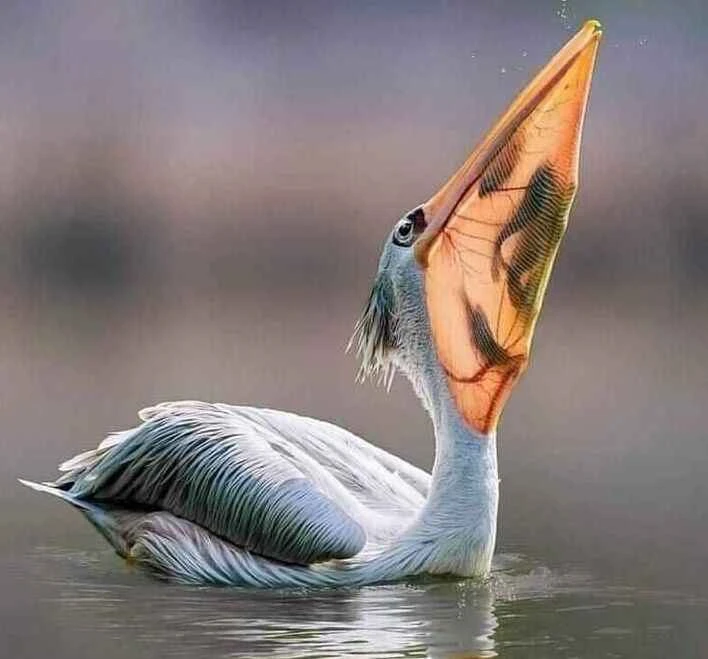
Pelicans are large waterbirds, distinguished by their long beaks and throat pouches. The throat pouch can expand to capture and store prey, especially fish.
Size : Adult pelicans are about 1.2-1.8 meters long and have a wingspan of 2.5-3.6 meters .
Weight : Generally between 5-15 kg , depending on the species.
Feather color : White pelicans have mainly white feathers, while brown pelicans have brown or grayish-brown feathers.
Flying ability : Pelicans are good at gliding and can fly for long periods of time using air currents without expending too much energy.
2. Habitat
Pelicans mainly live in wetlands, lakes, rivers, and coastal areas, and especially prefer places with abundant fish resources.
Freshwater habitat : White pelicans typically live near inland lakes and rivers.
Saltwater habitat : Brown pelicans prefer to live in coastal areas and estuaries.
Nesting locations : Pelicans typically build their nests on islands, in swamps, or in trees to avoid threats from ground predators.
3. Lifestyle and Diet
Lifestyle
Pelicans are gregarious birds that prefer to act in groups, especially when foraging and migrating. They have a unique cooperative hunting habit, often hunting in groups to drive schools of fish into shallow waters for easier capture.
diet
Pelicans primarily eat fish, but their diet is quite diverse:
Fish : such as herring, eel, small salmon, etc.
Other food sources include frogs, crustaceans (such as crabs), and occasionally small birds.
Hunting method : Use the throat pouch to quickly scoop fish from the water, expel excess water, and then swallow the prey.
Pelicans typically forage during the day, but are sometimes most active in the early morning or evening.
4. Distribution range, migration routes and habits
Distribution range
Pelicans have a wide distribution, spanning the Americas, Europe, Africa, Asia, and Australia .
White pelican : Found in parts of Africa, Europe and Asia.
Brown pelican : Primarily inhabits coastal regions of the Americas.
Migration routes and habits
Pelicans are seasonal migratory birds, and their migration patterns depend on the geographical location and climate conditions of the population.
Migration route : White pelicans in North America migrate from Canada and northern United States to the Gulf of Mexico and South America to spend the winter.
Habits : When migrating, they form V-shaped formations to reduce wind resistance and conserve energy.
5. Reproduction methods, parenting, and lifespan
Reproduction methods
Pelicans typically breed in the spring, often choosing islands or remote wetlands as their breeding grounds.
Nest building : The nest is made of twigs, reeds and grass, and is usually built by the female bird.
Egg laying : Each clutch contains 2-4 eggs, which are white or light blue.
Incubation period : approximately 30 days , with both male and female taking turns incubating the eggs.
Parenting
After hatching, the chicks are fed by their parents in turns, mainly with semi-digested fish. The chicks can fly independently and learn to forage after 2-3 months .
life
Pelicans have an average lifespan of 15-25 years , but their lifespan in the wild is greatly affected by predators and environmental threats. In well-protected environments, they may live even longer.
6. Variety Differentiation (Table Presentation)
| type | feature | Distribution area |
|---|---|---|
| White pelican ( Pelecanus onocrotalus ) | It is relatively large, with white feathers and a yellow beak and throat pouch. | Africa, Europe and Asia |
| Brown Pelican ( Pelecanus occidentalis ) | Its feathers are dark brown, and it lives in coastal areas. | North and South American coasts |
| Australian Pelican ( Pelecanus conspicillatus ) | It has an enormous beak and the longest wingspan. | Australia and New Guinea |
| American white pelican ( Pelecanus erythrorhynchos ) | It is entirely white with black wingtips and migrates over long distances. | North America and parts of South America |
7. Preserve the status quo
Protection level
According to the assessment of the International Union for Conservation of Nature (IUCN), most pelican species are classified as "Least Concern," but some populations are threatened by habitat destruction.
Population status
The pelican population is generally stable, but in some areas, such as coastal wetlands and inland lakes, the population has declined due to reduced food resources caused by pollution and overfishing.
8. Natural Enemies
Adult pelicans have few natural predators, but their eggs and chicks are vulnerable to predators, including:
Terrestrial predators : such as foxes, raccoons, and snakes.
Aerial predators : such as eagles and falcons.
In addition, human activities pose an indirect threat to pelicans, including pollution, entanglement in fishing nets, and habitat loss.
9. Arts and Culture
In culture, pelicans symbolize sacrifice and selflessness . In Western folklore, pelicans are believed to feed their young with their own blood, symbolizing love and dedication .
The pelican's elegant posture and unique throat pouch design have made it a source of inspiration for literature, painting, and sculpture. In modern times, pelicans also frequently appear in photography and environmental advocacy.
10. Reference
International Union for Conservation of Nature (IUCN) Red List of Species
Encyclopedia of Ornithology
National Geographic Channel: Pelican Special
Wetlands Conservation Organization: Pelican Ecological Conservation Research Report
Frequently Asked Questions
3 Frequently Asked Questions (FAQ)
1. What do pelicans eat?
Pelicans primarily feed on fish, but also prey on frogs, crustaceans (such as crabs), and occasionally small birds. They use their throat pouches to catch prey and are highly skilled at hunting in groups.
2. Where do pelicans live?
Pelicans live in wetlands, lakes, rivers, and coastlines, and are distributed across the Americas, Africa, Europe, Asia, and Australia.
3. How long can the Pelicans survive?
Pelicans have an average lifespan of 15-25 years , and may live even longer, exceeding 30 years, in well-protected environments.