Basic Information
Scientific classification
- Chinese name: Red River Pig
- Scientific name: African Red River Pig
- Classification: Hoof Order
- Taxonomic and genus: Red River Pig
Vital signs data
- Body length: 1-1.5 meters
- Weight: 45-120 kg
- Lifespan: 15 years
Significant features
Vibrant fur color and unique facial markings
Distribution and Habitat
They mainly inhabit rainforests, wetlands, and grasslands in sub-Saharan Africa, and prefer to be near water sources.
Appearance
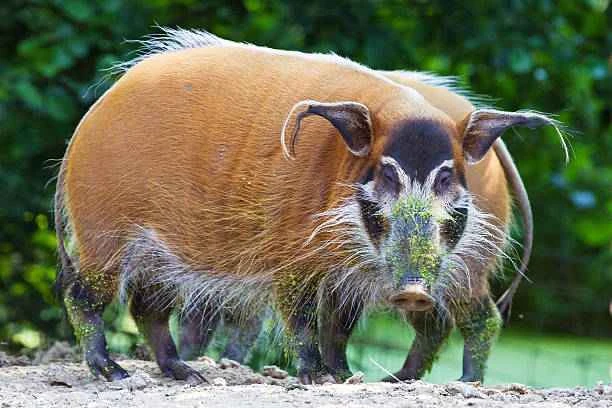
Its fur is a bright reddish-brown, with distinct white stripes on both sides of its body, prominent white tufts of fur and black markings on its face, and elegant long tufts of hair at the tips of its ears.
Detailed introduction
The Red River Pig ( Potamochohorus porcus) , also known as the African Red River Pig , is a wild pig species found in sub-Saharan Africa, famous for its bright coat color and unique facial markings.
Table of contents
Morphological characteristics
Habitat
Lifestyle and Diet
Distribution range
Reproduction methods, parenting and lifespan
Variety differentiation
Preserve the status quo
Protection level
Population status
Natural enemies
References
FAQ: Frequently Asked Questions about Red River Pigs
Scientific classification of species: Red River Pig
Kingdom: Animalia
Phylum: Chordata
Class: Mammalia
Order: Artiodactyla
Family: Suidae
Genus: *Potamochoerus*
Breed: Red River Pig (Potamochoerus porcus)
English name: Red River Hog
1. Morphological characteristics of the Red River Pig
Red River pigs are medium-sized, with adult individuals reaching 1-1.5 meters in length, a shoulder height of about 55-80 centimeters, and a weight typically between 45-120 kilograms.
Their fur is a bright reddish-brown, with distinct white stripes on their sides, prominent white tufts of hair and black markings on their faces, and elegant tufts of long hair at the tips of their ears. Male Red River Pigs also have two small facial protrusions on their heads, resembling tusks, used for defense and mating fights.
2. Habitat of the Red River Pig
Red River hogs primarily inhabit tropical rainforests, savannas, and wetlands near Africa. They prefer to stay near water sources, as water not only provides them with drinking water but also a place to shower and cool off.
This type of pig is highly adaptable, able to find habitats in forest edges, riverbanks, swamps, and farmland developed by humans. Dense vegetation and ample cover are especially important to them, as these places provide both food sources and protection from predators.
3. Living habits and diet of Red River pigs
Lifestyle
Red River hogs are typical social animals, usually consisting of a family group led by a single male, with each group comprising about 6-15 individuals. They are nocturnal, spending the day resting in shady places and foraging at night.
They are also known for their alertness, emitting sharp cries to warn their companions when they encounter danger.
diet
Red River pigs are omnivorous and eat almost anything. Their main diet includes:
Plants: fruits, roots, tender leaves, grasses, etc.
Animals: insects, lizards, small mammals, and even bird eggs.
They also stir up the soil in search of buried food, or go directly to farmland and eat the farmers' crops.
4. Distribution range of the Red River Pig
Red River hogs are mainly distributed in the forests, wetlands, and grasslands of sub-Saharan Africa, including Congo, Gabon, Cameroon, and Angola. Their habitats are usually connected to bodies of water, which gives them more opportunities to forage and reproduce.
Red River hogs are highly adaptable to their environment and can survive even in areas close to human activity. However, their distribution range is shrinking due to habitat destruction.
5. Reproduction, parenting, and lifespan of the Red River Pig
Reproduction methods
Red River pigs can breed year-round, but peak breeding season is usually during the rainy season when resources are abundant. The gestation period is approximately 120-127 days, and each litter typically produces 3-6 piglets.
Parenting
Sows are very protective of their piglets, often hiding them in secluded places and foraging nearby. Piglets can stand and move within hours of birth, and sows will nurse them with their milk for up to 2-3 months.
life
The average lifespan of a Red River pig is about 15 years in the wild, but can reach 20 years in protected environments such as zoos.
6. Breed differentiation of Honghe pigs (shown in table)
| Variety Name | Distribution area | Main features |
|---|---|---|
| West African subspecies (P. p. pictus) | West African rainforest | It has darker fur, a smaller body size, and longer ear hair. |
| East African subspecies (P. p. hassama) | East African wetlands and grasslands | It has a light-colored coat, a large body size, and indistinct stripes. |
| Central African subspecies (P. p. centralis) | Central African Republic Congo Basin | The stripes are more pronounced, and the contrast between black and white on the face is more prominent. |
7. Current Status of Red River Pig Conservation
Protection level
According to the assessment of the International Union for Conservation of Nature (IUCN), the red river hog is listed as **Least Concern**, but in some areas, habitat destruction and hunting pose a threat to its population.
Population status
The red river hog population is currently relatively stable, especially in protected areas where the numbers are higher. However, deforestation and increased human activity remain among the main threats. In some areas, the red river hog population is declining due to overhunting.
8. Natural enemies of the Red River Pig
The main predators of the Red River Pig include:
Large predators: lions, leopards, hyenas.
Threats to young cubs: pythons, eagles, etc.
Even so, Red River pigs are able to successfully avoid danger most of the time through group cooperation and keen senses.
9. References
International Union for Conservation of Nature (IUCN) Red List of Species
Encyclopedia of African Wildlife
Journal of Animal Protection and Ecological Research
Frequently Asked Questions
Common problems with Red River pigs
1. What do Honghe pigs eat?
Red River pigs are omnivorous, mainly eating fruits, roots, insects, and small animals. They will even eat crops in farmland.
2. Where does the Red River Pig live?
Red River pigs mainly inhabit rainforests, wetlands, and grasslands in sub-Saharan Africa, and prefer to stay near water sources.
3. How long can a Red River pig live?
Red River pigs have an average lifespan of 15 years in the wild, but can live up to 20 years or more in protected environments.