Basic Information
Scientific classification
- Chinese name: Grey-headed jade
- Scientific name: Halcyon leucocephala, Gray-headed Kingfisher, Chestnut-bellied Kingfisher
- Classification: Climbing birds
- Family and Genus: Order Coraciiformes, Family Kingfisher, Genus Kingfisher
Vital signs data
- Body length: 21-22 cm
- Weight: 46-57g
- Lifespan: No verification data available.
Significant features
Distribution and Habitat
It is distributed in south-central Africa (including the southern Arabian Peninsula and the entire African continent south of the Sahara Desert (Tropic of Cancer)).
Inhabits forests, grasslands, shrublands, thickets, thorn bushes, parks, and agricultural areas. Found in almost all land areas, but sparsely populated by dense forests and arid or semi-desert regions. Lives near water along riverbanks.
Appearance
The Grey-headed Kingfisher is 21-22 cm in length with a wingspan of 32-34 cm. Males weigh 46 g, and females weigh 57 g. Despite their small size, they are among the most beautiful birds in Africa, with vibrant and colorful plumage. The bill and feet are red. The head and breast are pale grey or pale brown, while the rump, tail, including the secondary feathers and flight feathers, are cobalt blue or bright purple. The belly and wings are red or chestnut. Males and females are almost identical, except that the female is slightly heavier. There are five subspecies, differing mainly in the blue of the head and variations in the grey of the wings.
Detailed introduction
The scientific name of the gray-headed kingfisher is Halcyon leucocephala, and its foreign names are Gray-headed Kingfisher and Chestnut-bellied Kingfisher. It has 5 subspecies.
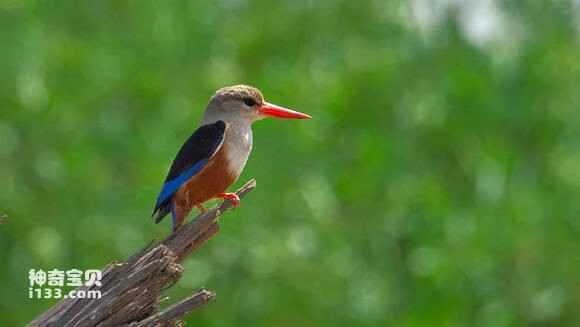
The Grey-headed Kingfisher's song is usually like a cry, consisting of a rapid, harsh, and rolling series of "it, it, it, it, it, it, it, it." But it also produces a rapid series of "tchi - tchi - tchi - tchi tchi" and a rapid, staccato sonata.
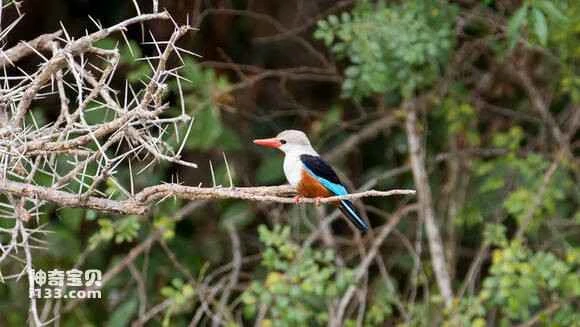
The Grey-headed Kingfisher is entirely carnivorous. It primarily feeds on locusts, a wide variety of insects and arthropods, but also consumes small vertebrates such as small fish, snakes, lizards, nestlings, and small mammals.
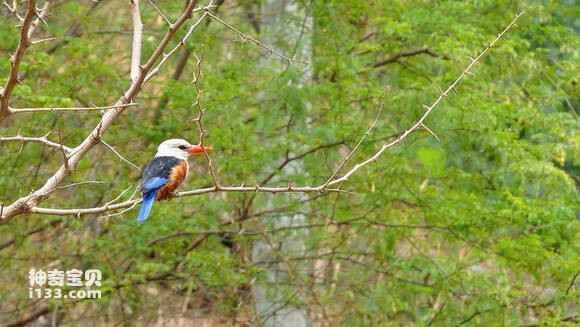
The Grey-headed Kingfisher nests on earthen cliffs or river embankments, using its beak to dig tunnel-like burrows, 50 cm to 1 meter deep. These burrows are generally unlined. The eggs are laid directly on the ground inside the nest. The female lays three eggs at a time, and both parents incubate them for 16 to 21 days. The eggs are nearly round and pure white.
Listed as Least Concern (LC) on the IUCN Red List.
Protect wild animals and ban the consumption of wild game.
Maintaining ecological balance is everyone's responsibility!