Basic Information
Scientific classification
- Chinese name: Brown-bellied Green Pit Dog
- Scientific name: Chloroceryle inda, Green-and-rufous Kingfisher
- Classification: Climbing birds
- Classification and genus: Order Coraciiformes, Family Kingfisher, Genus Kingfisher
Vital signs data
- Body length: Approximately 24 centimeters
- Weight: 46-62g
- Lifespan: No verification data available.
Significant features
Distribution and Habitat
The brown-bellied green kingfisher is distributed in South America (including Colombia, Venezuela, Guyana, Suriname, Ecuador, Peru, Bolivia, Paraguay, Brazil, Chile, Argentina, Uruguay, and the Falkland Islands).
Brown-bellied green kingfisher can reach altitudes of 400 meters, and their distribution is very uneven.
Appearance
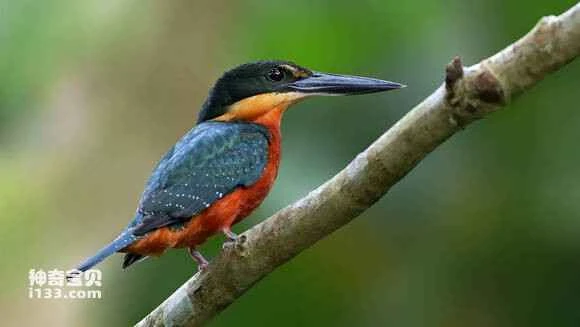
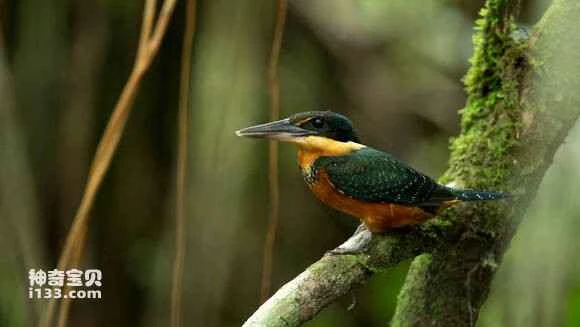
The Brown-bellied Green Kingfisher is 24 cm in length, with males weighing 46-60g and females 53-62g. Adult males have a blackish-green forehead and lores, with a red line above the eyebrow. The neck has a deep green sheen. The chin, throat, and barbels are pale yellow or light yellow, while the sides of the neck are bright red. A thin, pale yellow collar encircles the neck, with the upper part of the collar almost black. The tips of the remaining feathers have a deep green sheen. The inner wing coverts are white. The primary and secondary flight feathers have four neat rows of white spots. The tail has several small white spots. The lower abdomen is dark red, with slightly pale forewings and the lower tail. The bill is black, and the lower jaw is yellow. The iris is dark brown, and the legs are dark gray. Adult females differ, with a broad band of green feathers on the chest and a white forehead. They are larger in size. The bill is long and laterally compressed with a rounded ridge; the nasal groove is prominent; the first primary flight feather is shorter than the second, and the second or third is the longest; the tail is longer than the bill.
Detailed introduction
The Green-and-rufous Kingfisher, scientifically known as *Chloroceryle inda*, is a species of kingfisher.
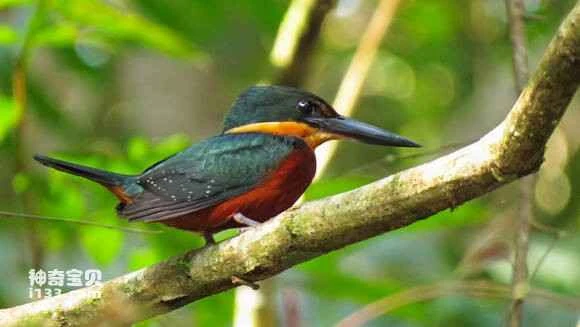
The Brown-bellied Green Kingfisher is a fish-eating kingfisher with exceptional diving and swooping skills, even hovering in mid-air to lock onto its prey. It primarily lives near rivers, feeding on fish. It inhabits shrublands or sparse forests, clear, slow-flowing rivers, streams, lakes, and irrigation canals. It often flies overhead over rivers, streams, ponds, and marshes, surveying for food. Once it spots prey, it swiftly and decisively swoops down. It usually perches alone on the tops of branches, telephone poles, or rocks near water, waiting for its prey. It is commonly seen perched on low branches or rocks near the water, patiently waiting for its prey. Like kingfishers, it hunts by swooping down from the water's surface or diving underwater; sometimes it can even disappear completely into the water. Other times, it flaps its wings, hovering about 3-10 meters above the water, seemingly suspended above the surface, and upon spotting prey, immediately plunges into the water to catch it. It places its catch on its perch, constantly manipulating it, even tossing the fish up to swallow it headfirst. Its diet consists mainly of small fish, supplemented by crustaceans, various aquatic insects and their larvae, as well as small frogs and a small amount of aquatic plants.
Brown-bellied green kingfishers typically nest on earthen cliffs, or on the banks of fields and streams, using their mouths to dig tunnel-like burrows, which are usually unlined. Eggs are laid directly on the ground inside the nest. Each clutch contains 3-5 eggs. The eggs are pure white, glossy, with a sturdy shell and slight spots.
Listed in the IUCN Red List of Birds, ver 3.1: 2008.
Protect wild animals and ban the consumption of wild game.
Maintaining ecological balance is everyone's responsibility!