
Basic Information
Scientific classification
- Chinese name: Blue Jade
- Scientific name: Halcyon pileata, Black-capped Kingfisher
- Classification: Climbing birds
- Family and Genus: Order Coraciiformes, Family Kingfisher, Genus Kingfisher
Vital signs data
- Body length: 25-31 cm
- Weight: 64-115g
- Lifespan: Approximately 10 years
Significant features
It is characterized by its black head, black wing coverts, and the rest of its upper body being a bright and luxurious blue-purple.
Distribution and Habitat
It is distributed in Bangladesh, Brunei Darussalam, Cambodia, China, India, Japan, the Democratic People's Republic of Korea, the Republic of Korea, the Lao People's Democratic Republic, Malaysia, Myanmar, the Philippines, Singapore, Thailand, and Vietnam.
Migratory birds: Indonesia, Nepal, Pakistan, Sri Lanka, and Taiwan.
In China, it is distributed across Heilongjiang, Changbai Mountain in Jilin, eastern, central and southern Liaoning, Hebei, Shandong, Shanxi, westward to Gansu, Sichuan, Guizhou, and Yunnan, and southward to Guangdong, Guangxi, Fujian, Hong Kong, Hainan Island, and Taiwan. It breeds in most parts of East China, Central China, and South China, from Liaoning to Gansu, as well as a vast area in the southeast; it is a resident bird in some areas. In Taiwan, it is a vagrant.
The Blue-crowned Kingfisher primarily inhabits forest streams, as well as rivers, ponds, and marshes in foothills and plains. It is not uncommon along clear rivers below 600 meters in altitude. Northern populations migrate south for the winter. It prefers the banks of large rivers, river mouths, and mangroves. It perches on branches along riverbanks. It is more of a river bird than the White-breasted Kingfisher.
Appearance
The Blue Kingfisher has a black forehead, crown, sides of the head, and nape; a white nape that extends laterally to connect with the white throat and breast, forming a broad white collar. There is a white patch below the eye. The back, rump, and uppertail coverts are cobalt blue, as is the tail, with black shafts. The wing coverts are black, forming a large black patch. The primary flight feathers are blackish-brown with blue edges, white at the outer base, and a large white patch at the inner base, with a pale purplish-blue patch on the corresponding outer side. The secondary flight feathers are blackish-brown on the inner side and cobalt blue on the outer side. The chin, throat, sides of the neck, cheeks, and upper breast are white; the area below the breast, including the axillaries and underwing coverts, is orange-brown.
The young bird has a white collar on the back of its neck tinged with brown, and the feathers on its throat and chest have light brown tips. Sometimes the feathers on its belly also have black edges.
The iris is dark brown. The mouth is coral red, the feet and toes are red, and the claws are brown.
Size measurements: Weight: ♂ 64-110 g, ♀ 64-115 g; Body length: ♂ 278-310 mm, ♀ 250-310 mm; Bill length: ♂ 56-65 mm, ♀ 58-66 mm; Wing length: ♂ 122-135 mm, ♀ 122-137 mm; Tail length: ♂ 81-88 mm, ♀ 75-90 mm; Tarsus length: ♂ 13-19 mm, ♀ 16-18 mm. (Note: Males—♂; Females—♀)
Detailed introduction
The scientific name of the blue jadeite is Halcyon pileata, also known as Black-capped Kingfisher, and it has no subspecies.
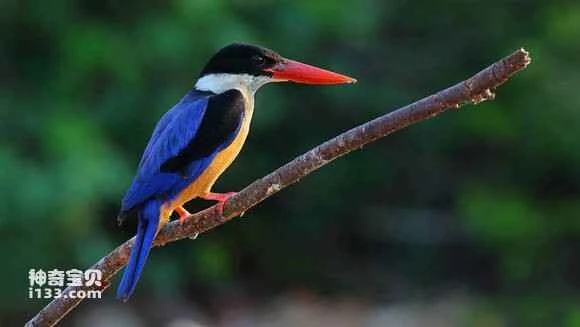
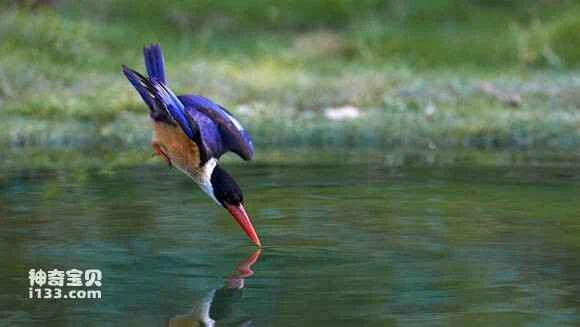
The blue kingfisher is usually solitary, generally perching on tree stumps and rocks along the riverbank, and sometimes on the low branches of small trees near the river. It often gazes motionless at the water's surface for long periods, and upon spotting fish or shrimp, it dives in with extreme speed and ferocity to catch them with its beak. Sometimes it also hovers in the air, flapping its wings and looking down at the water's surface; upon spotting prey, it plunges in and quickly captures it. It usually carries its prey back to its roost, beats it on branches or rocks until it dies, and then swallows it whole. Sometimes it also flies low and straight along the water's surface at great speed, often calling out as it flies.
The ecological habits of the blue kingfisher are similar to those of other species in this family. It primarily feeds on aquatic animals such as small fish, shrimp, crabs, and aquatic insects. It also eats frogs, coleopterans, lepidopteran insects, and their larvae.
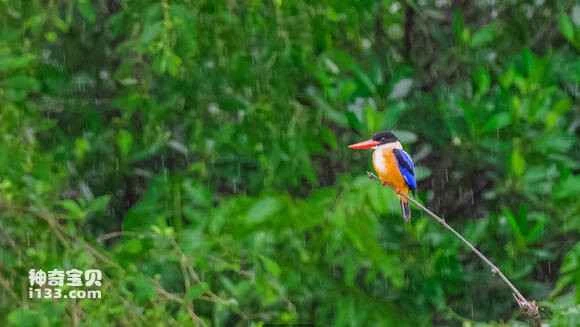
The Blue-eared Kingfisher's breeding season is from May to July. They nest on earthen cliffs or river embankments, digging tunnel-like burrows with their beaks. Both birds work together to dig the tunnels, which can reach a depth of 60 cm, widening at the end to form the nest chamber, 10-15 cm in diameter. These burrows are generally unlined. Eggs are laid directly on the ground inside the nest. Once the nest chamber is complete, the female lays 4 or 5 pure white eggs. Each clutch contains 4-6 eggs, measuring 26-29 × 21-24 mm, with an average of 27.3 × 2.5 mm. Both parents take turns incubating. The chicks are altricial and blind at birth. Incubation lasts 19-21 days. After hatching, they are cared for by their parents for 23-30 days before leaving the nest to fly.
Listed as Vulnerable (VU) in the IUCN Red List of Threatened Species ver 3.1: 2022.
It is listed in the "List of Terrestrial Wild Animals of Beneficial or Important Economic and Scientific Research Value under State Protection" (Item 270) issued by the State Forestry Administration of China on August 1, 2000.
Protect wild animals and ban the consumption of wild game.
Maintaining ecological balance is everyone's responsibility!


