Basic Information
Scientific classification
- Chinese name: Red-eyed tree frog
- Scientific name: Agalychnis callidryas
- Order: Anura
- Family and genus: Rhizophoraceae, *Leptochloa*
Vital signs data
- Body length: Adults are generally about 4–7 cm in length, with females slightly larger than males. They are small to medium-sized arboreal frogs.
- Weight: Individual weight typically ranges from a few grams to over ten grams, varying depending on individual size and nutritional status.
- Lifespan: In the wild, they can typically live for several years, and may live even longer in captivity under good conditions.
Significant features
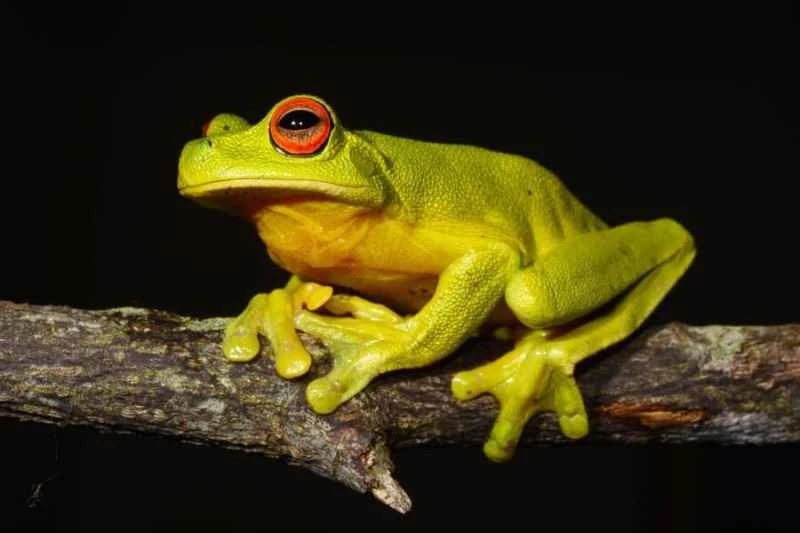
The colorful tree frog, a quintessential species of tropical rainforest frog, is characterized by its bright red eyes, bright green back, blue and yellow striped sides, and orange toes. It is nocturnal and arboreal, and lays its eggs on leaves suspended above the water when breeding.
Distribution and Habitat
Native to the tropical rainforests of southern Mexico and Panama in Central America, they are distributed from lowland rainforests to some low-altitude mountain rainforests. They mostly live on shrubs and leaves near water bodies and depend on warm, humid environments with vegetation cover.
Appearance
Small to medium-sized, with a bright green back, blue and yellow stripes on its head and sides when startled, slender limbs, orange toes with suckers, striking red eyes, and a light-colored abdomen, it is a highly ornamental Central American tree frog.
Detailed introduction
The Red-eyed Tree Frog (Agalychnis callidryas ) is a highly representative colorful tree frog of the tropical rainforest, belonging to the genus Agalychnis in the family Hymenidae. It boasts large, bright red eyes, a bright green back, blue and yellow striped sides, and orange or reddish-orange limbs and toes, making it one of the most famous "celebrity frogs" of the Central American rainforest.
Classification and nomenclature
Common Chinese name: Red-eyed tree frog
English name: Red-eyed Tree Frog
Scientific name: Agalychnis callidryas
Family: Hylidae → Genus: Agalychnis
Appearance and Identification Features
The red-eyed tree frog has extremely bright colors, making it very easy to identify:
Size: Adults are about 4–7 cm long, with females generally slightly larger than males;
Eyes: Large, bright red eyes with bright red or orange-red irises and vertical pupils are the most classic identifying features;
Back color: The back is mostly bright grass green or leaf green, which provides excellent camouflage when resting close to the leaves;
Side markings: The sides of the body are usually blue or blue-green with several vertical yellow or orange-yellow stripes.
Limbs and toes: The limbs are slender, and the toes have well-developed suckers at the ends, which are mostly orange or reddish-orange in color, making it easy to climb on leaves and branches;
Abdomen: The abdomen is lighter in color, often milky white or pale yellow;
Body shape: The body is relatively slender with long limbs, typical of a tree frog.
Distribution range and habitat
The red-eyed tree frog is native to the tropical rainforests of Central America .
It is mainly distributed in southern Mexico and Central American countries (such as Guatemala, Honduras, Nicaragua, Costa Rica, and Panama);
Records have been made of rainforests ranging from lowland to some low-altitude mountain rainforests.
Typical habitat characteristics include:
Tropical rainforests and secondary forests that are warm and humid year-round;
Vegetation near bodies of water such as ponds, still puddles, and slow-flowing streams;
They mostly live and reproduce on the leaves of the lower canopy and shrub layer, and are typical arboreal frogs.
Lifestyle
The red-eyed tree frog is a nocturnal, arboreal frog .
During the day, they usually rest close to the back of the leaves, with their eyes closed to cover their bright red irises, and their green backs blending into the leaves to reduce the chance of being discovered;
When threatened, it will suddenly open its bright red eyes and spread its limbs to reveal blue and yellow patterns on its sides and orange toes, using its "frightening coloration" to make the predator pause briefly, and then quickly escape.
They are most active at night, moving slowly or hopping among the branches and leaves, catching insects and searching for mates.
feeding habits
The red-eyed tree frog is carnivorous, primarily feeding on small invertebrates.
Various insects, such as moths, beetles, locusts, crickets, flies, etc.;
Spiders and other arthropods;
They occasionally prey on smaller frogs or other mollusks.
Reproduction and Development
The reproduction of the red-eyed tree frog is closely related to the monsoon season in tropical regions:
The breeding season is usually during the rainy season, and male frogs call out on branches and leaves near the water to attract female frogs.
The female frog lays her eggs on the back or tip of leaves that hang above the water surface. The egg mass is a green or translucent gelatinous mass.
The embryo develops in the egg. After a period of time, the tadpole will hatch from the egg mass on the leaf and slide down into the water below to continue developing.
Tadpoles complete tail development and morphological changes in the water, eventually becoming small tree frogs that climb ashore and begin an arboreal life on vegetation.
Protecting the status quo and threats
The red-eyed tree frog is currently assessed as Least Concern (LC) on the IUCN Red List, and the overall population remains relatively common.
However, in some localized areas, it still faces the following threats:
Tropical rainforest deforestation and fragmentation have led to habitat loss and quality decline.
The impact of farmland expansion, pesticides, and pollutants on nearby water bodies and vegetation;
Climate change is causing changes in rainfall patterns and extreme weather events;
The pet trade faces capture pressure in some areas (many countries already have stricter regulations and artificial breeding of individuals).
Maintaining the integrity of tropical rainforests and the vegetation around water bodies, and regulating amphibian trade, are crucial for the long-term conservation of the red-eyed tree frog and its symbiotic tree frog species.
Frequently Asked Questions
Q1: Why do red-eyed tree frogs have such vibrant colors?
During the day, when it's curled up on the underside of a leaf, it's predominantly green, providing excellent camouflage. When threatened, it suddenly opens its red eyes, spreads its limbs, revealing its blue-yellow sides and orange toes.
Creating a strong visual stimulus and briefly startling the predator, thus buying time for escape, is a phenomenon known as "fright color display."
Q2: Can red-eyed tree frogs be kept as pets?
In some countries, raising red-eyed tree frogs is permitted, provided they are from legal sources (such as artificially bred individuals) and meet the necessary breeding conditions.
However, capturing wild individuals can put pressure on natural populations, and it is necessary to understand local laws and regulations and professional care requirements before keeping them.
Q3: Are red-eyed tree frogs poisonous to humans?
Unlike some poison dart frogs, the red-eyed tree frog is not highly poisonous and generally poses no fatal threat to humans. However, like many amphibians, its skin secretions can be irritating.
Therefore, if brief contact is necessary, handle with care, wash hands afterwards, and avoid rubbing eyes or ingesting food.
Q4: What role does the red-eyed tree frog play in the ecosystem?
As a nocturnal predator, it controls the populations of insects and other small invertebrates in the rainforest, while also serving as prey for snakes, birds, and larger invertebrates.
It plays an important role in the tropical rainforest food web.