Basic Information
Scientific classification
- Chinese name: Red-crowned Toad Mouth Toad
- Scientific name: Pseudophryne australis
- Order: Anura
- Family and genus: False toad (Family: Ranidae)
Vital signs data
- Body length: Adults typically measure about 2.0–3.0 cm in length, making them small terrestrial frogs.
- Weight: Individual weight is only a few grams, and the specific value varies depending on the size of the individual and nutritional status.
- Lifespan: It is estimated that it can survive for several years in the wild and participate in multiple breeding seasons in suitable habitats.
Significant features
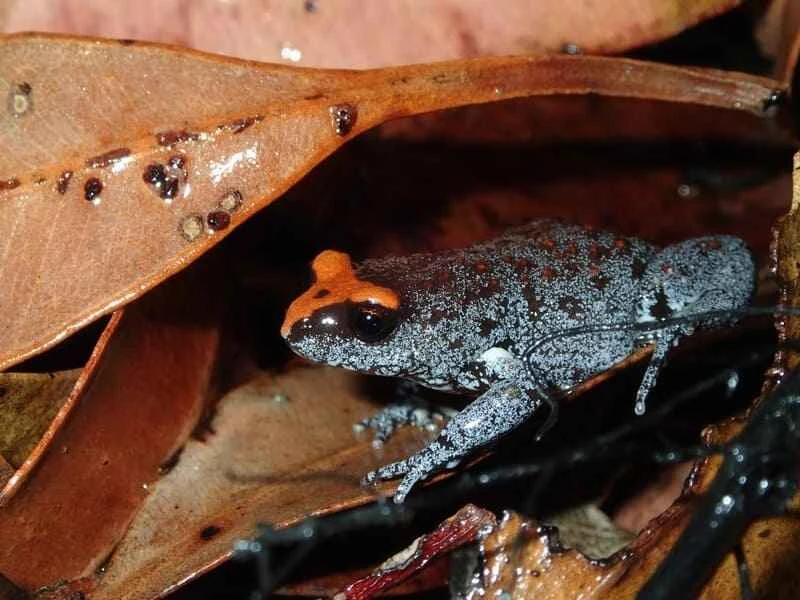
Despite its small size, it is brightly colored, with prominent orange-red "crown" patches on its head and behind its eyes, and bright spots on its armpits and groin. It mainly lives in the Sydney Basin and surrounding sandstone thickets and seepage zones, and is a small terrestrial frog endemic to eastern Australia.
Distribution and Habitat
It is limited to the eastern part of New South Wales, Australia, especially the Sydney Basin and surrounding sandstone highlands. It inhabits heather thickets, open woodlands, and hillsides on sandstone bases, and is active and reproduces in fallen leaves, moss, and rock crevices around shallow depressions, seepage zones, and temporary wetlands where rainwater collects.
Appearance
The back is black or dark gray and slightly rough, dotted with small warts; the top of the head and behind the eyes have orange-red patches, and orange-yellow or orange-red markings can be seen under the armpits, in the groin and under the limbs; the abdomen is dark with light-colored spots; the body is slightly wide and short, and the limbs are short and powerful, which is suitable for moving in rock crevices and leaf litter.
Detailed introduction
The Red-crowned Toadlet ( Pseudophryne australis ) is a small, brightly colored native Australian frog, belonging to the genus Pseudophryne in the family Ranidae. Its most distinctive features are the bright orange-red "crown" patches on its head and behind its eyes, as well as the bright orange-yellow or orange-red markings on its armpits, groin, and lower limbs, which stand out vividly against its black or dark body.
Classification and nomenclature
Chinese reference name: Red-crowned toadmouth frog, Red-crowned small toadmouth frog (Chinese name is not yet fully standardized)
English name: Red-crowned Toadlet
Scientific name: Pseudophryne australis
Family: Myobatrachidae → Genus: Pseudophryne
Appearance and Identification Features
The red-crowned toad is small in size, but its strong color contrast makes it highly recognizable.
Size: Adults are typically about 2.0–3.0 cm in length, making them small terrestrial frogs;
Back color: Overall black or dark gray, with a slightly rough surface covered with small warts;
Red crown on the head: The top of the head and the area behind the eyes have bright orange-red or orange patches, which are triangular or irregular in shape and are called "corona marks".
Markings on the sides and limbs: Orange or orange-yellow spots or stripes are often found on the armpits, groin, and under the limbs, creating a strong contrast with the black back;
Abdomen: The abdomen is mostly black or dark, often with irregular light-colored spots;
Body shape: The body is slightly wide and short, flat, with a wide head and a blunt snout;
Limbs: The limbs are short and powerful, with almost no webbed hands and feet, making them suitable for crawling and hopping among rocks, fallen leaves, and moss.
Eyes: The eyes are relatively large compared to the body size, with dark irises that are not particularly noticeable against a dark body surface.
Distribution range and habitat
The red-crowned toad is a species endemic to eastern New South Wales, Australia , with a relatively narrow distribution range.
They are mainly distributed in the sandstone highlands and slopes of the Sydney Basin and surrounding areas;
It is confined to a series of scattered, sandstone-based heather thickets, open woodlands, and canyon slopes.
Typical habitats include:
Sandstone terraces and heather thickets and open woodlands on the hillsides;
Shallow depressions where rainwater collects, temporary wetlands, and moss and leaf litter near seepage zones;
They often hide in damp little spaces such as rock crevices, under fallen trees, among thick layers of fallen leaves and grass roots.
Lifestyle
The red-crowned toad is a terrestrial frog that lives in a small area .
They spend most of their time near the ground and rarely climb to higher places;
They prefer to be active and call during humid weather, before and after rainfall, and during the rainy season;
During the day, they are mostly hidden in crevices, under fallen leaves and moss, but they are easier to observe at night or on rainy days.
Cry
The male red-crowned toad's call is short and rhythmic:
The call is often described as a monotonous, clearly spaced short syllable "bo, bo, bo", which is more noticeable after rain or on cloudy days;
Male frogs often call out under fallen leaves and stones in small depressions on the ground, near seepage zones;
Its call is not very loud, but it can still be clearly heard in the quiet bushes and valleys.
feeding habits
The red-crowned toad primarily preys on small invertebrates.
Small insects, such as ants, small beetles, and springtails;
Spiders and other arthropods that live in the leaf litter layer;
They move slowly among the damp leaves and moss, ambushing or actively hunting small prey that pass by.
Reproduction and Development
Similar to many species of the genus *Pseudotoads*, the reproduction of *Bombyx mori* involves temporary spawning in both aquatic and terrestrial bodies.
The breeding season typically coincides with the local rainy season and period of high rainfall.
Male frogs dig or use natural burrows or small pits in piles of fallen leaves as "nests" in moist depressions, near seepage zones, or in other places.
The female frog lays her eggs in these hidden, damp cavities, and the eggs are clustered together and attached to the soil or fallen leaves.
The egg develops on land first, and the embryo remains in a moist environment for a period of time;
When heavy rainfall causes flooding or temporary ponds submerge the nests, the eggs or newly hatched individuals enter the water to complete the remaining tadpole development stages before transforming into froglets and coming ashore.
This method, which combines terrestrial incubation with subsequent aquatic development, helps to utilize short-lived water resources.
Protecting the status quo and threats
On a global scale, the red-crowned toad is not listed as one of the most critically endangered groups. However, due to its narrow distribution range, which is mainly concentrated in urban and suburban expansion areas, it is considered a threatened species in New South Wales, Australia, and its habitat protection requires special attention.
The main threats include:
Urban sprawl, road and infrastructure construction have led to the destruction or fragmentation of sandstone shrubland and wetland habitats;
Drainage works and surface water flow modifications have altered the natural collection patterns of rainwater on terraces and hillsides, impacting temporary breeding wetlands.
Pollutants and runoff enter the habitat, affecting the survival of eggs, tadpoles, and tadpoles;
Frequent or excessively intense bushfires alter vegetation structure and the surface microenvironment.
Protecting sandstone shrublands and natural seepage zones, controlling urban encroachment on key habitats, and maintaining natural rainwater collection and drainage patterns are crucial for the long-term survival of the red-crowned toad.
Frequently Asked Questions
Q1: Why is the Red-crowned Toadlet called "Red-crowned Toadlet"?
The English name "Red-crowned" comes from the bright orange-red patches on its head and behind its eyes, which look like a small "red crown";
"Toadlet" refers to a small frog that is small in size and has a shape somewhat similar to a toad.
Q2: How to identify the Red-crowned Toad in the wild?
Key identifying features include: a very small body size, a rough, black or dark back, and distinct orange-red patches on the top of the head and behind the eyes.
The presence of orange-yellow or orange-red markings under the armpits and in the groin, combined with their distribution in the sandstone shrubland area of the Sydney Basin, allows for a relatively accurate diagnosis.
Q3: Does the red-crowned toad depend on permanent water bodies?
Its eggs first develop in hidden cavities on land, and only when heavy rain causes the nest to be flooded do they enter the water to complete the tadpole stage.
Therefore, it does not rely entirely on permanent ponds, but still requires seasonal water accumulation and seepage wetlands.
Q4: Is the red-crowned toad poisonous to humans?
Many species of the genus *Pseudotoads* contain toxic or irritating compounds in their skin secretions, which can help them defend against predators.
In general, simply avoid handling the object for extended periods, avoid rubbing your eyes or putting it in your mouth, and wash your hands with clean water.