Basic Information
Scientific classification
- Chinese name: Golden Crown Snake
- Scientific name: Cacophis squamulosus
- Classification: Squamata
- Family and genus: Cobra family, genus *Cyprinus*
Vital signs data
- Body length: Adult snakes are generally 50–75 cm in total length, which is relatively small and slender.
- Weight: Weight varies with individual size and nutritional status, with most adults weighing only a few tens of grams.
- Lifespan: It can typically survive for several years in the wild, and is expected to live even longer in areas with relatively few predators and disturbances.
Significant features
This small, nocturnal venomous snake, endemic to eastern Australia, has a striking golden crown on its head. It primarily hunts small prey such as lizards and frogs in leaf litter and rock crevices. While it poses a relatively low threat to humans, it should still be treated with respect and kept at a distance.
Distribution and Habitat
They are mainly distributed in moist or semi-moist forests, shrublands, river valley woodlands, and green spaces around cities in the eastern coastal and near-inland areas of Australia. They prefer surface microhabitats with thick layers of fallen leaves, dead branches, and piles of stones for hiding. They mostly hide during the day and are active at night.
Appearance
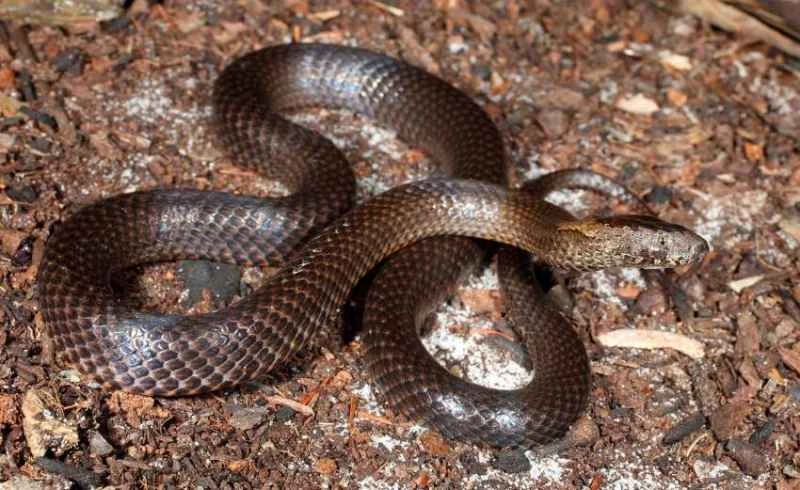
The body is slender, mostly dark brown or grayish-brown, with a lighter, creamy-yellow or pale orange underside. Distinct golden-yellow or pale-yellow crown markings on the head and behind the eyes are important distinguishing features. The body is covered in small, smooth scales, which facilitate movement through fallen leaves and soil crevices.
Detailed introduction
The Golden-crowned Snake (scientific name * Cacophis squamulosus *) is a small, elusive venomous snake belonging to the genus *Cacophis* in the family Elapidae. It is primarily found in forests, scrublands, and urban green spaces along the eastern coast and near the interior of Australia, and is a nocturnal, small reptile predator. It gets its name from the distinctive golden or pale yellow crest markings on its head and is one of the common but often overlooked native snakes of eastern Australia.
Classification and nomenclature
The Golden-crowned Snake belongs to the class Reptilia, order Squamata, suborder Serpentes, family Elapidae, and genus Cacophis . This genus contains several small Australian venomous snakes with light-colored "crowns" on their heads. The specific epithet * squamulosus* roughly relates to "covered with small scales," referring to the dense scales on its body surface. The English name *Golden-crowned Snake* directly describes the golden crown-like markings on its head, one of the important characteristics for identifying this species in the wild.
Appearance features
The golden-crowned snake is slender, with adults typically measuring 50–75 cm in length, much smaller than many well-known large venomous snakes. Its body color is mostly dark brown, grayish-brown, or olive-toned, with a lighter underside that may be creamy yellow or pale orange. Its most distinctive feature is the pale yellow or golden crown-like markings extending from the snout to the back of the head, forming a distinct light-colored arc behind the eyes, contrasting sharply with the surrounding dark scales. The head is slightly flattened, with medium-sized eyes and round pupils. The body is covered in small, glossy scales that feel smooth to the touch, facilitating movement through leaf litter and soil crevices.
Distribution range and habitat
The golden crown snake is mainly distributed in eastern Australia, from southeastern Queensland through the coastal and near-inland areas of New South Wales to parts of the south. Typical habitats include damp or semi-damp eucalyptus forests, rainforest edges, scrubland, river valley forests, and woodlands with abundant leaf litter, fallen logs, and rocks. In cities and suburbs, they can also inhabit parks, greenbelts, and backyards, provided there are sufficient trees, gardens, scrub, and piles of rocks. They mostly hide under rocks, decaying wood, or dense leaf litter during the day and are active at night.
Lifestyle Habits and Behaviors
The golden-crowned snake is a typical nocturnal, covert snake. During the day, it mostly hides in ground crevices, layers of dead leaves and branches, under rocks, or under tree roots to prevent moisture loss and avoid predators. It only begins to forage and roam when the temperature is suitable from dusk to night. While not particularly fast, it is very agile in moving among fallen leaves and bushes. When threatened, the golden-crowned snake often first coils its body, raises its forelimbs, and adopts a defensive posture. It may also hiss or make a show of attack to scare away potential threats; if it still cannot escape, it may bite in defense.
feeding habits
The golden-crowned snake primarily feeds on small reptiles and their eggs, making it an important small predator in forest floor ecosystems. They particularly favor lizards such as skinks and their eggs, but also consume small frogs, frog eggs, some snake larvae, and various invertebrates that inhabit the ground. Utilizing their keen sense of smell and touch, they slowly roam through leaf litter, around rocks, and near fallen logs, swiftly snapping at suitable prey and subduing it with their venom. Their small size and slender body are ideal for entering narrow crevices to search for lizards and eggs hiding within.
Reproduction and life cycle
The golden crowned snake is an oviparous snake, with its breeding season typically occurring in the warmer months. The female lays several to a dozen eggs in secluded, moderately humid locations (such as piles of dead leaves, among tree roots, or under rocks), the exact number depending on the female's size and nutritional status. Incubation depends entirely on ambient temperature and humidity. At the end of the incubation period, the young snakes hatch on their own, small but already capable of hunting small prey. Early mortality is high for juveniles, primarily due to predation, extreme environmental changes, or food scarcity. Surviving individuals reach sexual maturity after several years of growth.
Relationship with humans
The golden-crowned snake is a mildly venomous snake, effective against small prey, but generally poses little threat to healthy adults. A bite may cause localized pain, swelling, and numbness, but severe poisoning is relatively rare. However, any snakebite should not be taken lightly. If a bite is suspected, keep the affected area calm, immobilize the injured limb, and seek immediate medical attention for evaluation. In Australia, golden-crowned snakes are sometimes found near residential gardens or yards, but are generally timid and prefer to avoid humans.
Protecting the status quo and threats
Currently, the golden crown snake is generally assessed as "Least Concern" on the IUCN Red List, and its overall population remains stable within its range. Nevertheless, local populations may still be pressured by deforestation, habitat fragmentation due to urban expansion, road traffic fatalities, and invasive predators such as domestic cats. Maintaining leaf litter, decaying wood, and shrub structures in urban green spaces, reducing indiscriminate snake catching and poisoning, and enhancing public awareness of the ecological value and safety of native snakes will contribute to the long-term survival of the golden crown snake and other small snakes in urban and rural landscapes.
References
Cogger, HG, 1992. *Australian Reptiles and Amphibians*. Reed Books.
Glasby, CJ, Ross, GJB, and Beesley, PL (eds.) 1993. Fauna Australia. Volume 2A: Amphibians and Reptiles. AGPS Publishing, Canberra.
Griffiths, K. 1997. Frogs and Reptiles in the Sydney Area. University of New South Wales Press, Sydney.
Swan, G. 1990. *A Field Guide to Snakes and Lizards in New South Wales*. Three Sister Productions, Winnie the Pooh.
Frequently Asked Questions
Q1: How venomous is the golden crown snake? Is it dangerous to humans?
The golden-crowned snake is a mildly venomous snake, with strong venom against small prey such as lizards and frogs, but the risk of poisoning for healthy adults is relatively low. Symptoms after a bite typically include localized swelling, pain, and numbness; severe systemic reactions are rare. However, any snake bite should not be ignored, and medical attention should be sought as soon as possible.
Q2: What should I do if I encounter a golden crown snake in the garden?
Golden crowned snakes are generally timid and will often quickly hide when they encounter people. It is recommended to remain calm, keep a safe distance from the snake, and do not attempt to capture or drive it away; give it an escape route. If necessary, contact local wildlife rescue or professional snake catchers for assistance in relocation.
Q3: What do golden crown snakes mainly eat? What role do they play in the environment?
The golden crown snake primarily preys on small lizards, frogs, and their eggs, and also consumes some other small animals. It is one of the important small predators in forest floor and garden ecosystems, helping to regulate the populations of small reptiles and amphibians and maintain ecological balance.
Q4: What impact will urbanization have on the golden crown snake?
Urban expansion and road construction reduce continuous woodlands and shrublands, fragmenting habitats and increasing the risk of snakes being run over by vehicles. Meanwhile, the frequent activity of invasive predators such as domestic cats in residential areas also puts pressure on small snakes. Preserving some greenery, leaf litter, and decaying wood structures, and reducing indiscriminate snake hunting, will help the golden crown snake survive sustainably in urban environments.


