Basic Information
Scientific classification
- Chinese name: Jiqi Skink
- Scientific name: Egernia stokesii
- Classification: Squamata
- Family and genus: Skinkaceae, Scinculata
Vital signs data
- Body length: Adults typically have a snout-vent length of about 16–22 cm, and the total length including the tail can reach 25–40 cm, making them a robust and relatively medium-sized skink.
- Weight: Weight depends on the size of the individual and nutritional status, with most adults weighing between tens of grams and over one hundred grams.
- Lifespan: The Jiqi skink is a long-lived lizard that can survive for many years in the wild, and may live for more than 10 years under conditions of minimal disturbance and suitable environment.
Significant features
The typical "spiky-tailed skink" is robust in build, with a short, spiny tail. It lives in family groups and exhibits social behavior that is relatively rare among lizards. It is one of the most representative native lizards in the arid and semi-arid regions of Australia.
Distribution and Habitat
In the arid and semi-arid regions of central and western Australia, rock piles, rock slopes, and gitchie bush areas often use large rocks, stone walls, piles of dead wood, and surface fissures as concealed nests. They can also be found in relatively complex microhabitats on the edges of pastures and farms.
Appearance
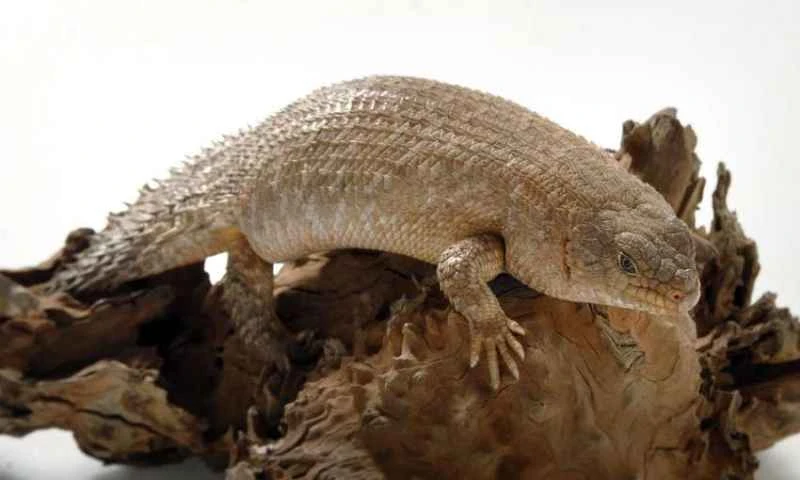
The body is short and stocky with a slightly flattened shape, and the limbs are short and powerful. The back and tail are covered with rough, ridged scales, and the tail is short, thick, cylindrical, and covered with spiky scales. The body color is mostly grayish-brown, olive-brown, or yellowish-brown, often with alternating light and dark markings, which helps it to camouflage itself among rocks and bushes; the underside is lighter in color, being pale yellow or cream.
Detailed introduction
The Gidgee Skink (also commonly known as the Stokes Skink, scientific name * Egernia stokesii *) is a robust, sturdy skink belonging to the family Skinidae and the genus *Egernia*. It primarily inhabits rocky outcrops and gidgee bushland in the arid and semi-arid regions of central and western Australia, making it a representative example of a social lizard in the Australian outback desert and scrub ecosystems. Unlike many solitary lizards, the Gidgee Skink lives in family groups and exhibits highly developed social behavior, making it quite unique among reptiles.
Classification and nomenclature
The Gidgee Skink belongs to the class Reptilia, order Squamata, family Scincidae, and genus Egernia . Many species in this genus have robust bodies, relatively short limbs, and tails covered in spines or rough scales, adapted for movement in rock crevices and rough surfaces. The scientific name * Egernia stokesii * commemorates the 19th-century British explorer and naturalist Stokes. The common English name *Gidgee Skink* derives from its habitat among *gidgee* shrubs (often referring to several species of *Acacia* in the genus *Mimosa*); another name, *Stokes's Skink*, directly inherits the specific epithet.
Appearance features
The Jiqi skink is robust and sturdy, with a slightly flattened torso and well-developed limbs that are relatively short compared to its body length, giving it an overall "short, stocky, and armored" appearance. Its back and tail are covered in rough, ridged scales, with the tail being particularly short, thick, and cylindrical, covered in sharp spines—a key characteristic of the species, used to block rock crevices or confuse predators when attacked. Its body color is mostly grayish-brown, olive-brown, or yellowish-brown, often with spots or bands of varying shades, aiding in camouflage among rocks and dead branches. The underside is lighter in color, generally pale yellow or cream. The head is broad and blunt, the snout is relatively short, and the eyes are medium-sized, contributing to its overall impression of being robust, durable, and adapted to harsh environments.
Distribution range and habitat
The Gitch skink is endemic to Australia, primarily distributed in arid and semi-arid regions of Western Australia, South Australia, and parts of central Australia. They prefer rock outcrops, piles of rocks, rocky slopes, and open scrub habitats scattered with Gitch wood and other drought-resistant shrubs. They can also be found on farm edges and in lightly disturbed pasture areas. Typical habitat microenvironments include large rock piles, stone walls, piles of deadwood, and crevices in the terrain. Members of the lizard family share these crevices as "nests," seeking refuge from high temperatures, predators, and sandstorms.
Lifestyle Habits and Behaviors
The Jichi skink is a diurnal lizard, most active during the day when sunlight is plentiful and temperatures are suitable. They often bask in the sun on rocks, near piles of stones, or at the roots of shrubs to warm up, then venture out short distances to forage before quickly returning to the safety of crevices. A key characteristic is their social nature: multiple individuals form stable family groups, including parents and offspring of different ages, sharing a set of rock crevices or burrows and defending their "territory" within a certain area. Studies have shown that there is long-term spatial overlap and a certain degree of kinship among members of these groups, making it a relatively typical example of a "family social structure" among reptiles. When threatened, individuals quickly rush back to the rock crevices, using their spiny tails to block the entrance and prevent predators from entering.
feeding habits
The Jichi skink is an omnivorous lizard with a highly flexible diet. They prey on insects and other small invertebrates, such as beetles, ants, spiders, crickets, and moth larvae, and also consume a certain proportion of plant matter, including the leaves, buds, flowers, fallen fruits, and seeds of succulent plants. In arid environments, water from plant tissues is particularly important to them. They primarily use their vision to locate moving prey on the ground or rocks, and once spotted, they sprint to capture it. They also search for edible plants and fallen seeds under bushes.
Reproduction and life cycle
Unlike many egg-laying lizards, the Jichi skink is viviparous (or ovoviviparous), meaning the female completes embryonic development internally before giving birth to live offspring. The breeding season is typically correlated with local temperature and rainfall patterns, concentrating more during the warmer months. Litters are relatively small, generally ranging from a few to a dozen or so, but the offspring are relatively large and capable of movement immediately after birth. The young usually remain within their parents' range for a considerable period, participating in family life, which is considered an important part of their social development. The Jichi skink grows at a moderate rate, taking several years to reach full sexual maturity, and can survive for many years, even exceeding ten years, in the wild.
Relationship with humans
The Gitch skink is non-venomous and does not actively attack humans, usually fleeing quickly into rock crevices or piles of deadwood when encountered. By preying on insects and other invertebrates, they play a role in controlling the populations of certain arthropods in arid and semi-arid regions. In some areas, the Gitch skink is also used for ecological education and nature observation, showcasing the reptile diversity and social behavior unique to the Australian outback environment. For ranchers and residents, as long as rock piles and shrub habitats are not excessively damaged, the Gitch skink has virtually no negative impact on human activities.
Protecting the status quo and threats
In overall assessments, the Gitchie skink is generally classified as "Least Concern" or regionally as a species of low threat. However, the status of different subspecies and local populations is not entirely the same, and some areas with severe habitat fragmentation may show a declining trend. Major threats include habitat destruction or fragmentation due to mining, agricultural expansion, and infrastructure construction; the removal or overturning of rock piles, depriving it of important "nests"; predation pressure from invasive predators such as domestic cats and foxes; and increased frequency and intensity of extreme droughts due to climate change. Effective measures to protect the Gitchie skink include: preserving rock outcrops and shrub structures in land-use planning; establishing protective buffer zones around pastures and mining areas; controlling invasive predator populations; and conducting public education to raise awareness that these "spiky-tailed skinks" are a unique and important part of the Australian outback ecosystem.
References
Cogger, HG 2000. *Australian Reptiles and Amphibians*. Reed New Holland Press, Sydney.
Ehmann, H. 1992. *The Australian Animal Encyclopedia: Reptiles*. Angus & Robertson, Pymbul.
Fyfe, G. Skink, family Skingidae. Cited in Swan, M. (ed.) 2008. *Australian Lizards: Keeping and Breeding*. Mike Swan Herp Books, Liliddale.
Greer, AE 1990. *The Biology and Evolution of Australian Lizards*. Surrey Beatty & Sons.
Greer, AE 2006. *Encyclopedia of Reptiles in Australia—Skincidae*. Australian Museum.
Frequently Asked Questions
Q1: Why is the tail of the Jiqi skink so thick, short, and spiny?
The tail of the Jiqi skink is covered with rough, spiny scales. When attacked, it quickly retreats into a rock crevice and blocks the entrance with its tail, increasing its protection and confusing predators, making it difficult for them to grab its vital parts. This "armored tail" is an adaptation to its rocky environment.
Q2: Is the Jiqi skink really a "social lizard"?
Yes. Unlike many solitary lizards, the Jichi skink often lives in family groups, with adults and juveniles of multiple ages visible in the same rock crevices or piles. Studies show that members of these groups are often related, exhibiting social characteristics of sharing nests and activity ranges over a long period.
Q3: Are the Jiqi skinks poisonous? Will they attack people on their own?
The Jichi skink does not have venom glands and is not considered a venomous lizard. When encountering humans in the wild, it usually flees quickly back to rock crevices rather than attacking. It may bite as a defensive measure only when caught or cornered, and generally will not cause serious harm to humans.
Q4: How to protect the habitat of the Jiqi skink in pastures or desert edges?
The practice of completely clearing rock piles can be reduced by preserving or piling up a certain amount of rocks and deadwood; buffer zones should be created for rock outcrops and shrubs during road construction, mining, and infrastructure development; the populations of invasive predators such as domestic cats and foxes should be controlled; and public education should be conducted in local communities to remind people that the Jiqi skink is a harmless and ecologically valuable native species.