Basic Information
Scientific classification
- Chinese name: green sea turtle
- Scientific name: Chelonia mydas
- Classification: Testudines
- Family and genus: Cheloniidae, Seychellois
Vital signs data
- Body length: Adults typically have a carapace length of about 80–120 cm, with larger individuals exceeding 1.2 meters, making them one of the larger sea turtles.
- Weight: Weight varies greatly depending on the individual and region. Most adult green sea turtles weigh about 70–200 kg, while very large individuals can exceed 200 kg.
- Lifespan: Green sea turtles are long-lived species, estimated to live for 50 years or even longer in the wild, and sexual maturity often takes 20–30 years.
Significant features
These large, seagrass-fed turtles are key species in tropical and subtropical shallow seagrass beds and coral reef ecosystems, exhibiting significant migratory and homing behaviors.
Distribution and Habitat
Widely distributed in nearshore shallow seas, coral reefs, seagrass beds, lagoons and lacustrines in tropical and subtropical waters worldwide, juvenile turtles live in the open ocean floating zone in their early years, while adults mostly forage in nearshore seagrass beds and algae-rich areas, and periodically migrate to specific beaches to lay eggs.
Appearance
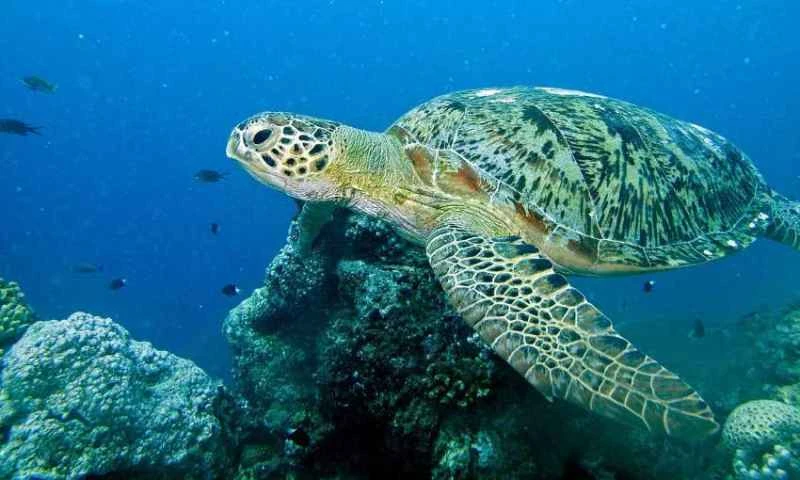
The carapace is oval and relatively smooth, mostly olive brown, yellowish-brown, or brownish-green with marbled patches; the plastron is pale yellow or cream-colored. The head is relatively small, the beak is hard but not sharp, and the forelimbs are powerful paddle-shaped flippers, suitable for long-distance swimming in the sea. The overall shape is clearly streamlined.
Detailed introduction
The green sea turtle (scientific name *Chelonia mydas* ) is one of the largest and most widely distributed sea turtles in the world, belonging to the genus *Chelonia* in the family Cheloniidae. It inhabits shallow seas, coral reefs, and seagrass beds in tropical and subtropical waters, and is a highly representative herbivorous large sea turtle in nearshore ecosystems. Despite its name containing "green," its carapace color is not necessarily bright green; rather, it gets its name from the slightly greenish hue of its internal fat. Due to long-term overfishing, habitat destruction, and human disturbance, the green sea turtle faces severe survival pressure in many seas around the world and is listed as a threatened species.
Classification and nomenclature
Green sea turtles belong to the class Reptilia, order Testudines, family Cheloniidae, and genus Chelonia . In their scientific name, *Chelonia mydas *, "Chelonia" refers to the sea turtle, and "mydas" is related to "wetlands" and "water," reflecting their marine lifestyle. The common English names "Green Turtle" or "Green Sea Turtle" primarily derive from the pale green color of their blubber, rather than the fact that their carapace is always green. Green sea turtles are one of the most representative species in the genus *Chelonia* and are frequently used as "flagship species" in marine conservation and endangered animal advocacy.
Appearance features
Green sea turtles are large and slightly oval-shaped, with a relatively smooth carapace that is slightly rounded at the front and lacks obvious serrations at the rear. Adults typically have an olive-brown, yellowish-brown, or brownish-green carapace with varying shades of marbled patterns or patches; the plastron (ventral deck) is pale yellow or cream-colored. Their heads are relatively small, with a hard beak that is not as pointed as that of hawksbill turtles, suitable for feeding on seaweed and algae. Their forelimbs have evolved into powerful paddle-like flippers, adapted for high-speed swimming in seawater; their hind limbs are shorter, used for turning and assisting in crawling. Adults have large eyes, adapted for observing their environment underwater. Like most sea turtles, green sea turtles cannot fully retract their heads and limbs into their shells.
Distribution range and habitat
Green sea turtles are widely distributed in tropical and subtropical waters worldwide, including coastal and island waters of the Atlantic, Indian, and Pacific Oceans. They typically use shallow nearshore waters, coral reefs, lagoons, and seagrass beds as feeding grounds, while laying their eggs on beaches or island shores far from the mainland. Hatchlings spend their early life in open ocean drift zones and outlying areas, gradually returning to shallow nearshore waters to feed as they grow. Green sea turtles exhibit a high degree of migratory and homing behavior; adult females often travel hundreds or even thousands of kilometers back to their birthplace to reproduce and lay their eggs.
Lifestyle Habits and Behaviors
Green sea turtles spend most of their time in the ocean, moving by swimming and floating. Unlike many other sea turtles, adult green sea turtles are primarily herbivorous, preferring to forage in shallow waters rich in seagrass beds and algae. They can stay underwater for anywhere from a few minutes to tens of minutes, resting quietly on the seabed or among reefs. Green sea turtles have a strong migratory instinct, and adults regularly migrate between their feeding and breeding grounds. They are more commonly seen coming ashore to lay eggs or moving slowly near the shore at night. Outside of the breeding season, green sea turtles are generally docile and will not actively attack humans.
feeding habits
The diet of green sea turtles changes with age. Juveniles and subadults are omnivorous, feeding on zooplankton, small crustaceans, mollusks, and jellyfish. Adult green sea turtles become more herbivorous, primarily consuming various seagrasses (such as seaweed and sea calamus) and large algae. By continuously biting off and swallowing seagrass leaves, they not only maintain their own nutrition but also, to some extent, "prune" the seagrass bed, promoting new leaf growth, thus having a significant impact on the structure and productivity of the seagrass ecosystem. Appropriate consumption of jellyfish and other mollusks may also help control localized outbreaks of these organisms.
Reproduction and life cycle
Green sea turtles are oviparous, and their breeding activities exhibit a distinct seasonality and periodicity. During the breeding season, adult females migrate long distances from their feeding grounds to specific breeding beaches. Most individuals possess a "biological compass" and memory, enabling them to return to the beach where they hatched or nearby areas. At night, the female crawls on the beach above the high tide line, digs a nest with her hind legs, and lays dozens of white, nearly spherical eggs. Multiple clutches can be laid each breeding season, spaced several weeks apart. After laying the eggs, the female buries the nest in sand and returns to the sea; the hatching of the eggs depends entirely on the temperature and humidity of the sand. The incubation period typically lasts 6–8 weeks. Once hatched, the young turtles collectively rush towards the sea at night, beginning their perilous "journey to the sea." During this stage, many hatchlings are preyed upon by seabirds, crabs, and fish; only a very small number survive to adulthood.
Relationship with humans
The relationship between green sea turtles and humans is complex and close. Historically, green sea turtles were heavily hunted and traded for their meat, eggs, and oil, which was used to make grease and traditional foods. Their shells were sometimes used as decorative materials. With the popularization of modern marine conservation concepts, many countries have banned or strictly restricted the hunting and trade of green sea turtles and listed them as protected species. Green sea turtles are loved by diving and ecotourism enthusiasts and have become a "star species" of marine ecotourism in many island nations. At the same time, human activities also pose direct and indirect threats to green sea turtles, such as beach development affecting spawning, entanglement in fishing gear, ingestion of plastic waste, ship collisions, and sea-level rise and beach temperature changes caused by climate change.
Protecting the status quo and threats
The green sea turtle is classified as "Endangered" on the IUCN Red List. While populations in some areas have shown signs of recovery, the species still faces multiple pressures. Major threats include: historical and current overfishing and poaching; occupation or damage to spawning beaches by tourism facilities and coastal engineering projects; artificial light sources interfering with the migration of hatchlings; bycatch and entanglement in fishing nets and longline gear; ingestion of marine plastic debris (especially plastic bags) mistaken for jellyfish; and climate change leading to warming seawater and altered beach temperatures, which can affect the sex ratio of hatchlings and hatching success rates. Key measures for protecting green sea turtles include: establishing and effectively managing turtle sanctuaries and spawning beaches; promoting turtle-friendly fishing techniques; reducing marine plastic pollution; controlling coastal light pollution; and strengthening international cooperation and public education.
Frequently Asked Questions
Q1: Why is it called the "green sea turtle"? Is its shell green?
The name "green sea turtle" comes primarily from the slightly greenish tinge of its body fat, rather than the fact that its carapace is always bright green. Adults typically have olive-brown, yellowish-brown, or brownish-green carapaces with marble-like markings. Dissection reveals that its fatty tissue is pale green, hence the name.
Q2: Are green sea turtles dangerous to humans? Can they bite?
Green sea turtles are not aggressive animals and generally do not attack humans unprovoked. They may bite with their beaks when severely frightened or improperly handled, but this is mostly a defensive behavior. Maintaining a proper distance and avoiding riding or handling them is the best way to respect wildlife and reduce conflict.
Q3: What can ordinary tourists do to protect green sea turtles?
Tourists can reduce disturbance to sea turtles and their habitats by choosing responsible ecotourism programs, adhering to beach and sea turtle sanctuary regulations, avoiding the use of bright lights on turtle beaches at night during the nesting season, and refraining from littering with plastic waste and fishing lines. They can also support relevant conservation organizations and research projects to help improve sea turtle conservation.
Q4: Why does marine plastic waste have a serious impact on green sea turtles?
Floating plastic bags and other plastic debris are easily mistaken for jellyfish or seaweed by green sea turtles, leading to ingestion and problems such as intestinal blockage, a false sense of fullness, and poisoning, which can be fatal in severe cases. Furthermore, discarded fishing nets and nylon ropes, often referred to as "ghost fishing gear," can become entangled in the turtles' limbs and necks, hindering their swimming and breathing. Therefore, reducing marine plastic pollution is crucial for the conservation of green sea turtles.