Basic Information
Scientific classification
- Chinese name: Hawksbill turtle
- Scientific name: Eretmochelys imbricata
- Classification: Testudines
- Family and genus: Cheloniidae, genus *Hawthorn*
Vital signs data
- Body length: Adult carapace length is usually about 70–90 cm, with some large individuals approaching or slightly exceeding 1 meter.
- Weight: Most adult hawksbill turtles weigh about 40–70 kg, with a few large individuals exceeding 70 kg.
- Lifespan: Hawksbill turtles are long-lived sea turtles, estimated to live for decades in the wild, and often take more than 20 years to reach sexual maturity.
Significant features
With its overlapping tile-like carapace and eagle-like beak, the typical tropical sea turtle is an important large "cleaner" in coral reefs, feeding mainly on sponges. However, it has long been severely hunted due to the hawksbill turtle shell trade.
Distribution and Habitat
Widely distributed in complex nearshore waters such as tropical coral reefs, clear shallow rocky reefs, coral reef lagoons, and mangrove edges worldwide, juvenile turtles mostly live in the open ocean floating zone, while adults settle in nearshore environments such as coral reefs and lay their eggs on tropical and subtropical beaches.
Appearance
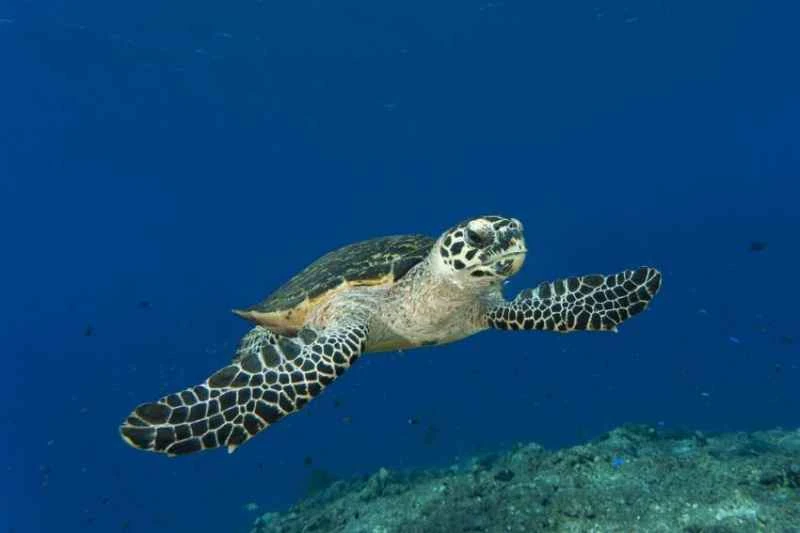
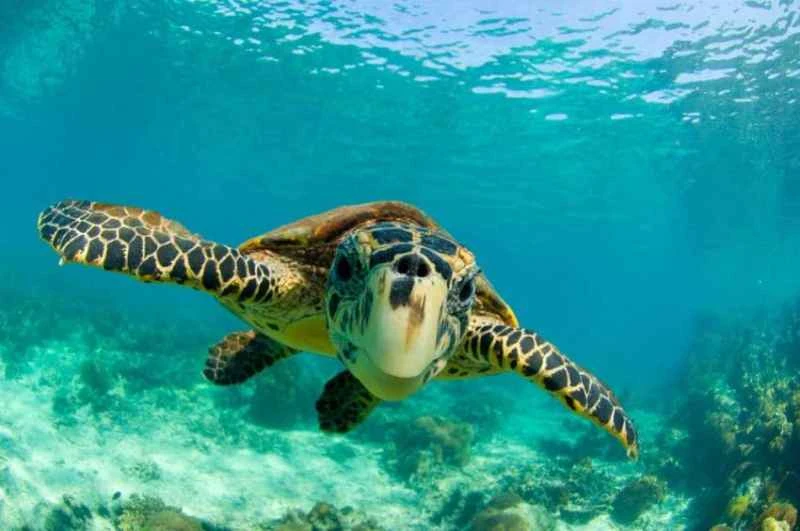
The carapace is medium-sized, oval to slightly heart-shaped, with distinctly serrated posterior margins, covered by layers of overlapping horny plates forming a tile-like structure. The carapace is typically a mottled pattern of golden yellow, amber, brown, and black, with a translucent sheen under light; the plastron is lighter, mostly pale yellow or cream-colored. The head is long and narrow, with an extended upper beak that hooks downwards; the forelimbs have long, powerful flippers, often with one or two pairs of claws.
Detailed introduction
The hawksbill sea turtle ( Eretmochelys imbricata ) is a medium-sized, highly recognizable sea turtle belonging to the genus Eretmochelys in the family Cheloniidae. It is known for its sharp, protruding, eagle-beak-like beak and the layers of overlapping horny plates on its carapace. It is an important sponge feeder and structural maintainer in tropical coral reef ecosystems. Due to centuries of overhunting for its shell, coupled with habitat degradation and human disturbance, the hawksbill sea turtle has suffered severe decline globally and is listed as a critically endangered species.
Classification and nomenclature
Hawksbill turtles belong to the class Reptilia, order Testudines, family Cheloniidae, and genus Eretmochelys . The scientific name *Eretmochelys imbricata * means "overlapping" or "tile-like," vividly describing the overlapping, tile-like structure of its carapace. The common English name, Hawksbill Sea Turtle, comes from its long, narrow, forward-curving upper beak, which closely resembles the beak of a bird of prey. Due to its unique patterns and the texture of its shell, hawksbill turtles have historically been used as ornaments and craft materials.
Appearance features
Hawksbill turtles are medium-sized, slightly smaller and more slender than green sea turtles. Adults have an oval to slightly heart-shaped carapace with distinct serrated edges, giving it a sharper overall profile than green sea turtles. The overlapping horny plates on the carapace resemble layers of roof tiles, a key distinguishing feature from other sea turtles. The carapace is typically a mottled pattern of golden yellow, amber, brown, and black, appearing translucent amber under light. The plastron is lighter, mostly pale yellow or cream-colored. The head is long and narrow, with a sharply curved upper beak, advantageous for reaching into coral crevices to catch prey. The forelimbs are long, powerful paddle-shaped flippers, often with one or two pairs of prominent horny claws visible at the leading edge.
Distribution range and habitat
Hawksbill turtles are widely distributed in tropical waters worldwide, including coral reefs, rocky reefs, and the waters surrounding tropical islands in the Atlantic, Indian, and Pacific Oceans. They prefer clear, structurally complex shallow coral reefs, rocky coasts, mangrove edges, and coral lagoons, often foraging and resting on reef slopes and edges. During breeding season, adult females will come ashore to lay their eggs on sandy beaches in tropical or subtropical regions, typically choosing relatively quiet shores with less light pollution. Hatchlings spend their early life in open ocean driftlands and open waters before gradually returning to nearshore reef areas to forage.
Lifestyle Habits and Behaviors
Hawksbill turtles spend most of their lives in the sea, only coming ashore at night to nest and lay eggs during the breeding season. They are strong swimmers, but their range is more concentrated in coral reef areas compared to some pelagic sea turtles. During the day, they are often observed leisurely swimming among coral reefs or briefly resting in reef caves and crevices, occasionally diving down to forage. Hawksbill turtles exhibit migratory and homing behaviors, regularly traveling between their foraging and breeding grounds. Individuals usually do not form groups, but multiple hawksbill turtles may be seen feeding together near prime foraging areas.
feeding habits
Hawksbill turtles have a unique diet, primarily feeding on sponges, making them one of the few large vertebrates in coral reefs that can consume large quantities of sponges. They use their eagle-like beaks to peck at various sponges attached to coral crevices and can tolerate certain toxins or stinging cells within the sponges. Besides sponges, hawksbill turtles also consume sea anemones, soft corals, algae, small crustaceans, and mollusks. By continuously consuming sponges, hawksbill turtles help prevent excessive sponge coverage and competition for coral space, thus indirectly maintaining the diversity of coral reef structures and light conditions.
Reproduction and life cycle
Hawksbill turtles are oviparous sea turtles, and their breeding season varies by region, but is generally concentrated in the warmer months. Adult females migrate from their feeding grounds on coral reefs to specific breeding beaches, usually coming ashore at night. They crawl to relatively safe sandy areas above high tide, dig bottle-shaped nests with their hind legs, and lay dozens of white, nearly spherical eggs in each nest. Multiple nests can be laid during a breeding season, with intervals of several weeks between nests. After laying eggs, the female buries the nest in sand and returns to the sea. Incubation typically takes 6–8 weeks, depending entirely on the temperature and humidity of the sand. Hatchlings usually emerge from the sand collectively at night and quickly crawl towards the sea, where they are highly vulnerable to predation by seabirds, crabs, and fish. Survivors spend their early life in the open ocean drift before returning to the coral reef system to continue growing until they reach sexual maturity decades later.
Relationship with humans
The relationship between hawksbill turtles and humans is fraught with contradictions. On the one hand, their beautiful shells have long been used to make combs, eyeglass frames, jewelry, and various fine handicrafts, and are considered a precious material in many cultures. On the other hand, this high economic value has directly led to the long-term overhunting of hawksbill turtles. While other sea turtles, such as green sea turtles, are also hunted for their meat and eggs, hawksbill turtles stand out in the "craft materials" trade. Modern international conventions (such as CITES) have banned the international trade of hawksbill turtles and their products, and many countries have listed them as strictly protected animals. Hawksbill turtles are often a stunning sight during diving and snorkeling tours, but improper contact, chasing, and touching can still cause stress to individuals.
Protecting the status quo and threats
The hawksbill turtle is classified as "Critically Endangered" (CR) on the IUCN Red List, with most global populations experiencing severe declines in the 20th century. Major threats include: illegal hunting and the smuggling trade of hawksbill turtle shells; the reduction and degradation of important spawning beaches due to coastal development and beach engineering; artificial light sources interfering with adult turtles coming ashore and juvenile turtles entering the sea; bycatch and entanglement from fishing nets and longlines; the impact of marine plastic debris and other pollutants; and climate change causing seawater warming, changes in storm frequency, and alterations in beach temperature. Current conservation measures include establishing turtle sanctuaries and no-fishing zones, strictly enforcing the law against illegal trade, promoting turtle-friendly fishing tools and methods, restoring and protecting spawning beaches, reducing coastal light pollution, and increasing public education support for hawksbill turtle and turtle conservation.
Frequently Asked Questions
Q1: What are the main differences between hawksbill turtles and green sea turtles?
In terms of appearance, the hawksbill turtle's carapace has layers of overlapping keratinous plates with a serrated posterior edge and a mottled amber color; the green sea turtle's carapace is relatively smooth. The hawksbill turtle's upper beak is long and sharp, resembling an eagle's beak, suitable for nibbling on sponges; the green sea turtle's beak is blunter, and it mainly feeds on seaweed. Ecologically, hawksbill turtles rely more on coral reefs and primarily feed on sponges, while adult green sea turtles mainly feed on seaweed.
Q2: Why does the "hawksbill turtle shell" trade have such a serious impact on hawksbill turtles?
Hawksbill turtle shells are hard, translucent, and beautifully patterned, and have long been used to make expensive handicrafts such as combs, eyeglass frames, and jewelry. To obtain the shell scales, adults must be hunted, which is devastating to a species that already has a slow reproductive rate. Even though international trade is currently prohibited, illegal hunting and smuggling still occur in some areas, threatening the remaining population.
Q3: Can hawksbill turtles be kept as pets?
No. Hawksbill turtles are marine wild animals protected by international conventions, and illegal capture and keeping are illegal in most countries. Furthermore, they require vast ocean areas, complex coral reef environments, and long-distance migrations, which are difficult to meet in captivity to meet their behavioral and health needs.
Q4: How can ordinary people participate in the protection of hawksbill turtles?
You can start by refusing to buy any "hawksbill turtle shells" or "turtle products"; choose responsible diving and turtle watching programs when traveling, and abide by the viewing guidelines of not touching or chasing turtles; reduce the use of single-use plastics and participate in beach and coastline cleanup activities; share turtle conservation knowledge on social media, support reputable conservation organizations and research projects, and garner more attention and resources for hawksbill turtles and other turtles.