Basic Information
Scientific classification
- Chinese name: Creeper tortoise
- Scientific name: Emydura krefftii
- Classification: Testudines
- Family and genus: *Tyrannosaurus* (Japanese turtle)
Vital signs data
- Body length: Adult carapace length is generally about 20–30 cm, with some large individuals slightly exceeding 30 cm, classifying them as medium-sized freshwater turtles.
- Weight: Weight varies depending on individual size and nutritional status, with most adults weighing several kilograms.
- Lifespan: It is estimated that under natural conditions, it can survive for decades, and sexual maturity usually takes several years.
Significant features
The medium-sized freshwater short-necked side-necked turtle, endemic to northeastern Australia, is adapted to river and reservoir environments, has a relatively mild temperament, and is of important indicative and ecological significance to the local freshwater ecosystem.
Distribution and Habitat
They are mainly distributed in rivers, streams, reservoirs and floodplain wetlands in northeastern Queensland, Australia. They prefer freshwater environments with slow-moving water, muddy or gravelly bottoms, and fallen trees and aquatic plants. They often sunbathe on fallen trees and riverbanks.
Appearance
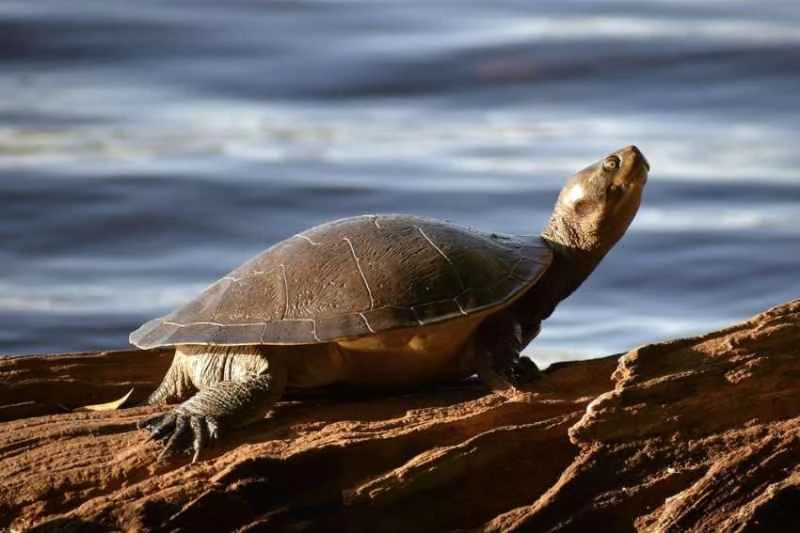
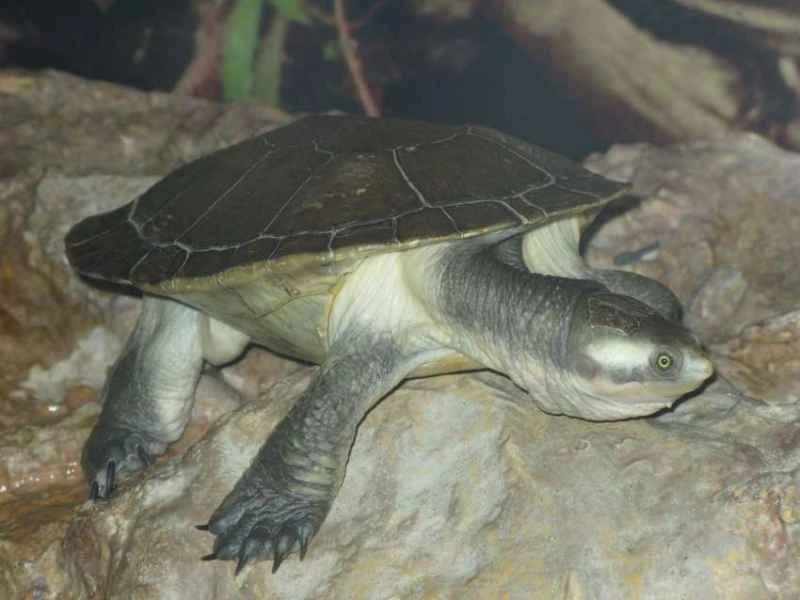
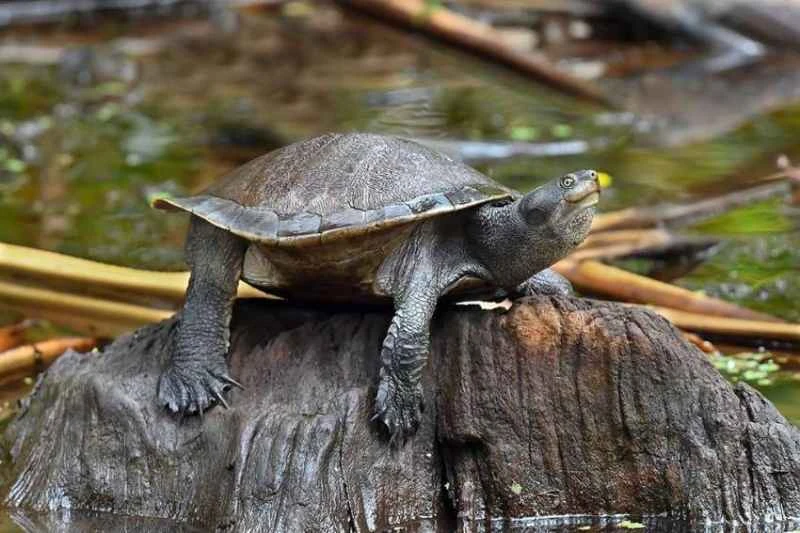
The carapace is slightly oval, mostly olive brown or grayish-brown in color, while the plastron is pale yellow or cream-colored, sometimes with dark spots. The head is broad and slightly flattened, with light-colored stripes or patches on the sides of the face. The neck is of medium length but still retains the "side neck" feature of the snake-necked turtle. The limbs are strong, with well-developed webbing between the toes, which facilitates swimming in the water.
Detailed introduction
The Krefft's Turtle (commonly known as the Krefft freshwater turtle or Krefft river turtle, scientific name *Emydura krefftii *) is a medium-sized freshwater side-necked turtle belonging to the genus *Emydura* in the family Cheloniidae. Native to rivers and reservoirs in northeastern Australia, it is one of the most common native freshwater turtles found in local streams, floodplain wetlands, and artificial water bodies. Unlike the long-necked snake-necked turtle, the Krefft's Turtle has a relatively short neck, but still retains the typical "side-neck" characteristic—when startled, it retracts its head to one side of its shell rather than vertically.
Classification and nomenclature
The Krefft turtle belongs to the class Reptilia, order Testudines, family Chelidae, and genus Emydura . Species in the genus Emydura are mostly short-necked or medium-necked freshwater turtles, widely distributed in Australia and New Guinea. The scientific name *Emydura krefftii * and the common name *Krefft's Turtle* are both named in honor of Gerard Krefft, a 19th-century German-Australian naturalist who made significant contributions to the study of reptiles and fishes in Australia. Some literature considers the Krefft turtle a regional subspecies of the Australian river turtle * Emydura macquarii *, but in practice, "Krefft turtle" is generally used as the broader term.
Appearance features
The Creeper tortoise is medium-sized with a slightly oval carapace that appears rounded from above, lacking prominent serrations along the posterior edge. The carapace is typically olive brown, grayish-brown, or dark brown, with some individuals showing a slight central ridge. The plastron (ventral plate) is generally pale yellow or cream-colored, sometimes with dark spots or irregular markings. The head is broad and slightly flattened, with a somewhat blunt snout. Light-colored stripes or patches are often present around the eyes and sides of the face; some individuals may have orange or reddish-brown markings on the sides of the neck and lower jaw. The neck is of medium length but significantly shorter than that of a typical "long-necked tortoise." The limbs are strong, with well-developed webbing between the toes, facilitating paddling in the water and crawling along riverbanks.
Distribution range and habitat
Creeper tortoises are primarily distributed in river systems in northeastern Queensland, Australia, and surrounding areas, including coastal rivers, tributaries, floodplain waterways, and some reservoirs and agricultural irrigation canals. They prefer habitats with relatively slow-moving water, muddy or gravelly bottoms, and abundant aquatic vegetation and fallen logs, such as river bends, shallows, still pools, and submerged root zones. During their daily activities, individuals can be seen swimming, resting underwater, or basking in the sun on fallen logs and riverbanks to regulate their body temperature.
Lifestyle Habits and Behaviors
Krefs turtles spend most of their time in freshwater and are typical aquatic turtles. They bask on driftwood, rocks, or riverbanks in the early morning or afternoon before returning to the water to forage. When startled, they quickly jump back into the water and dive to deeper depths or hide behind underwater obstacles. Like other snake-necked turtles, Krefs turtles fold their heads back to the side when defending themselves, partially concealing them on the front edge of their deck. They are generally docile and do not attack humans unless provoked, but may bite with their beak as a defense if caught or forcibly captured.
feeding habits
Krefs turtles are omnivorous freshwater turtles. Their diet includes various aquatic invertebrates (such as insect larvae, aquatic beetles, snails, crustaceans, etc.), small fish, amphibian larvae, and small amounts of aquatic plants, fruits, and seeds that have fallen into the water. They sometimes also peck at animal carcasses found in the water, acting as "cleaners." They mostly swim slowly or lie on the bottom, using their sight and smell to locate prey, and then capture their food by quickly extending their necks and biting.
Reproduction and life cycle
Krefs' turtles are oviparous freshwater turtles. Their breeding season is largely dependent on local climate and water level changes, typically occurring during the warmer months. The female leaves the water and searches for suitable sandy or loose soil along riverbanks or floodplains, digging a nest with her hind legs. The number of eggs laid per nest varies depending on the female's size, generally around ten. After laying the eggs, the female covers the nest with soil or sand and returns to the water. Incubation depends entirely on ambient temperature and humidity. Once hatched, the hatchlings emerge on their own and crawl towards the water. Early survival rates are significantly affected by predation, drought, and habitat disturbance. Krefs' turtles grow at a moderate rate, taking several years to reach sexual maturity, and can survive for many years or even decades in the wild.
Relationship with humans
In parts of Australia, Craigie turtles are common native freshwater turtles, familiar to local residents and anglers. They may occasionally ingest bait or fall into fishing nets, but usually do not significantly impact fishing activities. Due to their cute appearance and relatively docile temperament, some people have tried keeping native freshwater turtles as pets. However, in Australia, wild native reptiles are generally protected by law, and keeping and trading them must adhere to strict permits and regulations. For non-native countries, cross-border illegal trade and release pose a risk of invasive species, therefore, Craigie turtles are not recommended for international pet trade.
Protecting the status quo and threats
Currently, the Krefs tortoise is generally considered "Least Concern" or a relatively low threat species globally, but local populations may still be affected by habitat change and human activities. Major potential threats include: changes in flow velocity and water level due to river regulation, dam construction, and water intake projects; water pollution from agricultural and urban runoff; accidental catches and drownings from fishing gear; and predation of nests and hatchlings by invasive predators such as foxes, dogs, and cats. Key measures for protecting the Krefs tortoise and other freshwater turtles include: maintaining the natural meandering of rivers and floodplain structures; reducing water pollution; limiting heavy machinery and human trampling in key breeding areas; and raising public awareness of the ecological value and legal protection status of freshwater turtles.
References
Cann, J. 1998. *Australian Freshwater Turtles*. Beaumont Press, Singapore.
Cogger, HG 2000. *Australian Reptiles and Amphibians*. Reed New Holland Publishers, Sydney.
Ehmann, H. 1992. *The Australian Animal Encyclopedia: Reptiles*. Angus & Robertson, Pymbul.
Greer, AE 2006. *Encyclopedia of Reptiles of Australia: The Snake-necked Turtle Family*. Australian Museum.
Frequently Asked Questions
Q1: Is the Creeper turtle a sea turtle or a freshwater turtle?
Creeper turtles are typical freshwater turtles, spending almost their entire lives in rivers, streams, reservoirs, and freshwater wetlands. They are not sea turtles. They only briefly leave the water to dig nests on land when laying eggs.
Q2: What is the difference between the Krefs turtle and the "long-necked snake-necked turtle"?
The Crefter turtle has a relatively short neck and a more robust and rounded overall body shape, while the typical long-necked snake-necked turtle has a very long and slender neck, far exceeding the length of its carapace. Both belong to the snake-necked turtle family, but they differ in their physical proportions and hunting methods.
Q3: Are Creeper turtles suitable as family pets?
In Australia, native freshwater turtles are generally protected by law, and keeping or trading them requires a permit. In other countries, the cross-border introduction of native turtle species may pose risks of invasive species and disease transmission. Therefore, they are not recommended as ordinary family pets, but are more suitable for keeping and displaying in legal, professional aquariums or educational institutions.
Q4: How do human activities affect Craigie tortoises?
River channel improvements, dams, and water intake projects can alter water flow and levels, affecting their foraging and egg-laying; agricultural and urban wastewater can degrade water quality; fishing nets and hooks can cause entanglement and injury; and invasive predators can damage nests and prey on hatchlings. Improving water quality, protecting riparian vegetation, reducing plastic and fishing gear waste, and restricting heavy machinery access during critical breeding seasons can all help protect the Kreft tortoise population.