Basic Information
Scientific classification
- Chinese name: Red-breasted Bee-eater
- Scientific name: *Merops oreobates*, Cinnamon-chested Bee-eater
- Classification: Climbing birds
- Family and genus: Coraciiformes, Nematodae, Nematodae
Vital signs data
- Body length: Approximately 21 centimeters
- Weight: 25-29g
- Lifespan: No verification data available.
Significant features
Named for its fondness for bees.
Distribution and Habitat
It is distributed in Burundi, Democratic Republic of Congo, Kenya, Rwanda, South Sudan, Sudan, United Republic of Tanzania, and Uganda.
They inhabit wooded hillsides, forest edges, cedar forests, and open areas overgrown with ferns.
Appearance
The Red-breasted Bee-eater is a small climbing bird. It measures 21 cm in length and weighs 25-29 grams. Its plumage is magnificent. The upperparts are green with a broad black eye stripe resembling an eye patch; the cheeks are white; the yellow throat and black breast band often meet with a very narrow band of deep blue. The breast is orange-red, and the abdomen is orange-yellow. The beak is horn-colored, and the feet are flesh-colored.
The beak is slender, laterally compressed, and curved downwards. The wings are long and pointed. The tail is long with 12 tail feathers; some species have square tails, while in others the important tail feathers are elongated and pointed; the preen gland is bare. The bases of the fore toes are fused together, and the hind claw is shorter than the middle claw.
Detailed introduction
The Red-breasted Bee-eater is a small climbing bird. It has a long, slender, laterally compressed, and downward-curving beak. Its wings are long and pointed. It has a long tail with 12 tail feathers; some species have a square tail, while others have elongated, pointed tail feathers. The preen gland is bare. The foretoes are fused at the base, and the hind claw is shorter than the middle claw. Its plumage is magnificent, with green upperparts and a red chest and abdomen. A broad black band runs from the lores, across the eye, to the ear feathers. It is named for its predilection for bees.
Agile fliers, they are adept at hunting in flight, but their diet varies depending on location and season. Besides bees, they prey on weevils, horseflies, dragonflies, termites, lepidopteran insects, and crustaceans. They often perch on branches or power lines, waiting patiently for insects to approach before swooping down to peck at them. They nest in burrows carved into earthen cliffs, lining the bottom of the nest chamber with undigested bones and other materials. They lay 2-6 spherical eggs, which are incubated and raised by both sexes. They frequently build colonies, often with hundreds of pairs nesting in the same area. They typically dig burrows high on embankments or nest in tunnels within mountain cemeteries.
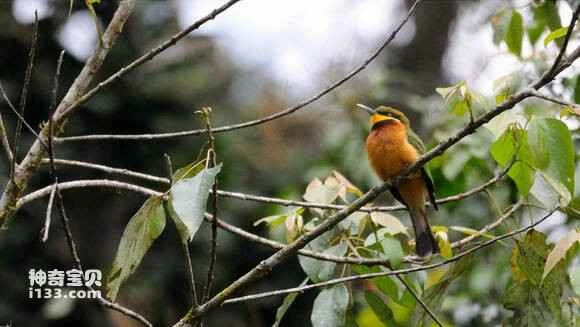
The red-breasted bee-eater is a typical forest bird. It lives alone, in pairs, or in flocks. It mostly flies and forages among the branches and flowers in the canopy. When resting, it often perches on the tops of high branches. When taking off, it often soars from the treetops, glides down in an arc, or circles in the canopy, calling as it flies. It spends most of the day flying, its flight straight and fast, its wings flapping rapidly, sometimes accompanied by gliding. It sometimes enters villages, around houses, and in orchards, and when resting, it often perches on power lines, dead branches, or bushes. Bee-eaters are agile fliers and adept at hunting in flight, but their diet varies depending on location and season. Besides bees, they also prey on weevils, elm crickets, horseflies, dragonflies, termites, butterflies, and other insects, as well as crustaceans.

The breeding season for the Red-breasted Bee-eater is generally from February to April in central Kenya, but in East Africa and most other regions it is from October to January of the following year, usually within a short period after the rainy season. They breed in colonies, often with hundreds of pairs in the same nesting area. They typically nest in burrows high on dikes, often on the banks of forest canyons or steep slopes beside mountain roads, and sometimes in tunnels within mountain cemeteries. Each clutch contains 5-6 eggs, white with a slight pink tinge, approximately 26 × 22 mm in size, and nearly spherical in shape. The incubation period is 20 days, with both male and female taking turns building the nest, incubating the eggs, and raising the chicks. The chicks are altricial.
This species has a wide distribution range and does not approach the threshold for vulnerable or endangered status (distribution area or fluctuation range less than 20,000 square kilometers, habitat quality, population size, fragmentation of distribution area), and its population trend is stable. Therefore, it is assessed as a species with no survival crisis.
Listed as Least Concern (LC) on the IUCN Red List of Threatened Species 2013 ver 3.1.