Basic Information
Scientific classification
- Chinese name: Red Bee Tiger
- Scientific name: Northern Carmine Bee-eater (Merops nubicus)
- Classification: Climbing birds
- Family and genus: Coraciiformes, Nematodae, Nematodae
Vital signs data
- Body length: No verification information available.
- Weight: No verification information available.
- Lifespan: No verification data available.
Significant features
It is one of the famous red bee-eaters in Africa (i.e., the red bee-eater and the southern red bee-eater).
Distribution and Habitat
It is distributed in south-central Africa, including the southern Arabian Peninsula and the entire African continent south of the Sahara Desert (Tropic of Cancer).
Appearance
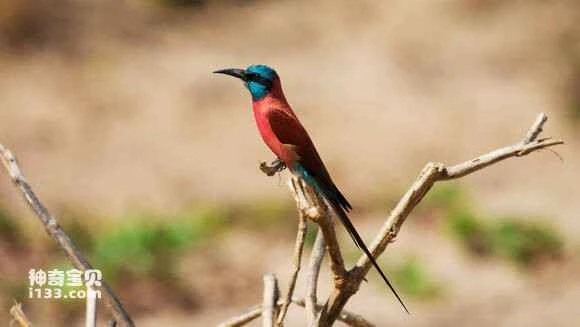
The red bee-eater resembles other bee-eaters in appearance, with similar features between the sexes. It has a long, curved black beak, a blue-green head, a black mask around its eyes, red eyes, a pink or dark red back, a red belly, a light blue flank, and square-shaped tail feathers with the central tail feathers being longer, making it a relatively conspicuous bee-eater.
Detailed introduction
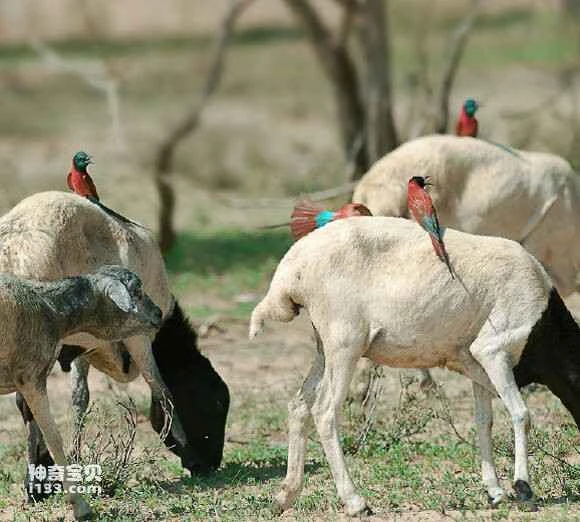
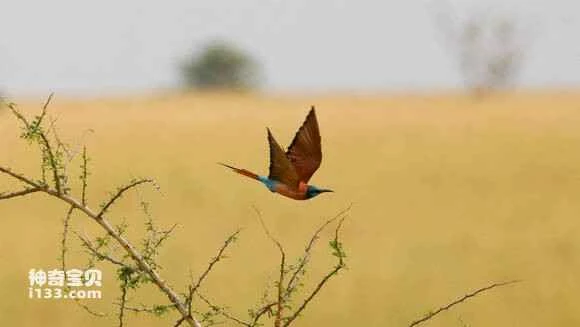
The Northern Carmine Bee-eater, scientifically known as *Merops nubicus*, primarily feeds on bees, locusts, grasshoppers, and other flying insects. When hunting, it waits on its perch for passing insects, swoops down to catch them, and then quickly returns to its original spot to peck at the prey. The Northern Carmine Bee-eater also likes to follow local tribes' grazing sheep in groups, catching grasshoppers, locusts, mosquitoes, and other insects that the sheep startle.
Listed in the IUCN Red List of Birds, version 3.1, 2009.
Protect wild animals and ban the consumption of wild game.
Maintaining ecological balance is everyone's responsibility!