Basic Information
Scientific classification
- Chinese name: Blue-tongued lizard
- Scientific name: Tiliqua rugosa
- Classification: Squamata
- Family and genus: Skink family, Blue-tongued Lizard
Vital signs data
- Body length: Adults are generally about 26–31 cm in total length, belonging to the small to medium-sized lizards with a stout body and a very short tail.
- Weight: Weight varies depending on body size and individual, with most adult individuals weighing several hundred grams.
- Lifespan: Long-lived lizards, they can live for more than ten years in the wild, and may live even longer under proper captive conditions.
Significant features
The Tile-backed Blue Tongue Lizard, unique to Australia, is robust in build, with an extremely short tail. Its back is covered with thick, tile-like scales, and its tongue is bluish-purple. It is relatively docile and has both ornamental value and ecological function.
Distribution and Habitat
Distributed in arid and semi-arid regions of southern and south-central Australia, they are active in various surface environments such as shrublands, open grasslands, sparse shrublands, farmland edges, and roadside edges. They often seek food and avoid predators under shrubs, beside fallen trees, near piles of rocks, and near animal burrows. They have a certain degree of adaptability to moderate human disturbance.
Appearance
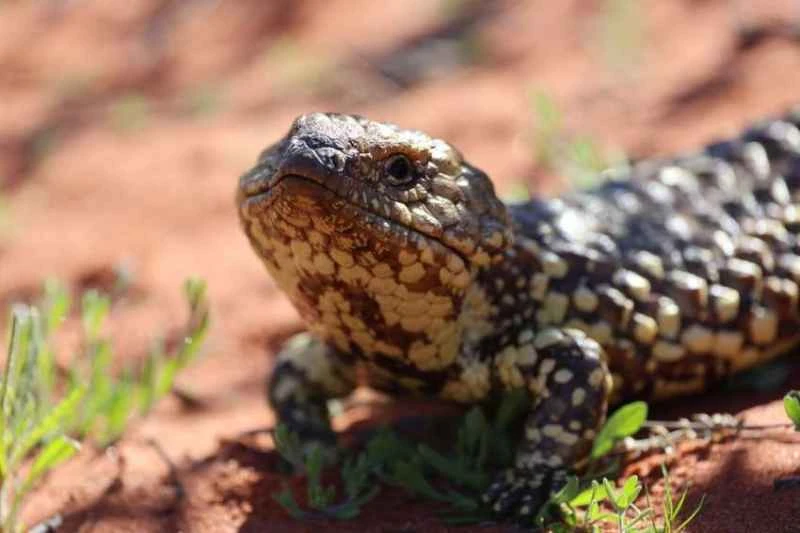
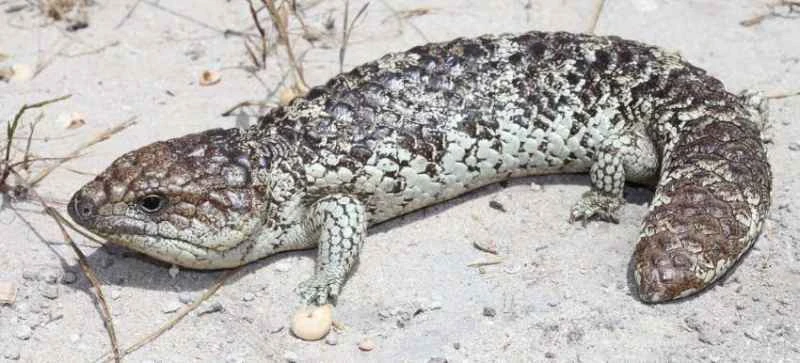
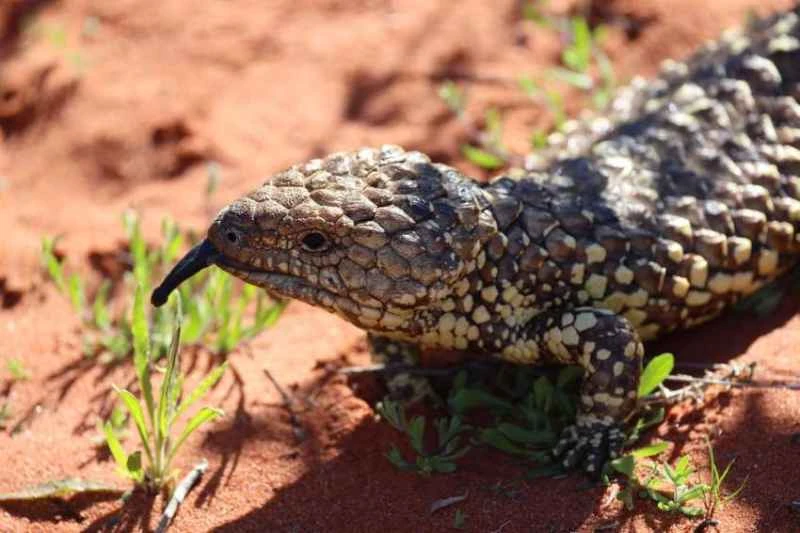
The body is robust and sturdy, with short, powerful limbs and an extremely short, blunt, rounded tail similar in shape to the head. The back is covered with large, thick, tile-like scales, ranging in color from dark brown and chocolate brown to yellowish-brown and olive, often with light-colored patches or patterns; the underside is lighter, pale yellow or grayish-white. The head is broad and blunt, with a relatively long mouth and a large, bluish-purple tongue, a distinctive physical characteristic of the Blue-tongued Lizard genus.
Detailed introduction
The shingleback lizard (scientific name *Tiliqua rugosa *) is a robust and distinctive Australian lizard belonging to the genus *Tiliqua* in the family Scincidae. It features a short, blunt, and rounded tail, and its body is covered in thick, roof-tile-like scales, giving it an armor-like appearance, hence the word "shingle" in its English name. The shingleback lizard belongs to the well-known shingle family, and its tongue is bluish-purple when extended. It is a typical small to medium-sized reptile in the Australian grassland and scrub ecosystem.
Classification and nomenclature
The Tiliqua rugosa belongs to the class Reptilia, order Squamata, suborder Sauria, family Scincidae, and genus Tiliqua . The genus Tiliqua includes various species of blue-tongued skinks found in Australia and surrounding areas, known for their large size, blue-purple tongue, and relatively docile temperament. This species, Tiliqua rugosa , has several common names throughout Australia, such as bobtail lizard, stuffy-tailed lizard, and shingleback skink, all related to its short, thick tail and tile-like scales. In Chinese, it is often translated literally as "瓦背蓝舌蝼" (Wabei Lanshezi) or "短尾蓝舌蝼" (Shunwei Lanshezi).
Appearance features
The Blue-tongued Lizard has a robust, sturdy body, short, powerful limbs, and an extremely short, blunt tail that closely resembles its head. This "head-tail resemblance" is believed to help confuse predators. Adults typically reach a total length of 26–31 cm, though some larger individuals may be slightly longer. Its back is covered in large, thick, raised scales with distinct ridges, arranged like overlapping tiles or small armor plates, making it highly recognizable. Body color ranges from dark brown and chocolate brown to yellowish-brown and olive, often interspersed with light-colored patches or irregular patterns; the underside is lighter, sometimes pale yellow or grayish-white. The head is broad and blunt, with a long mouth and a large tongue that, when extended, displays a striking bluish-purple hue—a signature feature of the Blue-tongued Lizard family.
Distribution range and habitat
The Blue-tongued Lizard is endemic to Australia, widely distributed in southern Western Australia, most of South Australia, and arid and semi-arid regions of western New South Wales and northwestern Victoria. They are adapted to a variety of terrestrial habitats, including dry scrubland, open grasslands, sparse scrubland, farmland edges, pastures, and roadside curbs. They are typically found on the ground, foraging for food and seeking refuge from predators under scrub, near fallen logs, piles of rocks, or near animal burrows. The Blue-tongued Lizard is somewhat adapted to moderate human disturbance and remains relatively common in some rural and agricultural landscapes.
Lifestyle Habits and Behaviors
The Blue-tongued Lizard is primarily diurnal, a typical example of a day-walking lizard. During the cooler hours of early morning and afternoon, they are active on the ground, basking in the sun to warm up and searching for food; when the sun is high in the sky, they mostly seek refuge in the shade of bushes, under rocks, or in burrows. Their movements appear relatively slow, but they can quickly burrow into cover when disturbed. When threatened, common defensive behaviors of the Blue-tongued Lizard include opening its mouth wide, extending its blue-purple tongue, hissing, and slightly flattening its body to appear larger; sometimes it will also use its short, stout body to defend itself or attempt to bite. Overall, they are relatively docile and do not actively attack humans; in the wild, they will usually retreat if kept at a distance.
feeding habits
The blue-tongued lizard is an omnivorous lizard with a very wide diet. It feeds on various plant matter, such as juicy leaves, flowers, fruits, berries, and buds, as well as insects and other invertebrates, such as beetles, snails, snail eggs, and caterpillars. Occasionally, it will also scavenge carrion or the remains of roadkill. In farmland and garden environments, they sometimes peck at fallen fruits and vegetables and help control garden pests such as snails, thus being considered a "natural pest control helper" in some areas.
Reproduction and life cycle
The Blue-tongued Scaly Lizard is a viviparous lizard. Like many members of the skink family, it does not lay eggs, but instead gives birth to fully developed offspring. They breed in spring and summer. After the embryo develops inside the female for several months, she gives birth to a small number of relatively large offspring at the end of the warm season, usually 1–4 per litter. The newborn offspring are nearly as long as adults and can forage with their mothers shortly after birth, but they still need to find food and avoid predators on their own. The Blue-tongued Scaly Lizard is a long-lived lizard, capable of living for more than ten years in the wild, and its lifespan may be even longer in captivity.
Relationship with humans
The Blue-backed Blue-tongued Lizard is popular among reptile enthusiasts in Australia and internationally due to its cute appearance, relatively docile temperament, and ease of care. However, the collection and keeping of native reptiles in the wild in Australia is strictly regulated, and in most cases, a license is required or it can only be kept by licensed organizations. For farm and rural residents, the Blue-backed Blue-tongued Lizard is both a common "neighbor" and a beneficial predator of insects and snails. It is not inherently aggressive, but it may bite if handled roughly or startled; therefore, when encountered in the wild, it should be observed without disturbing it.
Protecting the status quo and threats
The Blue-backed Gazelle is listed as "Least Concern" on the IUCN Red List, with a wide distribution and relatively stable population. However, it is still affected by factors such as road traffic (especially roadkilling), habitat loss and fragmentation, predation by invasive predators such as domestic cats and foxes, and illegal poaching and export to the international pet trade. Key measures for protecting the Blue-backed Gazelle include: setting up animal warning signs along roads and reducing vehicle speeds; protecting and restoring scrubland and grassland habitats; controlling invasive predator populations; and combating illegal collection and smuggling through enhanced monitoring and law enforcement.
Frequently Asked Questions
Q1: What is the purpose of the blue tongue of the blue-tongued lizard?
The blue-tongued lizard's protruding blue-purple tongue is primarily for defense and deterrence. When threatened, it opens its mouth wide, extends its conspicuous blue tongue, and hisses, using both visual and auditory means to scare away potential predators.
Q2: Will the blue-tongued lizard hurt people?
The blue-tongued lizard is relatively docile and does not actively attack humans. However, it may bite as a form of self-defense if forcibly grasped or severely frightened. It lacks venom glands, and bites are primarily mechanical injuries, but can still break the skin, cause bleeding, and carry a risk of bacterial infection.
Q3: What role does the blue-tongued lizard play in the ecosystem?
As an omnivorous reptile, it feeds on both plant parts such as fruits and flowers, as well as invertebrates such as insects and snails. It helps control pests in some farmlands and gardens, and is also a food source for birds of prey and large reptiles. It is an important part of the food web in arid and semi-arid ecosystems.
Q4: Is the Blue Tongue Lizard suitable as a pet?
Provided it is legal and from compliant sources, the Blue-tongued Lizard is indeed a common reptile pet due to its relatively docile temperament and moderate size. However, it requires suitable temperature, light, space, and diet, and its keeper needs a certain level of experience. Furthermore, collection from the wild in Australia is strictly limited; it is recommended to acquire individuals through legal channels and comply with relevant regulations.