Basic Information
Scientific classification
- Chinese name: Coarse-scaled snake
- Scientific name: Tropidechis carinatus
- Classification: Squamata
- Family and genus: Elapidae, genus *Elaphe*
Vital signs data
- Body length: Adults are generally about 70–110 cm in total length, with large individuals exceeding 1.2 meters. They are medium-sized, slightly stout venomous snakes.
- Weight: Weight varies depending on individual size and nutritional status. Most adults weigh several hundred grams, while larger individuals can weigh about 1 kilogram or more.
- Lifespan: It is estimated that it can survive for more than ten years in the wild, and its lifespan may be even longer under captive conditions. It generally takes several years to reach sexual maturity.
Significant features
With distinct longitudinal ridges on its scales and a rough texture, it is one of the typical highly venomous snakes in the rainforests and mountain valleys of eastern Australia. It prefers humid environments and feeds on frogs, small reptiles, and mammals.
Distribution and Habitat
They mainly inhabit rainforests, moist sclerophyllous forests and mountain valleys in eastern Queensland and northeastern New South Wales, Australia, and are often found in humid and hidden micro-habitats such as stream edges, rocky slopes, dense thickets, fallen trees, and rock crevices.
Appearance
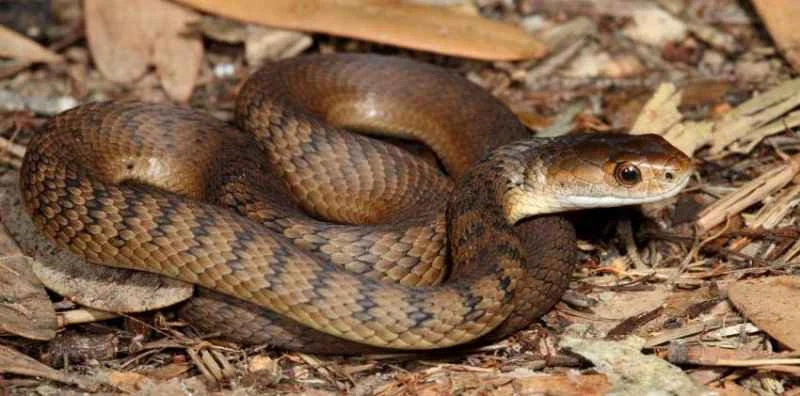
The body is somewhat stout, with an olive brown, dark olive green, or brownish-red back covered with darker horizontal bands or stripes, and a lighter belly that is pale yellow, cream, or grayish-white. The scales on the body surface have a distinct longitudinal ridge in the center, making the overall appearance and feel rough and angular. The head is slightly wide, and the eyes are medium-sized, giving the overall visual impression of "coarse scales and dark stripes".
Detailed introduction
The Rough-scaled Snake (scientific name *Tropidechis carinatus *) is a medium-sized, highly venomous Australian snake belonging to the genus *Tropidechis* in the family Elapidae. It gets its name from its rough-skinned scales with prominent longitudinal ridges, which feel coarser to the touch compared to many smooth-scaled snakes. The Rough-scaled Snake is mainly distributed in the humid forests and mountain valleys of eastern Australia, and is an important mid- to high-altitude predator in the local rainforest and humid woodland ecosystems.
Classification and nomenclature
The rough-scaled snake belongs to the class Reptilia, order Squamata, suborder Serpentes, family Elapidae, and genus Tropidechis . The genus Tropidechis is currently recognized as containing only one species, making it a monotypic genus. Phylogenetically, it is related to Australian venomous snakes such as the tiger snake. The specific epithet Carinatus means "ridged" or "ridged," describing the prominent longitudinal ridges on its scales. The common English name, Rough-scaled Snake, accurately summarizes this physical characteristic.
Appearance features
The Rough-scaled Snake is a medium-sized, somewhat stout venomous snake. Adults typically reach a total length of 70–110 cm, with larger individuals exceeding 1.2 meters. The back is usually olive-brown, dark olive-green, or brownish-red, covered with a series of darker transverse bands or stripes, giving it a somewhat similar appearance to certain tiger snakes. The belly is lighter, ranging from pale yellow, cream to grayish-white, sometimes with dark spots or cloud-like markings. Its most distinctive feature is the prominent central longitudinal ridge (car ridge) on its scales, which appear rough and angular under light and feel coarse to the touch. The head is slightly broad, clearly distinguishable from the neck. The eyes are medium-sized with round pupils, and the anterior part of the upper jaw has fixed anterior-fanged fangs, typical of Australian cobras.
Distribution range and habitat
The Roughscaled Snake is endemic to Australia, primarily found in the coastal and mountainous regions of eastern Queensland and northeastern New South Wales. It prefers warm, humid environments, with typical habitats including rainforests, moist sclerophyllous forests, mountain valleys and nearby rocky slopes, stream edges, and dense scrub. Roughscaled Snakes are often found near streams or wetlands, utilizing rock crevices, fallen logs, gaps between tree roots, and piles of fallen leaves for concealment. Some individuals possess climbing abilities and can move on scrub, fallen logs, or low branches, but overall, they remain primarily terrestrial.
Lifestyle Habits and Behaviors
The rough-scaled snake is mostly active at dusk and night, belonging to the nocturnal or calamous snake family; however, it may also be active during the day under cool or cloudy conditions. They are generally cautious and alert, and when disturbed, they tend to quickly escape to nearby shelters such as rock crevices, under fallen trees, or in dense vegetation. However, when cornered and unable to escape, the rough-scaled snake will noticeably raise its forebody, adopt an S-shaped posture, and display a threatening stance; if the threat persists, it may launch a swift and accurate bite. The venom of the rough-scaled snake is highly toxic and should be considered a high-risk venomous snake, on par with the tiger snake.
feeding habits
The rough-scaled snake is an omnivorous carnivorous predator, primarily feeding on small vertebrates. Its diet includes frogs and tadpoles, small lizards, other snakes, and small mammals (such as rodents). In damp forest and valley environments, frogs and other amphibians are often important prey sources. The rough-scaled snake typically hunts using a combination of ambush and active searching, moving slowly through leaf litter, along stream banks, or among rocks. Once prey is spotted, it quickly pounces and bites, injecting highly toxic venom to subdue its prey swiftly before swallowing it whole.
Reproduction and life cycle
The rough-scaled snake is viviparous, like many Australian cobras. It does not lay eggs; instead, the embryos develop inside the female, and the live young are born directly. The breeding season typically occurs from late spring to summer in the local area. During this time, males actively seek out females, and fighting between males may occur. After mating, the embryos develop inside the female for several months, followed by a litter of several to more than ten young snakes. Although the newborn snakes are small, they already possess a complete venom gland and fang system, and their venom is quite potent. They should be handled with the same caution as adults. Rough-scaled snakes are estimated to live for more than ten years in the wild, but sexual maturity takes several years.
Relationship with humans
Because the rough-scaled snake is mainly distributed in the humid forests and mountain valleys of the east, far from most densely populated urban areas, direct contact with humans is relatively infrequent. However, encounters are still possible near rural homes, campsites, forest roads, and hiking trails close to mountains or forests. The venom of the rough-scaled snake is extremely dangerous; a bite, if not treated promptly, can cause serious nerve, blood clotting, and muscle damage. The safest course of action when encountering a rough-scaled snake is to maintain distance and let it leave on its own; never attempt to capture or drive it away, as this may provoke a defensive bite. In Australia, native snakes are generally protected by law, and the general public is prohibited from killing them indiscriminately.
Protecting the status quo and threats
In the IUCN Red List and related assessments, the rough-scaled snake is generally classified as "Least Concern" or has a low overall threat level because its distribution area is relatively continuous and many of its habitats are located within national parks and protected areas. However, local populations still face several potential threats, including habitat fragmentation due to deforestation, crushing deaths due to increased road traffic, human hunting driven by fear of snakes, and changes in rainfall patterns due to climate change. The key to conserving the rough-scaled snake lies in maintaining the integrity of the eastern rainforest and humid woodlands, preserving natural vegetation in valleys and mountains, and reducing misunderstandings about venomous snakes and indiscriminate hunting through public education.
Frequently Asked Questions
Q1: Is the venom of the coarse-scaled snake extremely dangerous?
Yes, the rough-scaled snake is one of the highly venomous Australian cobras. If a bite is not treated promptly, it can lead to serious nerve, coagulation, and muscle damage. It should be considered a medical emergency, and pressure bandages should be applied immediately and the patient should be taken to a hospital.
Q2: Why is the coarse-scaled snake called the "coarse-scaled snake"?
The name "coarse scales" comes from the distinct longitudinal ridge (car ridge) in the center of its scales, which appears rough and angular under light and to the touch, unlike many snakes with smooth surfaces.
Q3: What should I do if I encounter a coarse-scaled snake in the wild or on a mountain trail?
The safest course of action is to stop immediately, maintain a safe distance from the snake, and slowly back away or walk around it, avoiding any attempt to drive it away, provoke it, or capture it. Most snakes will choose to leave on their own unless they feel continuously threatened.
Q4: What role does the coarse-scaled snake play in the ecosystem?
The rough-scaled snake is a mid-to-high-level predator in rainforest and humid woodland ecosystems, primarily preying on frogs, small reptiles, and rodents, helping to regulate these animal populations and maintain food web balance. It is also preyed upon by birds of prey and large snakes, making it an important component of forest biodiversity.