
Basic Information
Scientific classification
- Chinese name: Southern Red Bee-eater
- Scientific name: Southern Carmine Bee-eater (Merops nubicoides)
- Classification: Climbing birds
- Family and genus: Coraciiformes, Nematodae, Nematodae
Vital signs data
- Body length: No verification information available.
- Weight: No verification information available.
- Lifespan: No verification data available.
Significant features
Distribution and Habitat
The tropical and temperate regions that are spread throughout the Old World.
They live in hilly woodlands near villages and are arboreal.
Appearance
The Southern Red Bee-eater is medium-sized, with a long, slender, downward-curving beak that is pointed at the tip and has a ridged ridge at the apex. Its legs are slender and weak, with the middle and outer toes connected at least to the second joint from the base, while the inner toe is only connected to the first joint from the base. It has 10 primary flight feathers and 12 tail feathers. Its wings are of moderate length, and its legs are short. Some species have a ribbon-like tail. Its plumage is vibrant, and the sexes are similar; juveniles resemble adults.
Detailed introduction
The Southern Carmine Bee-eater, scientifically known as *Merops nubicoides*, has unknown specific habits.

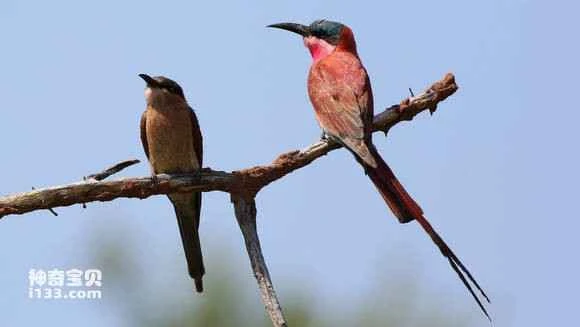
The Southern Red Bee-eater is oviparous and can reproduce year-round, with peak breeding season in September and October. Each nest contains 2-5 eggs, and the incubation period is 11-13 days. They will dig burrows in riverbanks to build their nests, with tunnels 1-3.5 meters long.
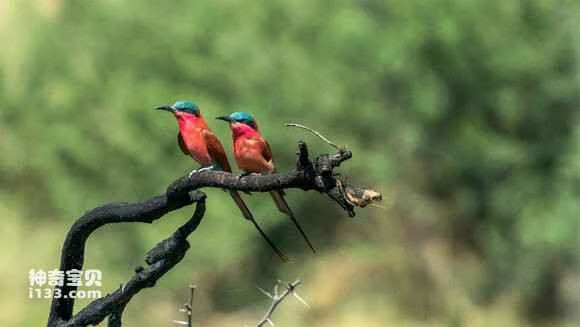
Listed in the IUCN Red List of Birds, version 3.1, 2009.

Protect wild animals and ban the consumption of wild game.
Maintaining ecological balance is everyone's responsibility!


