Basic Information
Scientific classification
- Chinese name: Eastern Grey Kangaroo
- Scientific name: Macropus giganteus
- Classification: Mammals
- Family and genus: Kangaroo family, Kangaroo genus
Vital signs data
- Body length: Adults typically have a head and body length of about 1.0–1.6 meters, a tail length of about 0.8–1.2 meters, and a shoulder height that can approach or exceed 1 meter.
- Weight: Males typically weigh around 50–90 kg, while females weigh around 25–40 kg; some large males may weigh even more.
- Lifespan: In the wild, lifespan is typically around 10–20 years, but is affected by drought, disease, predation (of juveniles), and human activities.
Significant features
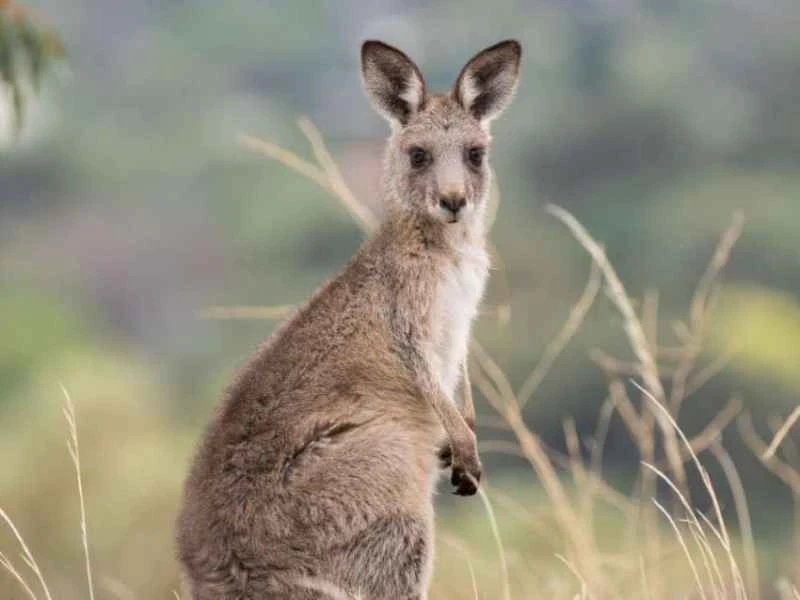
One of the most common large kangaroos in eastern Australia, with greyish-brown fur, strong hind legs, and a long, balanced tail; active at dawn and dusk, gregarious, feeding mainly on grasses, and often overlapping with farmland and roadside landscapes.
Distribution and Habitat
Distributed in eastern and southeastern Australia (including Tasmania), it prefers grasslands, open woodlands and woodland mosaic landscapes, and is also often found in pastures, farmland edges and urban suburban reserves.
Appearance
They are large and robust, with grayish-brown to brownish-gray fur, lighter on the belly; their hind legs are muscular and adapted for high-speed jumping, and their thick, long tails are used for balance and support; males are larger and stronger, and often engage in competitive displays during the breeding season.
Detailed introduction
The Eastern Grey Kangaroo ( Macropus giganteus ) is one of the most common and largest kangaroos in eastern Australia, and is the quintessential image many people have of a kangaroo: greyish-brown fur, strong hind limbs, a long tail for balance, and the ability to move at high speeds by leaping. They are often found in groups on open grasslands and woodland edges, most active at dusk and dawn, and resting in the shade or under bushes during the day. As a large herbivore, the Eastern Grey Kangaroo plays an important role as a vegetation "pruner" in grassland and forest edge ecosystems, influencing herbaceous plant regeneration, seed dispersal, and nutrient cycling.
Unlike the red kangaroo, which prefers arid inland areas, the eastern grey kangaroo prefers the relatively rainy eastern coast and foothills, and can also adapt to grasslands on the edges of farmland and near cities. Due to their high degree of overlap with human landscapes, they are not only iconic wild animals of Australia, but also frequently cause issues such as traffic collisions, agricultural and pastoral conflicts, and human-wildlife coexistence management.
Classification and nomenclature
The Eastern Grey Kangaroo belongs to the class Mammalia, superorder Marsupia, order Diprotodontia, family Macropodidae, and genus Macropus . Its English name, "eastern grey," refers to its primary distribution in eastern Australia and its common grey fur; "giant kangaroo" is also a descriptive name for its size and sex.
In popular science articles, the "grey kangaroo" is sometimes compared to the "western grey kangaroo," as they are similar in appearance but differ in distribution and some physical characteristics. The eastern grey kangaroo is generally larger and inhabits more humid eastern regions.
Appearance features
Eastern grey kangaroos are large and robust, with muscular hind limbs and a thick, long tail used for balance and support when jumping. Adults typically have a head-body length of about 1.0–1.6 meters and a tail length of about 0.8–1.2 meters; shoulder height can approach or exceed 1 meter. Weight varies considerably: males usually weigh around 50–90 kg, with some large males weighing even more; females generally weigh around 25–40 kg.
The coat is mostly grayish-brown to brownish-gray, lighter on the underside and often darker on the face and ear edges. The forelegs are relatively short but flexible and can be used for feeding, grooming, and light "holding". The hind legs are large and strong, adapted for long-distance jumping; they can maintain high speeds and conserve energy when running. During the breeding season, males often display their size and strength through "boxing" and fighting.
Distribution range and habitat
Eastern grey kangaroos are mainly distributed in eastern and southeastern Australia, including eastern Queensland, New South Wales, Victoria, and Tasmania. They prefer grasslands, open woodlands, savannas, river valleys, and forest edge scrublands, and especially enjoy "grassland-woodland mosaic" landscapes where herbaceous resources are abundant while forests provide shade and shelter from the wind.
In agricultural landscapes, they often forage for tender grasses at the edges of pastures and farmlands; they may also be found in parks, reserves, and golf courses near cities. Water availability and grass abundance influence their seasonal movement and population density.
Lifestyle Habits and Behaviors
Eastern grey kangaroos are mostly active at dawn and dusk, often resting in the shade during the hot day, but may continue to forage at night. They are distinctly social, often forming "mobs" (kangaroo colonies). The group structure is relatively loose, but they will form stable activity areas around food and water sources.
Social relationships within the group are complex: males compete for mating opportunities, with common confrontations including butting, grasping, kicking, and boxing. Females, on the other hand, focus more on raising their young and foraging, maintaining a close mother-child bond. Kangaroos communicate through posture, scent, and low-frequency sounds, and when threatened, they collectively become alert and quickly hop away.
feeding habits
Eastern grey kangaroos are typical herbivores, primarily feeding on grasses and other herbaceous plants, but also consuming tender leaves, bark, or shrub shoots (especially when grass resources are scarce). They possess a digestive system adapted to a high-fiber diet, enabling them to maintain energy balance even under low-nutrient conditions.
Feeding rhythms are usually related to temperature and humidity: the grass leaves have higher water content and more suitable temperature in the early morning, evening and at night, so these are their main feeding times.
Reproduction and life cycle
Eastern grey kangaroos are marsupials, and females typically give birth to one offspring at a time. The newborn is extremely small and crawls into the pouch to attach to a nipple and continue developing. As they grow, the offspring gradually venture out of the pouch, but will return to it to feed and seek shelter until fully weaned.
Females can become pregnant again during the juvenile stage and employ reproductive strategies such as "embryonic diapause" (a common phenomenon in marsupials) to improve reproductive efficiency. Their lifespan in the wild is typically 10–20 years, influenced by factors such as food, drought, disease, predation (more pronounced in juveniles), and human activity.
Relationship with humans
The Eastern Grey Kangaroo is one of Australia's most iconic wild animals and an important resource for ecotourism. However, due to its frequent presence along roads and in agricultural and pastoral areas, vehicle collisions (especially at dusk and dawn) are a common cause of human-caused death. They can also conflict with pasture utilization, requiring a balance between conservation and agricultural management.
In areas where kangaroos coexist, slowing down while driving at night, using warning signs, increasing attention in areas with high kangaroo density, and avoiding feeding and close chasing all help reduce risks and minimize disturbance to wildlife behavior.
Protecting the status quo and threats
The Eastern Grey Kangaroo is generally assessed as Least Concern (LC), with relatively stable or even above-average populations in many areas. However, this does not mean there is no stress: drought and extreme weather can affect grass cover and reproduction; habitat fragmentation can alter migration routes; road deaths and local conflict management can also cause mortality.
In some areas, the management focus is on "coexistence and risk reduction": reducing collisions through road safety measures, adopting more sophisticated fencing and avoidance strategies in agricultural areas, and maintaining ecological functions and habitat connectivity within protected areas.
Frequently Asked Questions
Q1: What are the differences between the eastern grey kangaroo and the red kangaroo?
Red kangaroos are more common in the arid interior of Australia and have reddish fur; eastern grey kangaroos are mainly found in the wetter eastern regions and have greyish-brown fur. Both are large, but their distribution and habitat preferences differ.
Q2: Why do they often appear at dusk and dawn?
The temperature is more suitable and the grass has a higher water content during these two periods, which is conducive to foraging; at the same time, it avoids the high temperature during the day.
Q3: What do Eastern Grey Kangaroos eat?
It mainly feeds on grasses and other herbaceous plants, and when grass resources are insufficient, it will also feed on tender leaves, shrub branches or bark.
Q4: What precautions should be taken when coexisting with kangaroos?
Drivers should reduce speed and be aware of roadside activities during dusk and dawn; do not feed or chase wild kangaroos, and keep your distance to reduce stress and road risks.