Basic Information
Scientific classification
- Chinese name: Sound-producing frog
- Scientific name: Cophixalus crepitans
- Order: Anura
- Family: Microhylidae crepitans
Vital signs data
- Body length: Adults are generally about 1.6–2.3 cm in length, belonging to the very small terrestrial frogs.
- Weight: Individual weight is only a few grams, varying with size and nutritional status.
- Lifespan: It is estimated that it can survive for several years in the wild and participate in multiple breeding seasons in stable rainforest environments.
Significant features
The miniature brooding frog, found in the humid tropical mountain rainforests of Queensland, Australia, is known for its short, sharp "quack/crunch" sounds and its direct terrestrial rearing method, making it a typical small leaf frog.
Distribution and Habitat
Confined to the humid tropical mountain rainforests and wet forests of northeastern Queensland, Australia, they mostly inhabit the moist leaf litter, decaying wood, and rocky microhabitats under the closed canopy, and can reproduce even far from large bodies of water.
Appearance
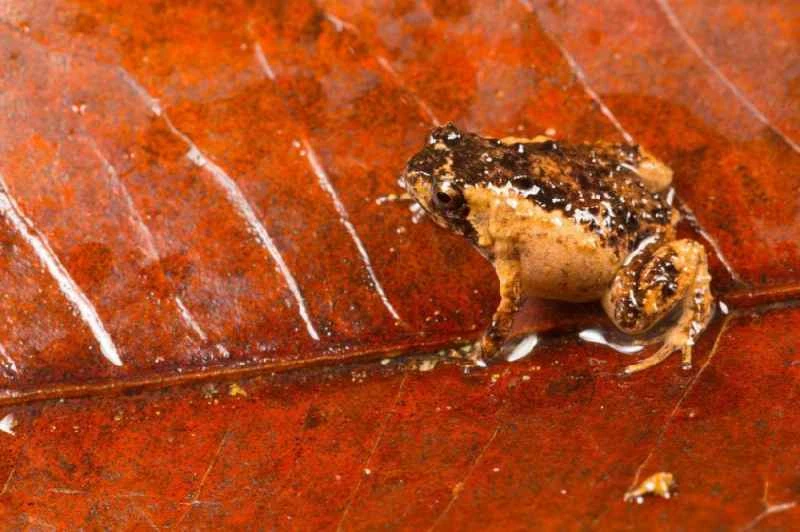
It is small in size, with a slightly rounded and short body. Its back is brown to grayish-brown with mottled patterns, and its belly is light-colored. Its limbs are short and sturdy, without obvious webbing or suckers, which is suitable for crawling and hopping among thick fallen leaves and decaying wood. Its eyes are relatively large, which is beneficial for nocturnal activity.
Detailed introduction
The Rattling Nursery Frog ( Cophixalus crepitans ) is a very small native Australian frog, belonging to the family Microhylidae. It is found in the rainforests of northeastern Queensland and is named for the short, sharp "quack-quack" sound produced by the males. In the damp nights of the mountain rainforest, their seemingly tiny "clucking" chorus can often be heard.
Classification and nomenclature
Suggested Chinese name: Sound-producing frog, croaking frog (direct translation based on English name and breeding method; Chinese name is not yet fully standardized);
English name: Rattling Nursery Frog;
Scientific name: Cophixalus crepitans ;
Family: Microhylidae → Genus: Cophixalus (Frog Breeder).
Appearance and Identification Features
The melodious frog is very small, but its adaptations to rainforest floor life are very obvious:
Size: Adults are generally about 1.6–2.3 cm in length, belonging to the very small frogs;
Back color: The back is mostly brown, grayish brown or slightly olive, often accompanied by irregular dark and light markings;
Patterns: Some individuals have light-colored stripes or faint V-shaped or W-shaped markings on their backs, which help to break up the outline;
Body shape: The body is slightly round and short, the head is relatively small, the snout is blunt, and the overall appearance is "chubby and small";
Abdomen: The abdomen is lighter in color, mostly grayish-white or cream, sometimes with slight spots;
Limbs: The limbs are short and sturdy, with almost no webbed hands and feet and no obvious suction cups, making them more suitable for crawling and short jumps in the leaf litter rather than climbing trees;
Eyes: The eyes are relatively large compared to the body size, which is beneficial for moving around and finding prey in low-light environments.
Distribution range and habitat
The melodious brooding frog is a species endemic to the tropical rainforests of northeastern Queensland, Australia .
It is mainly found in the montane rainforests and adjacent humid forests of the Wet Tropics region of Queensland;
It is commonly found in cool, humid mountain environments at medium and high altitudes.
Typical habitat characteristics include:
The shady, damp rainforest under the closed canopy is covered with a thick layer of fallen leaves and decaying wood.
They are often found around tree roots, under fallen logs, in crevices between rocks, in moss thickets, and in piles of fallen leaves.
Even far from large bodies of water, they can reproduce in sufficiently moist surface environments.
Lifestyle
The melodious frog is a nocturnal, terrestrial small frog .
During the day, they mostly hide under fallen leaves, rocks, and decaying wood, clinging tightly to the moist substrate;
They are most active from dusk to night, especially during or after the rainy season when humidity is high and the temperature is suitable.
Their movement is mainly characterized by short jumps and slow crawling, with very few long-distance jumps.
Cry
The reason why the Rattling Nursery Frog is called "Rattling" is closely related to its vocal characteristics:
The male frog emits a series of short, rhythmic "click-click-click" or soft "quack-quack" sounds, which sound like tiny "castanets" or "clucking".
On quiet rainforest nights, when multiple male frogs call out at the same time, the ground will create a faint "rustling" background.
The calls are not loud, but the rhythm is clear, which can serve as an important clue for identifying the species in the wild.
feeding habits
Similar to other small frogs in the genus Microraptor, the Sound-Breaking Frog primarily preys on very small invertebrates:
Ants, small beetles and other tiny insects;
Springtails, small arthropods, and larvae that live in the leaf litter layer;
They mostly move slowly along the damp ground at night, waiting for an opportunity to catch their prey.
Reproduction and "Raising" Methods
The melodious frog belongs to the genus *Rana*, and its reproductive method also features direct development and parental care :
Reproduction is closely related to the rainy season and high humidity conditions;
Female frogs lay a small number of eggs, but the eggs are relatively large, in damp leaf litter, under decaying wood, or in soil crevices.
Male frogs typically stay near the eggs and call out; in many species of the same genus, males exhibit a degree of protective behavior toward the eggs and larvae.
Eggs develop on land, and the embryo completes most of the metamorphosis process directly in the egg;
During hatching, tiny "frogs" emerge from the eggs, rather than tadpoles that swim in the water—hence the name "nursery frog."
Protecting the status quo and threats
On the IUCN Red List, Cophixalus crepitans is currently assessed as Least Concern (LC) , and its population is generally considered relatively stable in suitable rainforest habitats.
Potential threats include:
Fragmentation and shrinkage of tropical mountain rainforest habitats (roads, infrastructure and localized development).
Climate change-induced temperature rises and changes in cloud cover may make the surface of mountain rainforests drier.
The impacts of extreme storms and improper fire management on forest surface structure and litter thickness.
Maintaining the integrity of Queensland’s humid tropical zone and its mountain rainforests is crucial for the sound-breeding frog and other small frogs that depend on the leaf litter layer.
Frequently Asked Questions
Q1: Why is it called "Rattling Nursery Frog"?
"Rattling" comes from the short, clicking sound made by male frogs at night, while "Nursery Frog" refers to the terrestrial activity of frogs in this genus.
Often accompanied by parental care, the eggs develop directly into small frogs instead of tadpoles.
Q2: Do the croaking frogs need a pond or stream to breed?
No. It uses a direct development model; the eggs are laid in moist fallen leaves or soil crevices, and the hatchlings are directly small frogs.
They do not go through the free-swimming tadpole stage, and therefore do not depend on permanent bodies of water.
Q3: Are the croaking frogs easy to spot in the wild?
Because of their small size and camouflage color, they spend most of their time hiding under layers of fallen leaves and decaying wood, making them difficult to spot visually.
Usually, you first hear a "quack" or "cluck" sound coming from the ground, and then you have to carefully search for the source of the sound to find them.
Q4: What role does the sound-based frog breeding system play in the ecosystem?
It helps regulate small arthropod populations by preying on tiny invertebrates in the leaf litter.
It is also a potential food source for snakes, birds, and small mammals, and is part of the mountain rainforest food web.