Basic Information
Scientific classification
- Chinese name: Solomon Islands monkey bat
- Scientific name: Pteralopex (monkey-faced bat)
- Order: Chiroptera
- Family: Fruit bat, Monkey-faced bat
Vital signs data
- Body length: The head and body length are mostly in the range of about 16–22 cm (significant differences between species; only a few species have detailed measurement records).
- Weight: There is a wide range of weight variations: reported individuals weigh approximately 280–500 grams or more; systematic data are lacking for most species.
- Lifespan: Basic data such as lifespan and reproduction are still lacking for most species, and publicly available data are mostly marked as "unknown/insufficient data".
Significant features
The "monkey-faced" fruit bats, unique to the Solomon Islands, have a very narrow distribution and are highly sensitive to deforestation. They feed mainly on fruit and are important seed dispersers and potential pollinators.
Distribution and Habitat
It is limited to tropical rainforests and mountain forests in the Solomon Islands, and is commonly found in primary or secondary forests, rainforest edges, and areas rich in fruit trees; it is extremely sensitive to deforestation, mining, and forest fragmentation.
Appearance
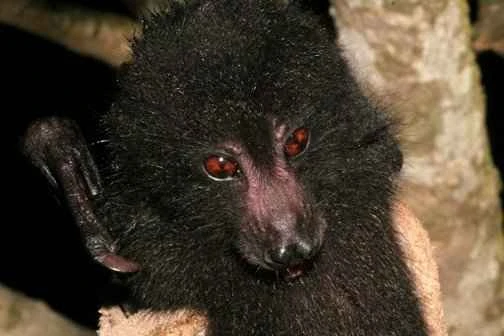
The head is thick, the snout is relatively short and wide, and the canines are well-developed; the fur is mostly dark brown to blackish brown, the ears are small and often covered by fur, the eyes are large, and some species have a striking red iris; the wing membranes are mostly dark and may have light-colored patches.
Detailed introduction
Monkey-faced bats are a group of large fruit bats endemic to the Solomon Islands, belonging to the genus * Pteralopex *. They are named for their facial features and expressions, which resemble those of monkeys. They live in tropical rainforests and mountain forests, are primarily nocturnal, and feed on fruits, nectar, and pollen, making them important pollinators and seed dispersers in the island's forests.
Unlike many widely distributed fruit bats, species in the genus *Batus* have extremely narrow distribution ranges, often confined to forest patches on a single island or a few islands, making them highly sensitive to habitat destruction. Species in this genus are generally threatened by habitat loss due to deforestation, mining, and infrastructure development, as well as by hunting and invasive predators, resulting in high conservation pressure.
Classification and nomenclature
The genus *Pteropodidae* belongs to the order Chiroptera. They are primarily confined to the rainforest ecosystems of the Solomon Islands. Representative species described in this genus include: * P. anceps * (Bouganville bat), *P. atrata* (Guadalcanal bat), * P. flanneryi* (Greater bat), *P. pulchra * (Alpine bat), and * P. taki * (New Georgian bat).
Appearance features
The barn bat is a medium to large fruit bat, with a thick head, a relatively short and wide snout (unlike many fruit bats with "long snouts"), and large eyes, with some species having striking red irises. Its ears are relatively small and often obscured by dense hair. Fur color ranges from dark brown and blackish-brown to grayish-brown; some species have dark wing membranes with light-colored patches. It has well-developed canines, which are advantageous for cracking open hard fruits.
Distribution range and habitat
The genus *Batus* is restricted to tropical rainforests and montane forests in the Solomon Islands. Different species are often found on specific islands or island chains, with habitats primarily in primary or secondary forests, humid montane forests, rainforest edges, and nearby areas rich in fruit trees. Due to their dependence on forest structure and food resources, they are typically very sensitive to large-scale deforestation and forest fragmentation.
Lifestyle Habits and Behaviors
Mostly nocturnal, they leave their roosts to forage after dusk and are active in the canopy or forest edges at night. Public information about their daytime roosting habits is relatively limited, but it is speculated that they, like other fruit bats, roost in trees, possibly in small groups or loosely clustered. Due to the island environment and low-density distribution, field monitoring is quite challenging.
feeding habits
They primarily feed on fruits, but may also consume nectar, pollen, and tender leaves. By feeding and excreting or carrying seeds, they promote seed dispersal in forest plants; they may also perform pollination functions during the flowering season of some plants.
Reproduction and life cycle
Reproductive data for many species in this genus are scarce, but it is generally assumed to be similar to that of fruit bats: each litter typically produces one offspring, with a relatively long rearing period. Key parameters such as weight and lifespan remain poorly studied in most species.
Relationship with humans
The barn bat is of significant value to the local ecosystem, but may be misunderstood due to its feeding on orchard crops. Hunting pressure exists in some areas; meanwhile, mining, logging, and road construction further increase human activity in the forest, exacerbating disturbance and hunting risks.
Protecting the status quo and threats
Species of the genus *Pteropoda* are generally listed as High Threatened (mostly Endangered (EN) or Critically Endangered (CR)/Possibly Extinct) on the IUCN Red List. For example, *Pteropoda atrata * is listed as Endangered (EN), and * Pteropoda pulchra * is listed as Critically Endangered with the label "Possibly Extinct." Major threats include habitat loss and fragmentation, hunting, invasive predators (such as wildcats), and the impact of extreme weather on island forests. Effective conservation typically requires: preserving continuous forest patches, limiting clearing and mining in high-value forests, collaborating with communities to reduce hunting, and conducting systematic field surveys and long-term monitoring.
Frequently Asked Questions
Q1: Is the Solomon Islands "monkey bat" a species?
No. It usually refers to a group of species in the genus * Pteralopex *, and different islands may correspond to different species.
Q2: What do they mainly eat?
They primarily feed on fruits, but may also consume nectar and pollen, thus playing a vital role in forest seed dispersal and pollination.
Q3: Why are they so rare?
Because each species has a very narrow range of distribution and often lives only in a few patches of forest on a few islands, their habitats decline rapidly once they are logged or fragmented.
Q4: Are they endangered animals?
Many species of the genus *Batus* are listed as Endangered (EN) or Critically Endangered (CR/Possibly Extinct) by the IUCN, requiring protection of their forest habitats and reduction of hunting pressure.