Basic Information
Scientific classification
- Chinese name: Rain Whistle Frog
- Scientific name: Austrochaperina pluvialis
- Order: Anura
- Family: Microhylidae pluvialis
Vital signs data
- Body length: Adults are about 2–3 cm in length, belonging to the very small terrestrial frogs.
- Weight: Individual weight is only a few grams, varying with size, sex, and nutritional status.
- Lifespan: It is estimated that it can survive for several years in the wild and participate in multiple breeding seasons in stable rainforest environments.
Significant features
The miniature ground frog of the wet tropical region of Queensland, Australia, is known for its clear "whistling" call on rainy nights. Despite its small size, it can develop directly on the rainforest floor far from water, making it a typical species of the microfrog family adapted to the rainforest environment.
Distribution and Habitat
It is limited to the humid tropical rainforest region of northeastern Queensland, Australia, ranging from lowland to mid-altitude rainforests and cloud forests. It thrives in forests covered with thick layers of fallen leaves, decaying wood, and moss, and can survive and reproduce even far from surface water bodies.
Appearance
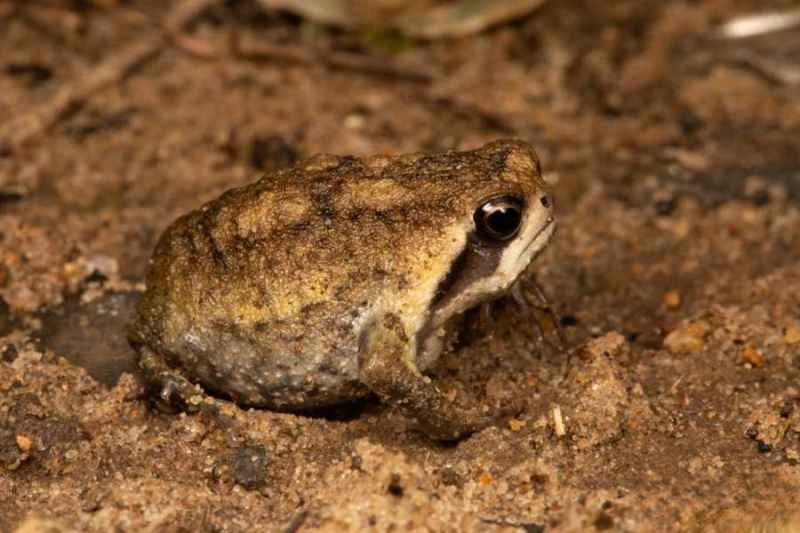
Its body is short, with a brown to dark brown back with irregular mottled patterns, closely resembling damp leaves and dead branches; its limbs are short and powerful, without obvious webbing or suckers, making them more suitable for crawling and short jumps in the leaf litter; its ventral side is lighter in color.
Detailed introduction
The Rain Whistling Frog ( Austrochaperina pluvialis ) is a very small native Australian frog, belonging to the family Microhylidae. It primarily inhabits the floor of Queensland's humid tropical rainforests and is named for its clear, monotonous whistling call, which can echo throughout the rainforest floor on damp nights during the rainy season.
Classification and nomenclature
Common Chinese name: Rain Whistle Frog (direct translation from English name; Chinese name is not yet standardized)
English name: Rain Whistling Frog
Scientific name: Austrochaperina pluvialis
Family: Microhylidae → Genus: Austrochaperina
Appearance and Identification Features
The rain whistle frog is small in size, but it has good camouflage on the rainforest floor.
Size: Adults are about 2–3 cm in length, making them very small terrestrial frogs;
Body color: The back is mostly brown, dark brown or brownish-black, often accompanied by irregular spots and cloud-like patterns;
Camouflage: The mottled brown and black patterns are similar in color to damp fallen leaves, dead branches and soil, which can help it hide well on the rainforest ground;
Body shape: The body is slightly stocky and short, the head is small, and the limbs are short and powerful;
Abdomen: The abdomen is lighter in color, mostly grayish-white or pale yellowish-gray;
Limb characteristics: The hands and feet have almost no obvious webs, the tips of the fingers and toes are slightly enlarged, but there are no obvious suction cups, which makes them suitable for walking in the leaf litter rather than climbing trees;
Eyes: The eyes are relatively large compared to the body size, and the dark irises match the body color, making the overall appearance less noticeable to predators.
Distribution range and habitat
The rain whistle frog is a species endemic to the humid tropical region of Queensland, Australia .
They are mainly distributed in the wet tropical rainforest region of northeastern Queensland.
Records have been made of rainforests ranging from low-altitude valleys to mid-altitude mountain rainforests.
Typical habitat characteristics include:
Dense tropical rainforests and cloud forests;
The ground was covered with a thick layer of fallen leaves, dead branches, decaying wood, and moss;
They are often found around damp tree roots, under fallen logs, in crevices between rocks, and in piles of fallen leaves;
Even far from obvious bodies of water, they can reproduce and live on suitable, moist ground.
Lifestyle
The rain whistle frog is a nocturnal, terrestrial frog .
During the day, they mostly hide in the leaf litter, rock crevices, or under fallen trees, clinging to the damp substrate;
They are most active from dusk to night, especially during the rainy season or on damp, warm nights after rain.
Frogs are not good at long-distance jumps; they rely more on short jumps and slow crawling to move on the ground.
Calls and Rainy Season Activities
The call of the rain whistle frog is one of its most distinctive features:
Male frogs emit clear, short, and repetitive whistling sounds on wet nights during the rainy season;
The sound of a single individual is not particularly loud, but when multiple individuals call out at the same time in the rainforest, it is as if a layer of "whistling background sound" is spread on the ground;
Because its call is clear and simple, it is easily mistaken for the call of some small bird.
feeding habits
The rain whistle frog primarily preys on small invertebrates living on the rainforest floor and in the leaf litter layer.
Tiny insects such as ants, beetles, and springtails;
Various small arthropods that live in fallen leaves and mosses;
They take advantage of nocturnal activity to slowly move across damp ground and hunt passing prey.
Special reproductive method: direct development
The rain whistle frog belongs to the family Microraptoridae, and its reproductive method features "direct development," skipping the aquatic stage of the tadpole .
Female frogs lay their eggs in damp fallen leaves, mud, or hidden crevices, rather than in ponds or streams;
The eggs develop on land, and the embryo completes most of the metamorphosis from "embryo to frog" directly in the egg;
What emerges from the eggs during hatching is no longer a swimming tadpole, but a tiny "frog" that already has four limbs and can live on the ground;
This reproductive method allows the species to adapt to the complex and rapidly changing water environment of the rainforest, without relying on stable water bodies.
Protecting the status quo and threats
The rain whistling frog is currently assessed as Least Concern (LC) on the IUCN Red List, and its overall population is considered relatively stable within its range.
Potential threats include:
Fragmentation and reduction of tropical rainforest habitats (e.g., logging, development, and road construction);
Climate change's impact on rainfall patterns and cloud humidity may alter surface humidity conditions;
Large-scale extreme weather events cause short-term disturbances to the surface ecology of local rainforests.
Protecting the Queensland wet tropical rainforest and its surface microenvironment is crucial for the rain whistling frog and other small rainforest frogs that depend on the leaf litter layer.
Frequently Asked Questions
Q1: Why is it called the "Rain Whistle Frog"?
The name comes from the clear whistling sound it makes during the rainy season or on wet nights after rain. The rhythm is monotonous and regular, sounding like whistling on the rainforest floor.
Q2: Do rain whistle frogs need to be near water to reproduce?
No. It uses a "direct development" method, laying its eggs in moist fallen leaves or soil, and hatching directly into small frogs, completely skipping the aquatic tadpole stage, so it does not depend on ponds or streams.
Q3: How do you find the rain whistle frog in the rainforest?
Its size and color are very camouflage, making it difficult to spot visually. The best way is to first identify its clear "whistling" call, and then carefully examine the area around the fallen leaves and rocks along the sound source.
Q4: What role does the rain whistling frog play in the rainforest ecosystem?
By preying on large numbers of tiny invertebrates, it helps maintain the balance of the small animal community in the leaf litter layer, while also providing food for snakes, birds and small mammals, making it an important part of the rainforest food web.


