Basic Information
Scientific classification
- Chinese name: Broodling frog
- Scientific name: Assa darlingtoni
- Order: Anura
- Family and Genus:
Vital signs data
- Body length: Adults are about 2.0–2.7 cm in length, belonging to the very small, completely terrestrial frogs.
- Weight: Individual weight is only a few grams, varying with size and nutritional status.
- Lifespan: It is estimated that it can survive for several years in the wild and can participate in reproduction multiple times in stable, high-altitude, humid forests.
Significant features
The miniature terrestrial frog, found in the high-altitude rainforests of eastern Australia, is known for the brood pouches on the sides of the male's abdomen carrying tadpoles. Reproduction occurs entirely outside the water, making it a unique "terrestrial brooding" species among amphibians.
Distribution and Habitat
It is found only in the mountain rainforests and moist sclerophyllous forests of southeastern Queensland to northern and north-central New South Wales in eastern Australia. It mainly inhabits forest surface environments with high altitudes, long-term humidity, thick leaf litter, and decaying wood cover.
Appearance
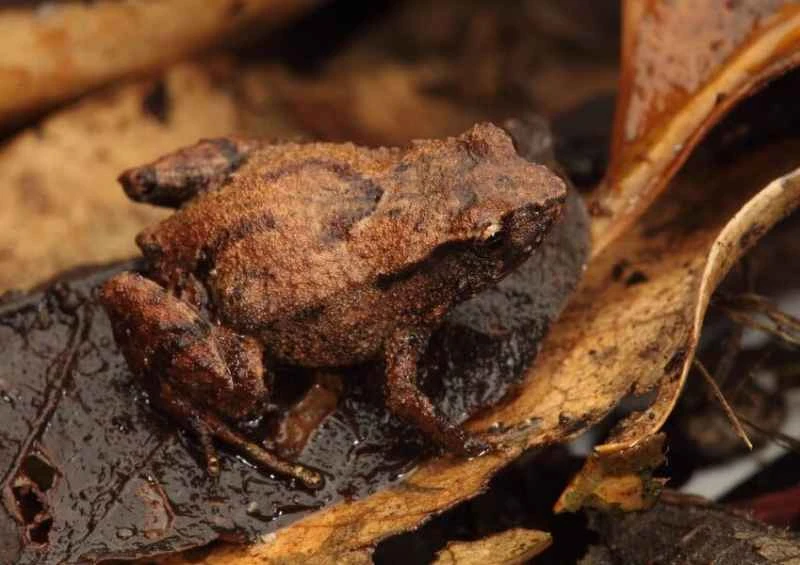
It is small in size and slightly flattened in body. Its back is reddish-brown or grayish-brown with light-colored spots and possible inverted V-shaped patterns. Its sides have dark stripes and obvious skin folds. Its belly is light-colored. Its hands and feet have no obvious webs or suckers, and its fingers and toes are slightly enlarged, making it more suitable for slowly crawling among moist fallen leaves and decaying wood.
Detailed introduction
The pouched frog ( Assa darlingtoni ) is a small, entirely terrestrial frog native to Australia. It is also commonly known as the "hip-pocket frog." Belonging to the family Myobatrachidae, it is famous for the "brood pouches" on the sides of the male's body—after hatching, tadpoles burrow into these subcutaneous pouches on either side of the male's rump to complete their tadpole stage. This is one of the most unique reproductive methods among amphibians.
Classification and nomenclature
Common Chinese names: Bryonic sac frog, Sac-like frog (slight variations depending on the source).
English names: Pouched Frog, Hip-pocket Frog, Australian Marsupial Frog, etc.
Scientific name: Assa darlingtoni
Family: Myobatrachidae → Genus: Assa
Appearance and Identification Features
The brooding frog is very small, but has unique physical characteristics:
Size: Adults are about 2.0–2.7 cm in length, belonging to the miniature frog family;
Body color: The back is mostly reddish-brown, brown or grayish-brown, some individuals have light brown or inverted V-shaped markings, as well as small light-colored spots;
Lateral stripe: Most individuals have a dark stripe on their side that extends from the nostril through the eye to the side of the body;
Skin folds: There are obvious skin folds on both sides of the body that extend from the eyes backward and connect to the buttocks;
Abdomen: The abdomen is mostly light-colored or grayish-white and relatively uniform;
Limbs and toes: The hands and feet have almost no webs or suction cups, and the tips of the fingers and toes are slightly enlarged, making them more suitable for crawling and walking on the forest floor than for long-distance jumping;
"Brood sac": Males have subcutaneous brood sacs on both sides of their buttocks, where tadpoles develop, hence the name.
Distribution range and habitat
The brooding frog is a species endemic to the high-altitude rainforests and humid woodlands of eastern Australia .
It is mainly distributed in the mountainous regions from southeastern Queensland to northern and north-central New South Wales;
It is commonly found in high-altitude, high-humidity mountain rainforests and adjacent wet sclerophyll forests.
Its habitat has the following characteristics:
The forest floor remains moist for a long time, with a thick layer of fallen leaves, decaying wood, and abundant moss;
They are mostly found in valleys, shady and damp slopes, and misty rainforests;
They usually hide under rocks, fallen logs, piles of leaves, and near tree roots, and rarely appear on open ground.
Lifestyle
The brooding frog is a completely terrestrial frog that lives in seclusion .
They mostly live in damp forests rather than relying on ponds or streams for survival;
They primarily crawl slowly and jump short distances, and are not good at large jumps.
During the day, they mostly hide under fallen leaves and decaying wood, and come out to be active at night or when the humidity is high.
Its call is relatively soft and not loud; it is a series of short "eh-eh-eh…" syllables, which are often more noticeable at dawn and dusk.
feeding habits
Like most small terrestrial frogs, the broodstock frog primarily feeds on tiny invertebrates:
Small insects, such as ants, beetle larvae, and small beetles;
Small spiders, springtails, and other arthropods that live in the leaf litter layer;
They move slowly through layers of damp leaves and moss, hunting passing prey.
Unique breeding and parenting methods
The broodstock frog has a very unique reproductive method, being a well-known example of frogs that practice "broodstock nurturing" :
Reproduction mostly takes place during the humid seasons of spring and summer.
Female frogs lay their eggs under damp fallen leaves, rotten wood, or rocks. The eggs develop on land, not in water.
Both male and female frogs will guard the eggs for a period of time to prevent them from drying out or being eaten.
After the eggs hatch, the tiny tadpoles emerge from the egg mass and actively crawl into the brood pouches on both sides of the male frog's buttocks.
Tadpoles complete their entire tadpole stage within the brood pouch, without needing to live in water, relying on the yolk and the pouch environment for development;
Only after metamorphosis is complete do the young frogs crawl out of the sac and enter the forest surface as miniature adult frogs.
Protecting the status quo and threats
On a global scale, the IUCN Red List currently assesses the brood frog as Least Concern (LC) , but in Australia's domestic conservation system, it has been listed as a Vulnerable species.
The main threats include:
Loss and fragmentation of high-altitude rainforest and humid forest habitats (logging, roads, development, etc.);
The damage to the rainforest surface microenvironment caused by extreme forest fires and changes in fire frequency;
Climate change has led to altered rainfall and cloud patterns, making previously humid mountain environments drier.
Diseases such as amphibian chytriditis may affect local populations.
Due to its limited distribution range and strong dependence on moist forest surfaces, maintaining high-altitude rainforests and related protected areas is particularly important for the long-term survival of the bursal frog.
Frequently Asked Questions
Q1: Why is the brooding frog called "bag frog" or "butt bag frog"?
The name comes from the brood pouches on either side of the male frog's rump. After the eggs hatch on land, the tadpoles do not enter the water, but instead crawl into the "pockets" on either side of the male frog to develop until they are fully grown froglets.
Q2: Do brood frogs need ponds or streams to reproduce?
No. Their eggs are laid under damp fallen leaves and decaying wood, and the tadpoles develop in the male frog's brood pouch. The entire process takes place on land, making it a reproductive mode completely detached from water.
Q3: Are brood frogs easy to spot in the wild?
It's not easy. They are small, their color is similar to fallen leaves, and they like to hide under rocks and decaying wood, making them very well-hidden most of the time.
They can often only be detected by getting close and hearing their faint calls.
Q4: What is the role of the brood frog in the ecosystem?
It helps maintain the micro-ecological balance of the forest surface by preying on large numbers of small invertebrates living in the leaf litter layer.
It also provides food for snakes, birds and small mammals, and is part of the mountain rainforest food web.