Basic Information
Scientific classification
- Chinese name: White-bellied Piranha
- Scientific name: Ceryle alcyon, Belted Kingfisher
- Classification: Climbing birds
- Classification: Order Coraciiformes, Family Kingfisher, Genus Iguana
Vital signs data
- Body length: 28-35 cm
- Weight: 140-170g
- Lifespan: No verification data available.
Significant features
The forehead and top of the head are dark blue feathers, while the underside and tail are entirely white, with varying shades of pale yellow or yellow.
Distribution and Habitat
The white-bellied kingfisher is distributed in North America (including the United States, Canada, Greenland, Bermuda, Saint Pierre and Miquelon, and the transitional zone between North and Central America within Mexico), Central America (located between North and South America, including Guatemala, Belize, Honduras, El Salvador, Nicaragua, Costa Rica, Panama, the Bahamas, Cuba, Haiti, Jamaica, Dominican Republic, Antigua and Barbuda, Saint Vincent and the Grenadines, Saint Lucia, Barbados, Grenada, Trinidad and Tobago, etc.), and South America (including Colombia, Venezuela, Guyana, Suriname, Ecuador, Peru, Bolivia, Paraguay, Brazil, Chile, Argentina, Uruguay, and the Falkland Islands).
White-bellied dogfish live in different types of aquatic habitats: lakes, streams, coastlines, mangroves, bays, swamps, rivers, reservoirs, and calm seas.
Appearance
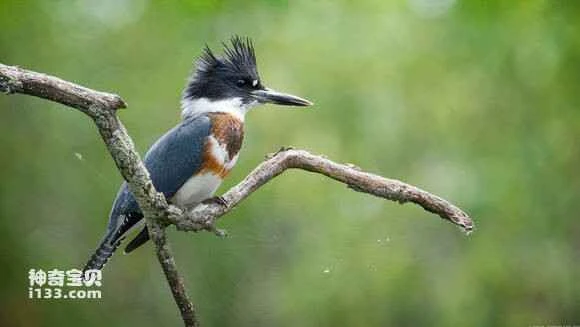
The White-bellied Kingfisher measures 28-35 cm in length, has a wingspan of 48-58 cm, and weighs 140-170 g. Its forehead and crown are dark blue, with white lores. The cheeks are black. It has a white collar, and the black ring around the neck is sometimes discontinuous. The back, tail, and wings are dark brown. The back feathers have scaly markings. The underside and tail are entirely white, with more or less pale yellow, pink, or yellow hues. Some birds have fine black markings on their chin, throat, and breast.
The head has a grey crest, with head feathers spreading to the neck. The throat and neck are white, with brown feathers intermingled between the white belly and grey breast. The female has a red band overlapping the grey band on the belly. The legs are short, and the weight, head, and neck are particularly disproportionate to the rest of the body.
It is relatively large in size. The beak is long and laterally flattened with a rounded ridge; the nasal groove is prominent; the first primary flight feather is shorter than the second, and the second or third is the longest; the tail is longer than the beak; the body feathers are mottled with black and white.
Detailed introduction
The white-bellied kingfisher, scientifically known as *Ceryle alcyon*, has no subspecies.
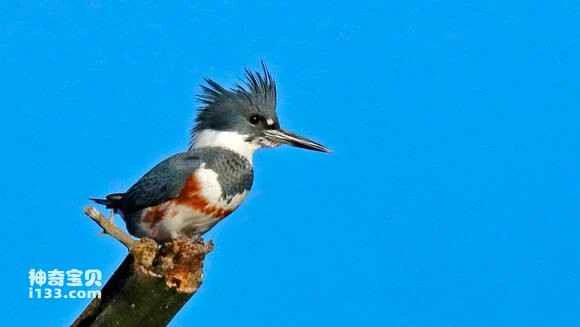
The white-bellied kingfisher emits a distinct call as a warning when threatening intruders or when acting as a partner. They are highly territorial, and most of their homeland defense is achieved through vocal commands or calls to intimidate others. Their calls resemble the knocking of vibrating machinery. Between two partners, a short, sharp screech is used as a threat. Their hunting methods are similar to other kingfishers. This species migrates, although they can tolerate the harsh cold of the North American climate. Their main diet consists of fish, mostly trout, scorpion, and Atlantic salmon, and they typically consume small fish. When fish are scarce, they also eat mollusks, crustaceans, aquatic insects (dragonflies), amphibians, reptiles, other young birds, small mammals, and berries.
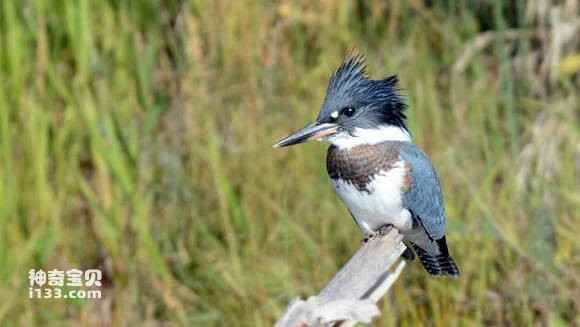
During the egg-laying period, the white-bellied kingfisher actively defends its territory. The male, in particular, reacts immediately by raising its feathers to warn of any potential intruders. This species is monogamous; the male sings to the female and provides her with food. Once mating is established, both parents will jointly select a site along the riverbank and dig a nest about 80 cm long in loose sand or clay. The nest is usually built near fishing areas. The female typically lays 6 to 8 eggs at a time, with incubation lasting 22 to 24 days. Both parents take turns incubating the eggs. The chicks usually leave the nest on the 28th day but remain with their parents for about three weeks.
Listed as Least Concern (LC) in the IUCN Red List of Threatened Species 2016 ver 3.1.

Protect wild animals and ban the consumption of wild game.
Maintaining ecological balance is everyone's responsibility!