Basic Information
Scientific classification
- Chinese name: Crested Dogfish
- Scientific name: Crested Kingfisher (Megaceryle lugubris)
- Classification: Climbing birds
- Classification and genus: Order Coraciiformes, Family Kingfisher, Genus Kingfisher
Vital signs data
- Body length: 37.2-42.5 cm
- Weight: 244-500g
- Lifespan: No verification data available.
Significant features
With a prominent crest
Distribution and Habitat
Crested dogfish originates from: Afghanistan, Bangladesh, Bhutan, China, India, Japan, South Korea, Lao People's Democratic Republic, Myanmar, Nepal, Pakistan, Thailand, and Vietnam.
Migratory bird: Russian Federation.
Crested kingfishers inhabit forest streams, plains at the foot of mountains, thickets or sparse forests, clear and slow-flowing rivers, brooks, lakes, and irrigation canals. They often fly over rivers, streams, ponds, and marshes, looking down to hunt for food.
Appearance
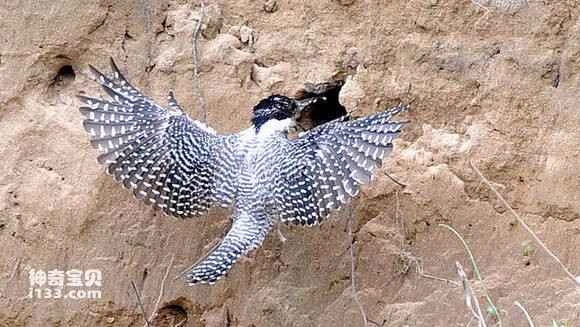
The Crested Kingfisher is a medium-sized crested kingfisher. It measures 24-26 cm in length, has a wingspan of 45-47 cm, weighs 70-95 grams, and has a lifespan of 4 years. This kingfisher has a prominent crest on its head. The head is black with many large white oval or other shaped spots; the center of the crest is almost entirely white with only a few white round spots. The underside of the mouth, nape, and hindneck are white. The back, rump, and undertail coverts are greyish-black, each feather also bearing many white horizontal bars. The wings are black, with each primary flight feather having many less-than-round white round spots, and each secondary flight feather having many neat white horizontal bars. The chin and throat are white, with a thick black line extending from below the mouth to the forechest. The forechest is black with many white horizontal bars; the lower chest, belly, and short undertail coverts are white; the long undertail coverts and flanks, similar to the forechest, are black and white. The iris is brown; the corners of the mouth are black, with a pale greenish-brown base and tip of the upper mandible; the legs are flesh-colored.
The main difference between the subspecies lies in the fact that the nominate subspecies has a lighter upper body, wider white patches, and more white patches on the inner webs of the flight feathers; while the common subspecies has a darker upper body, narrower white patches, and fewer white patches on the inner webs of the flight feathers.
The beak is thick, straight, long, and strong, with a rounded ridge; the nasal groove is indistinct; the wingtips are long, with the first primary flight feather being slightly shorter, and the third and fourth being the longest; the tail is short and rounded; the head is large, the neck is short, the wings are short and rounded, and the tail is also mostly short; the beak is large and pointed, with a blunt cusp; the legs are very short, the toes are thin and weak, the fourth toe is mostly fused with the third toe, and only fused with the second toe at the base. The preen gland is covered with (protruding feathers). Coracoid bones are present on both sides, and there are four notches on the posterior margin of the sternum; the manubrium of the sternum is simply formed by external spines.
Size measurements: Weight: ♂ 244-322 g, ♀ 300-500 g; Body length: ♂ 372-425 mm, ♀ 395-425 mm; Bill length: ♂ 57-78 mm, ♀ 72-75 mm; Wing length: ♂ 182-196 mm, ♀ 182-200 mm; Tail length: ♂ 114-129 mm, ♀ 115-130 mm; Tarsus length: ♂ 12-15 mm, ♀ 14-16 mm. (Note: ♂ male; ♀ female)
Detailed introduction
The crested kingfisher, scientifically known as *Megaceryle lugubris*, has three subspecies: 1. the common subspecies *Megaceryle lugubris guttulata*; 2. the Hokkaido subspecies *Megaceryle lugubris pallida*; and 3. the nominate subspecies *Megaceryle lugubris lugubris*.

Crested kingfishers typically fly along the middle of streams, swooping down swiftly and nimbly once they spot prey. They usually perch alone on treetops, telephone poles, or rocks near the water, waiting for their prey. They place their catch on their perch, manipulating it and sometimes even tossing the fish into the air to swallow it headfirst. Their diet consists mainly of small fish, supplemented by crustaceans, various aquatic insects and their larvae, as well as small frogs and a small amount of aquatic plants. Crested kingfishers maintain excellent vision even underwater because their eyes can quickly adjust to the visual contrast caused by light changes in the water. This makes them highly skilled at catching fish. Their call is similar to a sharp whistle.

The breeding season for crested kingfishers is from February to August, with most breeding in May and June. Nests are built on steep banks, cliffs, field embankments, or dikes of fields and streams. They dig small, round burrows with their beaks, usually without lining. Eggs are laid directly on the ground. Each clutch contains 3-7 eggs, mostly 4-6. The eggs are oval, pure white, glossy, and slightly spotted, measuring approximately 37-40 mm × 30-35 mm. There are 1-2 clutches per year; the incubation period is about 21 days. Both parents incubate the eggs, but only the female feeds the chicks. In northern regions, crested kingfishers nest in spring and summer. In northern tropical regions, they lay eggs from September to March, and in the south from April to August. In equatorial regions, nesting and egg-laying can occur at any time of year.
Listed as Least Concern (LC) on the IUCN Red List of Threatened Species 2012 ver 3.1.
Protect wild animals and ban the consumption of wild game.
Maintaining ecological balance is everyone's responsibility!