
Basic Information
Scientific classification
- Chinese name: Big Fish Dog
- Scientific name: Megaceryle maxima, Giant Kingfisher
- Classification: Climbing birds
- Classification and genus: Order Coraciiformes, Family Kingfisher, Genus Kingfisher
Vital signs data
- Body length: 42-48 cm
- Weight: 255-426g
- Lifespan: No verification data available.
Significant features
It is the largest kingfisher in Africa.
Distribution and Habitat
Distributed in south-central Africa, including Angola, Benin, Botswana, Burkina Faso, Burundi, Cameroon, Central African Republic, Chad, Congo, Democratic Republic of Congo, Côte d'Ivoire, Equatorial Guinea, Eritrea, Ethiopia, Gabon, Gambia, Ghana, Guinea, Guinea-Bissau, Kenya, Lesotho, Liberia, Malawi, Mali, Mauritania, Mozambique, Namibia, Niger, Nigeria, Rwanda, Senegal, Sierra Leone, South Africa, South Sudan, Sudan, Swaziland, United Republic of Tanzania, Togo, Uganda, Zambia, and Zimbabwe.
They mainly inhabit forest streams, plain valleys, reservoirs, ponds, and even the banks of paddy fields.
Appearance
The Great Kingfisher is a relatively large waterbird. It measures 42-48 cm in length and weighs 255-426 grams. It has a crest on its head, and its black upperparts are speckled with numerous large, beautiful white oval or other shaped spots. The female has a chestnut belly and a black breast with white spots. The male has darker spots on its sides, a chestnut breast, and a white belly with black spots. The underside of the bill, nape, and hindneck are white; the back, rump, and undertail coverts are greyish-black, each feather also bearing numerous white spots. The wings are black, with each primary flight feather having numerous, not-so-round, white spots, and each secondary flight feather having numerous neat white horizontal bars. The chin and throat are white, and a thick white stripe extends from the neck to the breast. The iris is brown; the corners of the bill are black, with a pale greenish-brown base and tip of the upper mandible; the legs are flesh-colored.
The beak is large, long and pointed, laterally flattened like a spear, with a rounded ridge; the nasal groove is prominent; the wingtips are prominent, with the first primary flight feather shorter than the second, and the second or third being the longest; the tail is longer than the beak; the head is large, the neck is short, the wings are short and rounded, and the tail is also short; the beak ridge is rounded and blunt, the legs are very short, the toes are thin and weak, the fourth toe is mostly fused with the third toe, and only fused with the second toe at the base. The preen gland is covered with (feathers).
Detailed introduction
The Giant Kingfisher, scientifically known as *Megaceryle maxima*, has two subspecies: the nominate subspecies (*M. m. maxima*), found in open terrain, and the rainforest subspecies (*M. m. gigantea*), found in rainforest areas. The rainforest subspecies is slightly darker in color, with fewer spots on the upper half and more patches on the lower half. The two subspecies interbreed at forest edges.
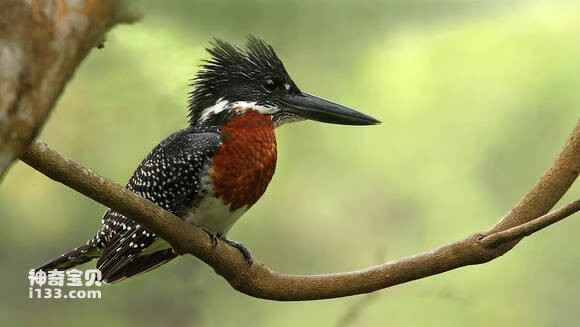
The kingfisher barks incessantly as it flies, especially when it rapidly dives into the water to hunt, its bark becoming even louder. It is solitary, usually perching alone near water, including on branches or rocks near streams, estuaries, seashores, and polluted ponds. It commonly hunts along water-ploughed furrows in the arid plateaus and irrigated areas of southern Africa, using methods similar to the kingfisher: swooping down on the water's surface or diving in to catch prey; sometimes it can even disappear completely underwater. Other times, it flaps its wings and hovers about 3-10 meters above the water, seemingly suspended above the surface, then immediately plunges into the water to hunt its prey.
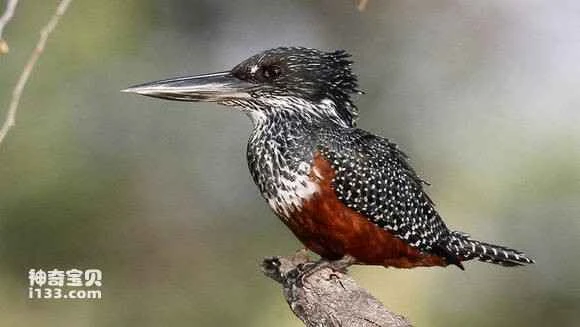
The Great Pitfish primarily feeds on small fish, supplemented by crustaceans, various aquatic insects and their larvae, as well as small frogs and small amounts of aquatic plants. It is entirely carnivorous, with its diet varying by region: in Liberia and South Africa, it mainly consumes freshwater crabs, while in Zaire, it primarily eats fish. It can swallow small crabs whole, and will tear apart crustaceans with 35-45 mm carapaces before swallowing. To supplement its diet, it also hunts various mosquitofish (3-7 cm long), small freshwater fish, frogs, toads, centipedes, and small reptiles. Juveniles mainly eat fish: the largest fish they prey on can reach 18 cm in length.
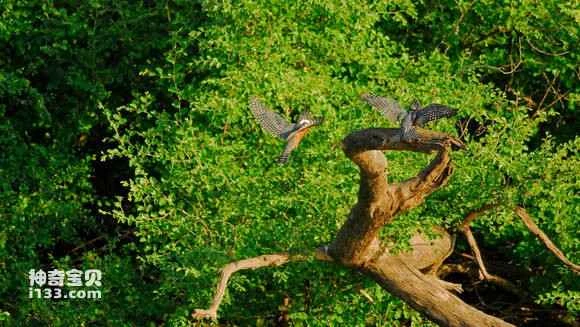
The Great Pitfish is monogamous, with its breeding season from August to January. It digs tunnel-like burrows in the banks of rivers and streams, using its beak to create nests that are 11 cm high, 15 cm wide, and 2 meters deep. The female incubates the eggs alone. The nest is unlined. Each clutch contains 2-3 eggs, which are round, with a sturdy, smooth, white shell with small spots. The incubation period is 22-24 days. The chicks are altricial.
Listed as Least Concern (LC) in the IUCN Red List of Threatened Species 2016 ver 3.1.
Protect wild animals and ban the consumption of wild game.
Maintaining ecological balance is everyone's responsibility!


