Basic Information
Scientific classification
- Chinese name: Eastern snake-necked turtle
- Scientific name: Chelodina longicollis
- Classification: Testudines
- Family and genus: *Pterygota* (family Serpentidae)
Vital signs data
- Body length: The carapace length of adults is usually about 20–30 cm, and some large individuals can exceed 30 cm. When the neck is fully extended, the length can be the same as or even longer than the carapace.
- Weight: Weight varies depending on individual size and sex, with most adults weighing approximately 0.5–1.5 kg.
- Lifespan: The Eastern Snake-necked Turtle is a long-lived freshwater turtle that can live for decades in the wild. Under good captive conditions and proper management, its lifespan can exceed 30 years.
Significant features
The typical "side-necked turtle" has an unusually long and thin neck and a unique way of folding its neck to the side. When threatened, it can also secrete a gland with a strong odor. It is a highly recognizable native turtle species in the freshwater ecosystem of eastern Australia.
Distribution and Habitat
Widely distributed in still or slow-moving water bodies such as rivers, lakes, swamps, farmland irrigation ditches, reservoirs, and pasture water storage ponds in eastern and southeastern Australia, they prefer environments with aquatic plants, muddy bottoms, and fallen logs, rocks, and shore platforms for sunbathing. When drought occurs or water bodies dry up, they will burrow into the mud or land to seek temporary shelter.
Appearance
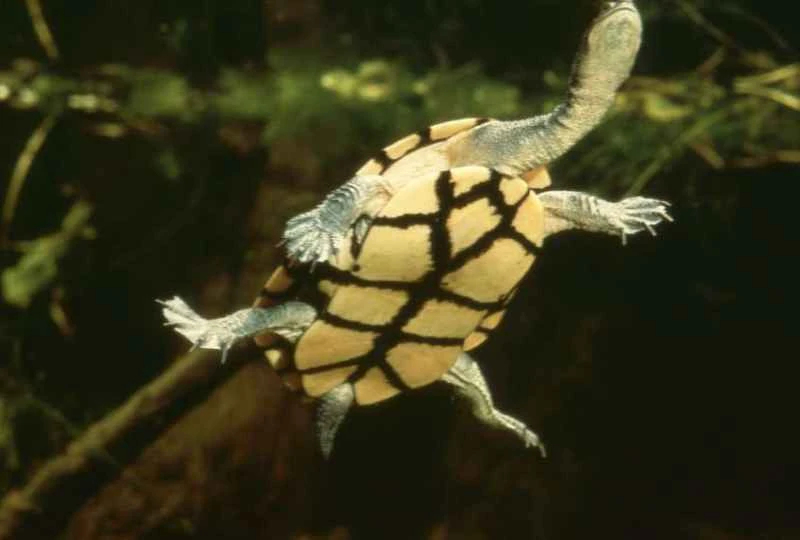
The carapace is oval or slightly heart-shaped, mostly dark brown, blackish-brown, or olive-colored on the back, while the plastron is pale yellow or cream-colored with dark spots; the limbs are stout and the toes have well-developed webbing. The most distinctive feature is the long, slender, and highly extendable "snake-like neck," which, when fully extended, is almost as long as or exceeds the length of the carapace.
Detailed introduction
The Eastern Snake-necked Turtle ( Chelodina longicollis ), commonly known as the Eastern Long-necked Turtle, is a freshwater turtle belonging to the genus Chelodina in the family Chelodinaidae. It is widely distributed in rivers, lakes, swamps, and farmland ponds in eastern Australia, and is one of the most common freshwater turtles there. When threatened, the Eastern Snake-necked Turtle not only quickly retracts its long neck to one side of its shell but also secretes a glandular fluid with a strong odor, hence its nickname "Stinky Turtle."
Classification and nomenclature
The Eastern Snake-necked Turtle belongs to the class Reptilia, order Testudines, family Chelidae, and genus Chelodina . Chelodina are typical "side-necked turtles," unlike most "hidden-necked turtles" which can retract their heads into their shells. They fold their long necks laterally, hiding them on one side of their carapace. The specific epithet "longicollis" in Chelodina longicollis means "long neck," accurately describing its most prominent morphological feature. The English names Eastern Snake-necked Turtle or Eastern Long-necked Turtle both emphasize its distribution area and long-necked characteristic.
Appearance features
The Eastern Snake-necked Turtle is medium-sized, with an oval or slightly heart-shaped carapace, typically dark brown, blackish-brown, or dark olive-colored, with smooth or slightly serrated edges. The plastron is mostly pale yellow or cream-colored, often covered with small dark spots or marbled patterns. Its most striking feature is its unusually long neck, which, when fully extended, can be as long as or even longer than its carapace. The head is relatively small, with a slightly pointed snout and medium-sized eyes. The limbs are robust, with well-developed webbing between the toes, adapted for swimming in water and crawling on muddy bottoms. Overall, it resembles a "normal-sized freshwater turtle with an exceptionally long, snake-like neck," making it highly recognizable.
Distribution range and habitat
The Eastern Snake-necked Turtle is mainly distributed in eastern and southeastern Australia, found in inland waters from southeastern Queensland to New South Wales, the Australian Capital Territory, Victoria, and parts of South Australia. It prefers still or slow-moving waters, such as gentle sections of rivers, lakes, swamps, agricultural irrigation ditches, reservoirs, and pasture water storage ponds. As long as there are sufficient aquatic plants, muddy bottoms, and basking spots (fallen logs, rocks, or riverbank platforms), the water is suitable for its settlement. During dry seasons or when water bodies temporarily dry up, the Eastern Snake-necked Turtle will burrow into the mud, hide in riverbank soil, or in concealed locations on land to "aestivate," waiting for the aquatic environment to recover.
Lifestyle Habits and Behaviors
The Eastern Snake-necked Turtle is a semi-aquatic species, spending most of its time in the water, but it also frequently comes ashore to bask in the sun or "walks" between habitats. They are mostly active during the day when temperatures are suitable, being most active in the early morning and afternoon. When threatened, in addition to quickly diving or hiding in aquatic plants and muddy bottoms, they will fold their long neck to one side of their shell and secrete a strongly scented yellow or brown liquid from their tail and glands to scare away predators, hence the local nickname "Stinky Turtle." In suitable waters, Eastern Snake-necked Turtles are often seen floating on the surface, stretching their heads to breathe, or basking on fallen logs.
feeding habits
The Eastern Snake-necked Turtle is a carnivorous omnivorous freshwater turtle, primarily preying on various small aquatic and semi-aquatic animals. Typical prey includes small fish, tadpoles and adult frogs, aquatic insects and larvae, crustaceans (such as small shrimp), mollusks (such as snails and clams), aquatic invertebrates, as well as insects falling to the water's surface and occasionally carrion. They use their long necks to quickly extend their heads to ambush prey in the water, and sometimes they also slowly search for edible matter on the bottom. Under captive conditions, they are generally provided with fish, small shrimp, insects, a moderate amount of meat, and a small amount of aquatic plants or pellet food to meet their nutritional needs.
Reproduction and life cycle
The Eastern Snake-necked Turtle is an oviparous species. The breeding season typically occurs during the warmer months, with males courting females through chasing and gentle nipping. After mating, the female climbs ashore and digs an egg-laying pit in soft sand or mud. The number of eggs laid varies depending on the size of the individual turtles, generally between 10 and 25. After laying the eggs, the female covers the nest with mud to camouflage it and leaves the eggs to incubate naturally. Incubation time is greatly affected by temperature and humidity. The hatchlings are tiny, resembling adults but much smaller in proportion, and need to immediately adapt to their aquatic and terrestrial environment, learning to forage and defend themselves. Eastern Snake-necked Turtles grow slowly but have a long lifespan, surviving for decades in the wild and even exceeding 30 years in captivity under favorable conditions.
Relationship with humans
Eastern snake-necked turtles are non-venomous and do not attack humans unless provoked. They typically bite or secrete a foul-smelling liquid only when caught or handled roughly. They play a vital role as small to medium-sized predators in freshwater ecosystems, feeding on fish, insect larvae, and other aquatic animals. In some areas, they are kept as educational exhibits and pets, but owners must provide sufficient water space, basking platforms, clean water, and a suitable diet, strictly adhering to local wildlife protection regulations and prioritizing legally bred individuals. For the general public, the best approach when encountering eastern snake-necked turtles in the wild or farm waters is to observe them from a distance and avoid capturing or removing them.
Protecting the status quo and threats
Currently, the Eastern Snake-necked Turtle is not generally considered an endangered species and is typically classified as "Least Concern" on the IUCN Red List, remaining common in many suitable bodies of water and artificial ponds. However, local populations may be affected by wetland reclamation, water pollution, altered hydrological conditions due to water conservancy projects, road traffic fatalities, and predators such as domestic dogs and foxes. Improper use of fishing nets and traps in aquaculture can also lead to accidental capture and drowning. Effective measures for protecting the Eastern Snake-necked Turtle include: maintaining and restoring wetland and slow-flowing aquatic ecosystems, reducing pesticide and heavy metal pollution, establishing wildlife crossings or warning signs in areas where roads traverse wetlands, and raising public awareness of the importance of native freshwater turtles through public education.
Frequently Asked Questions
Q1: Are Eastern Snake-necked Turtles poisonous? Could they pose a danger to humans?
Eastern snake-necked turtles do not have venom glands and are not considered venomous animals, generally posing no serious threat to humans. They may bite or spray a foul-smelling liquid when caught or strongly disturbed, but this is primarily a defensive behavior, and bites usually only cause minor skin abrasions.
Q2: Why do Eastern snake-necked turtles have a "stinky smell"?
When threatened, the Eastern Snake-necked Turtle secretes a strongly scented, brownish-yellow liquid from glands near its tail as a chemical defense to scare away predators and intruders. This odor can linger in the air for a period of time, hence its local nickname, "Stinky Turtle."
Q3: Are Eastern Snake-necked Turtles suitable for keeping in a home environment?
Subject to legal permission and relevant permits, Eastern snake-necked turtles can be kept as ornamental turtles, but require a large aquatic space, stable water quality, a basking platform, and a varied diet. Keeping them long-lived is also essential. This is not a "beginner" species for inexperienced keepers, and all individuals should be from legally bred captive sources.
Q4: How to protect the Eastern Snake-necked Turtle in the wild or farm waters?
Practical measures include: preserving some natural shorelines and aquatic plants in farmland irrigation ditches and ponds as much as possible; reducing pesticide and heavy metal emissions; setting up speed reduction and wildlife warning signs when roads pass through wetland areas; inspecting and improving fishing nets, lobster traps, and other tools to avoid long periods of unattended operation and accidental capture of freshwater turtles; and not removing or releasing individuals into completely unfamiliar bodies of water when they are found, so as to avoid the spread of diseases and population mixing.


