Basic Information
Scientific classification
- Chinese name: Eastern Water Skink
- Scientific name: Eulamprus quoyii
- Classification: Squamata
- Family and genus: Skinkaceae, Water Skink
Vital signs data
- Body length: Adults typically have a snout-vent length of about 8–11 cm, and the total length including the tail can reach 20–30 cm, making them medium-sized, slender skinks.
- Weight: Weight varies depending on individual size and nutritional status, with most adults weighing between tens of grams and over one hundred grams.
- Lifespan: Individuals in the wild can generally live for several years or more, and in areas with less disturbance and a good environment, they may live for 8–10 years or even longer.
Significant features
A typical semi-aquatic skink, it is slender and agile, often found near streams and ponds. When startled, it quickly jumps into the water and is a highly recognizable native lizard in the aquatic ecosystem of eastern Australia.
Distribution and Habitat
They are mainly distributed along the edges of streams, riverbanks, ponds, reservoirs and wetlands in the eastern coastal and inland areas of Australia. They are often found among rocks, fallen trees, grassy areas and tree roots by the water. They are also commonly seen in urban parks and suburban stream restoration areas.
Appearance
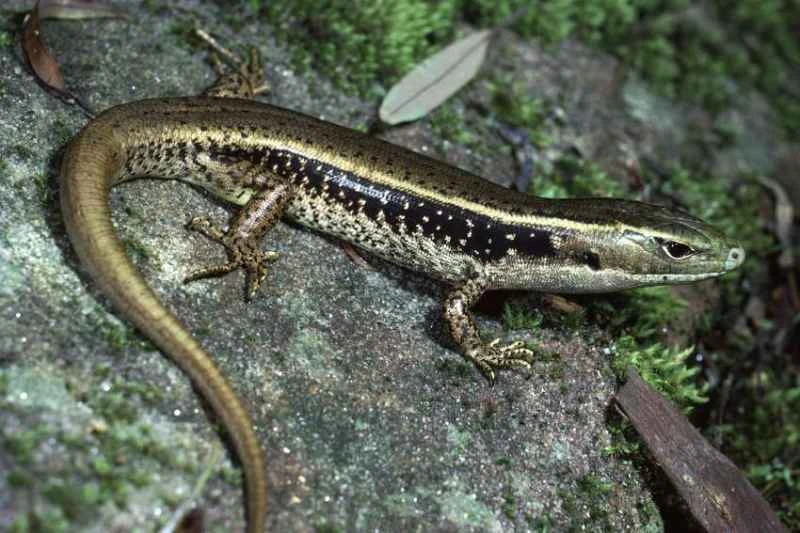
The body is streamlined, with well-developed limbs and long toes, and a slightly triangular head. The back is mostly olive brown or grayish brown, with dark stripes on the sides of the body and small yellow or cream-colored spots. The belly is noticeably brighter, being yellow or light cream-colored. The scales are smooth, and the overall appearance is sleek and glossy.
Detailed introduction
The Eastern Water Skink ( Eulamprus quoyii ) is a medium-sized skink belonging to the family Skinidae and the genus Eulamprus. Widely distributed in eastern Australia, it is a common semi-aquatic lizard found along streams and ponds. Agile and adept swimmers, they are often seen basking on rocks or scrambling rapidly along the water's edge, readily diving into the water when startled. Due to their close relationship with aquatic environments, the Eastern Water Skink is considered one of the representative species of the eastern forest stream ecosystem.
Classification and nomenclature
Eastern water skinks belong to the class Reptilia, order Squamata, suborder Scalypis, family Scincidae, and genus * Eulamprus *. This genus includes various species of water skinks closely associated with streams and wetlands, characterized by their slender bodies, agile limbs, and proficiency in running and swimming. The scientific name * Eulamprus quoyii* commemorates Quoy, an early naturalist who studied Australian zoology. The common English name, Eastern Water Skink, succinctly indicates its distribution area (eastern Australia) and its close connection to aquatic environments.
Appearance features
The Eastern Water Skink has a slender, streamlined body with well-developed limbs and long, flexible toes, adapted for rapid running and climbing. Its head is slightly triangular, with medium-sized eyes and prominent ear openings. The back is generally olive brown, grayish-brown, or bluish-brown, with dark stripes or irregular markings along the sides. The sides are often adorned with small yellow or cream-colored spots, creating a striking "dotted pattern." The underside is brighter, usually yellow, golden, or light cream, sometimes with sparse, small dark spots. The scales on its body are smooth and slightly glossy, appearing particularly vibrant in humid environments and under sunlight.
Distribution range and habitat
Eastern water skinks are mainly distributed in eastern Australia, from southeastern Queensland through New South Wales, the Australian Capital Territory, and parts of Victoria. They can be found in coastal and near-inland forests, scrublands, and urban green spaces. They are highly dependent on water bodies and are commonly found in streams, riverbanks, ravines, ponds, reservoir edges, and woodland wetlands. Typical habitat microenvironments include waterside rocks, fallen logs, riverside grass, and crevices between tree roots. They require both open locations for basking in the sun and bodies of water for quick hiding and diving escape. Eastern water skinks can also be observed in urban parks and suburban stream restoration areas, provided conditions are suitable.
Lifestyle Habits and Behaviors
The Eastern Water Skink is a diurnal lizard, most active during the bright, warm days. They typically bask in the sun on rocks, tree roots, or fallen logs in the early morning and afternoon, then patrol the water's edge in search of food. When startled, they often run and leap into the water, weaving underwater or among the vegetation along the water's edge, before surfacing to observe their surroundings. They are excellent swimmers, using their tails for powerful propulsion. Individuals usually exhibit territoriality; adult males may use display behaviors such as head nodding and sideways postures to intimidate and demarcate boundaries. During colder seasons, their activity decreases significantly, spending more time hiding in crevices, under fallen logs, or in burrows.
feeding habits
The Eastern Water Skink is an omnivorous predator that primarily feeds on animal matter, mainly preying on small invertebrates in waterside and forest edge environments. Common prey includes various insects and larvae (such as beetles, crickets, grasshoppers, and moth larvae), spiders, and millipedes. It also consumes some small aquatic or semi-aquatic organisms, such as insect nymphs near water and insects that have fallen into the water. Larger individuals may occasionally prey on small lizards or amphibian larvae. They typically detect moving prey visually and then sprint to capture it, foraging for food by moving among rocks, leaf litter, and grass near the water.
Reproduction and life cycle
The Eastern Water Skink is an oviparous lizard. The breeding season is generally from spring to early summer. During this period, males expand their range and attract and compete for females through chasing, head nodding, and body display. After mating, the female digs an egg-laying pit in loose soil, under fallen trees, or under rocks. The number of eggs laid per clutch depends on the size and health of the female, typically ranging from a few to more than ten. The eggs incubate under the temperature and humidity provided by the environment. The hatchlings are small but resemble adults and quickly begin to hunt small insects independently. The Eastern Water Skink has a moderate growth rate, reaching sexual maturity within a few years, and can live for several years or even up to ten years in the wild.
Relationship with humans
Eastern water skinks are non-venomous and pose no direct danger to humans, generally fleeing quickly when they sense human approach. They help control mosquitoes and other potential pests to some extent by preying on large numbers of insects and other small invertebrates along streams and water edges. Due to their medium size, beautiful markings, and active behavior, they are occasionally kept as ornamental lizards or used for ecological education demonstrations under legal conditions. However, any keeping or collection should comply with local wildlife protection regulations to avoid illegally capturing wild individuals. For the average tourist and resident, the best way to coexist harmoniously with these semi-aquatic lizards is to quietly observe their natural behavior on stream trails and in urban parks, without capturing or disturbing them.
Protecting the status quo and threats
Currently, the Eastern Water Skink is not generally considered an endangered species, typically listed as "Least Concern" in regional and global assessments, and remains common in many suitable habitats. However, in certain localized areas, they may face pressure from stream channelization, water pollution, riparian vegetation fragmentation, and predators such as domestic cats and dogs. Roads crossing valleys can also pose a risk of being run over by vehicles. Effective measures to protect the Eastern Water Skink include: protecting and restoring natural riparian vegetation and fallen timber structures; reducing pesticide and pollutant emissions; preserving near-natural stream buffer zones in urban and suburban planning; and raising public awareness of the importance of native aquatic lizards through public education.
Frequently Asked Questions
Q1: Can the eastern water skink swim?
Yes. The Eastern Water Skink is a typical semi-aquatic lizard, adept at swimming and diving. When startled, it often jumps directly into the water, quickly swimming away from the danger zone by undulating its body and tail. It briefly hides on the bottom or among aquatic plants before cautiously peeking out to observe its surroundings.
Q2: Are the Eastern Water Skink poisonous? Do they pose a threat to humans?
Eastern water skinks do not have venom glands and are not considered venomous lizards, posing no threat to humans. They are generally extremely wary and afraid of people; as long as you keep your distance and do not attempt to grasp them, biting incidents are unlikely.
Q3: How to observe the Eastern Water Skink in a city park or stream trail?
A better approach is to walk slowly and quietly along the edge of a stream or pond on a sunny, warm day, looking for lizards basking in the sun on rocks, fallen logs, and vegetation along the bank. When you spot an individual, remain quiet and at a safe distance, avoiding quick approaches or sudden movements to prevent them from jumping into the water to hide.
Q4: What role does the presence of the Eastern Water Skink play in the ecosystem?
As small to medium-sized predators, the eastern water skink helps regulate invertebrate populations in riparian and forest edge ecosystems by preying on insects, spiders, and other small invertebrates. Within the food web, they are both predators and preyed upon by higher-level predators such as birds and snakes, playing a crucial role in maintaining the ecological balance along waterways.