Basic Information
Scientific classification
- Chinese name: Red-breasted Woodpecker
- Scientific name: Dryobates cathpharius, Dendrocopos cathpharius, Crimson-breasted Woodpecker
- Classification: Climbing birds
- Family and genus: Order Gastropoda, Family Woodpecker, Genus *Leptochloa*
Vital signs data
- Body length: 16-18 cm
- Weight: 30-45g
- Lifespan: No verification data available.
Significant features
Distribution and Habitat
The Red-breasted Woodpecker is distributed within China in southern Tibet, western and northwestern Yunnan, southern Gansu, northern, central, northeastern and southwestern Sichuan, southern Shaanxi and southwestern Hubei. Outside of China, it is found in Bhutan, India, Laos, Myanmar, Nepal, Thailand and Vietnam.
The Red-breasted Woodpecker mainly inhabits evergreen or deciduous pine forests and mixed coniferous and broad-leaved forests at altitudes of 1,500-3,500 meters, and sometimes also appears in coniferous forests and secondary forests at forest edges.
Appearance
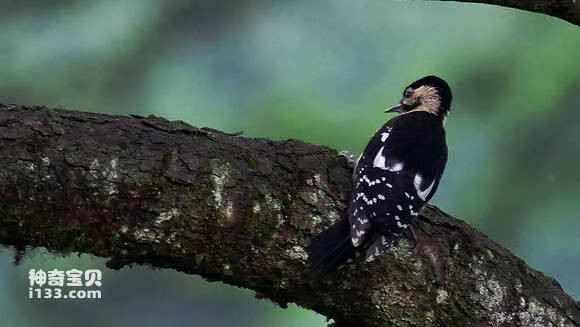
The male Red-breasted Woodpecker has a black upper body; a dirty white or pale tawny forehead; a brownish-white or dirty white face and lores; dirty white, brownish-brown, or tawny ear coverts and sides of the neck, with red tips, especially noticeable on the ear coverts, which connect with the deep red crown. The back of the head and nape are also deep red, while the rest of the head and upper body are black. The wings are blackish-brown with white spots, forming horizontal bars when folded. The greater and median wing coverts on the inner sides of the wings have broad white tips or are entirely white, forming large white patches on the wings. The tail feathers are black, with the outer two pairs of tail feathers having tawny horizontal bars. A broad black jaw stripe splits into two branches from the base of the beak backward, one branch connecting to the black back, and the other running down the side of the throat to connect to the black side of the chest; the chin and throat are dirty white or dark tawny. The chest is bright red, forming a large red patch on the chest; the sides of the chest, flanks, and belly are yellow or dark brown, densely covered with black longitudinal stripes; the undertail coverts are red.
The female Red-breasted Woodpecker is similar to the male, but the back of its head and nape are black instead of red, and its ear coverts have red edges.
The red-breasted woodpecker has brown or red irises, a pale leaden beak, dark leaden or greenish-brown feet and toes, and brown claws.
Size measurements: Weight: ♂ 30-33 g, ♀ 45 g; Body length: ♂ 165-185 mm, ♀ 170 mm; Bill length: ♂ 19-20 mm, ♀ 20 mm; Wing length: ♂ 97-100 mm, ♀ 97 mm; Tail length: ♂ 73-75 mm, ♀ 74 mm; Tarsus length: ♂ 15-17 mm, ♀ 16 mm. (Note: ♂ male; ♀ female)
Detailed introduction
The Crimson-breasted Woodpecker, scientifically known as Dryobates cathpharius and Dendrocopos cathpharius, has six subspecies.
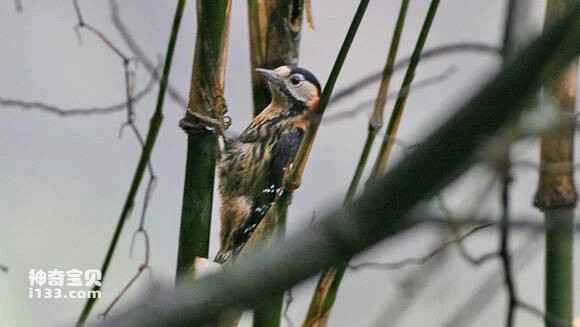
The Red-breasted Woodpecker is a resident bird, appearing in pairs only during the breeding season; otherwise, it is mostly solitary. Its main diet consists of various insects. When hunting, it taps on tree trunks with its beak, producing a "tap, tap" sound. If it finds insects in a particular spot, it clings tightly to the tree, its head and beak almost perpendicular to the trunk. It first pecks open the bark, then uses its tongue to hook out and eat the insects one by one, also using its sticky substance to extract the eggs. When it encounters insects hiding deep within the trunk's tunnels, it taps on the tunnels with its beak, producing a distinctive, frightening drumming sound that drives the insects out of their burrows, which it then captures and eats. It typically eliminates all the small cysts on the entire tree before moving on to another tree.
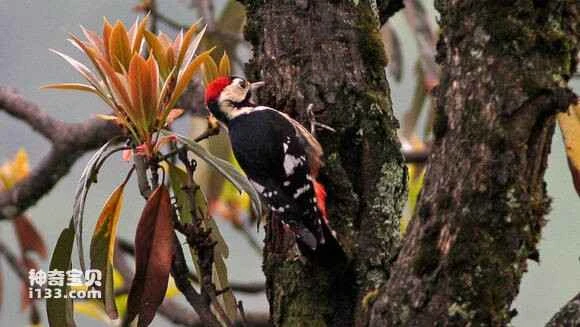
The Red-breasted Woodpecker breeds from April to May, nesting in broad-leaved and mixed forests at altitudes above 1200 meters. Nest burrows are typically chosen on dead or living trees, and are dug by both parents, with the entrance usually oval. Each clutch contains 2-4 eggs. The eggs are white and measure 19.5-25 × 15-18 mm. Both parents take turns incubating the eggs. The chicks are altricial.
The Red-breasted Woodpecker is a common species, but its population is small in China.
It is listed in the "List of Terrestrial Wild Animals of Beneficial or Important Economic and Scientific Research Value under State Protection" issued by the State Forestry Administration of China on August 1, 2000.
Listed as Least Concern (LC) on the IUCN Red List of Threatened Species (IUCN 2016 ver 3.1).
Protect wild animals and ban the consumption of wild game.
Maintaining ecological balance is everyone's responsibility!