Basic Information
Scientific classification
- Chinese name: Striped-backed Woodpecker
- Scientific name: Dryobates scalaris, Picoides scalaris, Ladder-backed Woodpecker
- Classification: Climbing birds
- Family and genus: Order Gastropoda, Family Woodpecker, Genus *Leptochloa*
Vital signs data
- Body length: 16.5-19 cm
- Weight: No verification information available.
- Lifespan: No verification data available.
Significant features
Distribution and Habitat
The striped-backed woodpecker is distributed throughout North America, including the United States, Canada, Greenland, Bermuda, Saint Pierre and Miquelon, and the transitional zone between North and Central America within Mexico. Central America, located between North and South America, includes Guatemala, Belize, Honduras, El Salvador, Nicaragua, Costa Rica, Panama, the Bahamas, Cuba, Haiti, Jamaica, the Dominican Republic, Antigua and Barbuda, Saint Vincent and the Grenadines, Saint Lucia, Barbados, Grenada, and Trinidad and Tobago.
The striped woodpecker lives in tree cavities carved into tree trunks, while in arid regions it chooses to carve cavities in large cacti.
Appearance
The Striped Woodpecker measures 16.5–19 cm (6.5–7.5 inches) in length. Its plumage is primarily black and white, with black and white tiered stripes on its back and wings. The underside of its tail feathers is white with black spots, while its breast and sides are creamy white with small black spots. Southern populations have a dark yellow breast and a significantly smaller beak. Adult males have a reddish-brown crown, which females and juveniles lack.
Detailed introduction
The Ladder-backed Woodpecker, scientifically known as Dryobates scalaris, Picoides scalaris, is a small woodpecker.
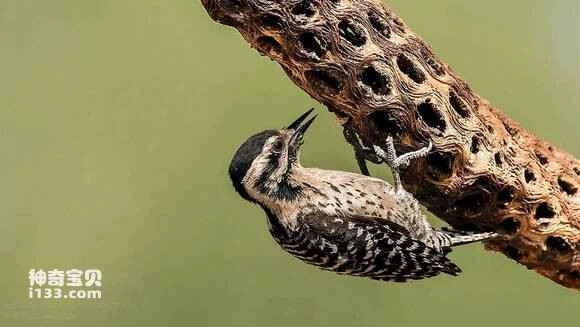
The Striped-backed Woodpecker is very similar in appearance to the California Woodpecker, but has less black on its head and upper back feathers, and their distribution areas overlap only slightly in Southern California and Northern Baja California. Hybrids also exist between the two.

Like most woodpeckers, the striped-backed woodpecker uses its chisel-like beak to drill holes in tree trunks to forage for insects and their larvae, but it also eats cactus fruit.
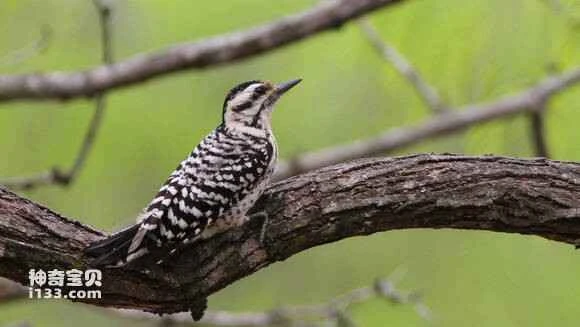
The female lays 2-7 eggs at a time, which are pure white. The eggs are incubated by both parents, but the time required for nest building and other details are still unknown.
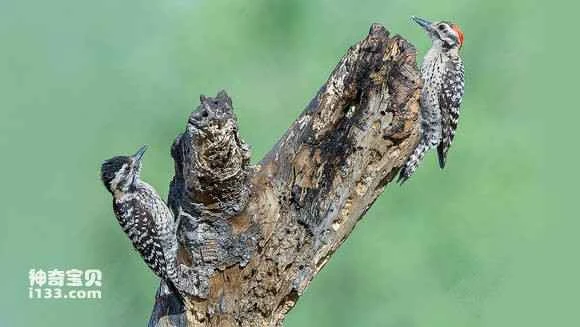
Listed in the IUCN Red List of Birds, version 3.1, 2009.
Protect wild animals and ban the consumption of wild game.
Maintaining ecological balance is everyone's responsibility!