Basic Information
Scientific classification
- Chinese name: Weak Night Hawk
- Scientific name: Phalaenoptilus nuttallii (North American Little Nightjar)
- Classification: Climbing birds
- Genus and family: Order Noctuidae, Family Noctuidae, Genus *Hemiberles*
Vital signs data
- Body length: Approximately 20 centimeters
- Weight: No verification information available.
- Lifespan: No verification data available.
Significant features
One of several hibernating birds
Distribution and Habitat
Native to North America, including the United States, Canada, Greenland, Bermuda, Saint Pierre and Miquelon, and the transitional zone between North and Central America within Mexico, as well as Central American countries and regions such as Guatemala, Belize, Honduras, El Salvador, Nicaragua, Costa Rica, Panama, the Bahamas, Cuba, Haiti, Jamaica, Dominican Republic, Antigua and Barbuda, Saint Vincent and the Grenadines, Saint Lucia, Barbados, Grenada, and Trinidad and Tobago.
They mostly inhabit the southern edge of the United States, preferring dry environments, sparse grasslands, and even stony deserts.
Appearance
It is about 20 cm (8 inches) long; its plumage is gray and mottled; its tail is short with white horns; there is a pale-colored band on its upper breast, white in males and pale yellow in females. The Weak Nightjar often comes out at night to hunt flying insects.
Detailed introduction
The scientific name of the Weak Night Hawk is Phalaenoptilus nuttallii, and its English name is Caprimulgidae, derived from its call.
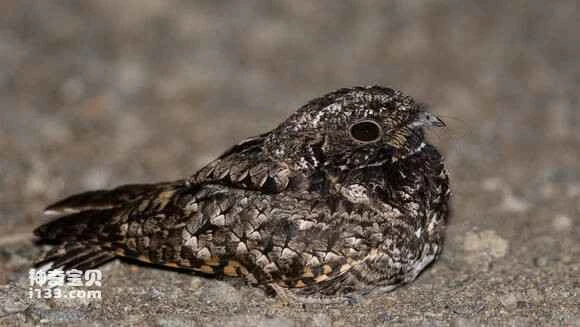
The Weak Nightjar breeds in the arid regions west of the Mississippi River in the United States, extending north to British Columbia in Canada. It lays two white eggs on the ground. It winters from California to central Mexico. The Weak Nightjar is one of the few hibernating bird species. Dr. Edmund Jaeger first described its hibernation in 1948. When winter arrives, the Weak Nightjar finds a rock crevic or a cave in decaying wood to hibernate. During hibernation, its energy consumption is only 7% of its normal level, and it remains in a deep dormant state for weeks or months. Once hibernation ends, it takes up to seven hours for it to regain its normal mobility.
Protect wild animals and ban the consumption of wild game.
Maintaining ecological balance is everyone's responsibility!