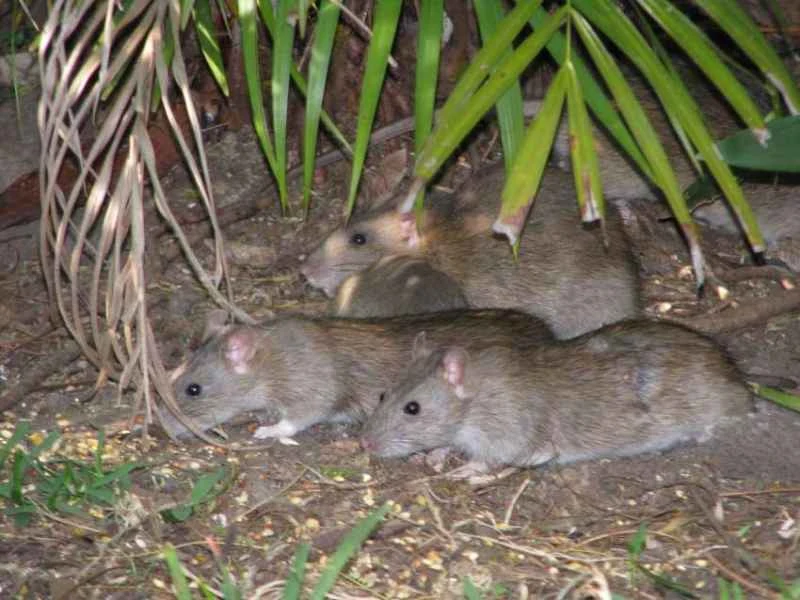
Basic Information
Scientific classification
- Chinese name: Brown house rat
- Scientific name: Rattus norvegicus
- Classification: Rodentia
- Family and genus: Muridae, Rat
Vital signs data
- Body length: Adults typically have a head and body length of about 20–28 cm, while the tail is usually 16–22 cm long and is often shorter than the head and body length.
- Weight: Common weight is about 200–500 grams, but well-nourished or large males can exceed 600 grams.
- Lifespan: The average lifespan in the wild is about 1 year, with a few reaching 2-3 years; it may be longer under stable environment or captive conditions.
Significant features
One of the most common house rodents in the world, it is relatively large in size with a short tail. It is good at digging and swimming, reproduces quickly, and has a wide diet, making it an important target for urban rodent management and public health.
Distribution and Habitat
They are distributed almost globally, preferring environments closely related to human activities, such as sewers, subways, basements, warehouses, ports, food processing areas, garbage dumps, and farm feed areas; they can also spread along riverbanks, drainage ditches, and farmland, often digging burrows to build nests and using building structures and piles of debris as concealed passageways.
Appearance
It has a sturdy build, a broad head and blunt snout, and relatively small ears. Its back is grayish-brown to brownish-gray, and its belly is light gray. Its tail is thick and usually shorter than its head and body length. Its incisors are orange-yellow and grow throughout its life, often leaving bite marks on wood, wires, and plastic. Its limbs are strong and its hind feet are large, making it suitable for running and swimming on the ground.
Detailed introduction
The brown rat (also known as the Norwegian rat, scientific name *Rattus norvegicus *) is one of the most widely distributed rodents in the world and most closely related to humans. Originally from parts of Eurasia, it has spread to towns, ports, farmlands, and storage areas almost everywhere in the world due to shipping, trade, and urbanization. Brown rats are relatively large, highly adaptable, and reproduce rapidly. They are opportunistic omnivores in the ecosystem and one of the most important "urban wild animals" in human public health and food security management.
Classification and nomenclature
The brown rat belongs to the class Mammalia, order Rodentia, family Muridae, and genus Rattus . The English name "Norway rat" stems from an early misunderstanding of its origin and does not necessarily mean it originated in Norway; "brown rat" refers to its common brown fur. Common Chinese names include "褐家鼠" (hèjiāshǔ), "褐鼠" (hèshǔ), and "火星鼠" (hèhuǒshǔ). In many urban rodent management contexts, the brown rat and the black rat ( Rattus rattus ) are considered the two most common domestic rodents.
Appearance features
Brown rats are sturdy animals with broad heads, blunt muzzles, and relatively small ears that are not as thin and large as those of black rats. Adults typically have a head-to-body length of 20–28 cm, with a tail length of 16–22 cm, usually shorter than the head and body length. They commonly weigh 200–500 grams, though well-nourished or larger males can exceed 600 grams. The back fur is mostly grayish-brown or brownish-gray, while the belly is light gray to grayish-white; individual fur color varies depending on the region and habitat.
Compared to black rats, brown rats have stronger limbs and larger hind feet, making them adept at running, digging, and swimming on the ground. Their tails are thicker and have prominent scale rings. Their orange-yellow incisors grow throughout their lives and must be constantly worn down through gnawing, often leaving bite marks on wood, plastic, electrical wires, and building materials. They have well-developed whiskers and a keen sense of smell and touch, relying primarily on their sense of smell, tactile sensation from their whiskers, and hearing to explore and forage during their nocturnal activities.
Distribution range and habitat
Brown rats are now a globally widespread species, establishing populations in almost all areas with human settlements and food storage activities. They prefer environments with stable food supplies and hiding places, and are particularly common in urban underground spaces (sewers, subways, basements), ports and docks, warehouses, food processing areas, garbage dumps, farm feed areas, and near riverbanks and drainage ditches.
In the wild or semi-natural environments, brown rats can also live in farmland, grasslands, wetland edges, and riverbanks, often spreading along waterways. They are adept at digging burrows and building nests under embankments, building foundations, or piles of debris. Due to their strong cold resistance and swimming ability, brown rats can maintain stable activity underground or inside buildings even during the winter in temperate cities.
Lifestyle Habits and Behaviors
Brown rats are mostly nocturnal, becoming more active after dusk, but may also forage during the day when human activity is minimal. They exhibit a clear territorial and hierarchical structure, often occupying resource points (food, water, and nests) in groups, with dominant individuals within the group. Brown rats often show caution and avoidance towards new things (novel phobia), which is one of the reasons why a "pre-baiting period" is needed for rodent control.
They excel at learning and memorizing paths, often moving along edges such as walls, pipes, and ditches (edge effect), and marking their territory with scent through urine, feces, and glandular secretions. Brown rats also possess excellent swimming and diving abilities, enabling them to migrate long distances within cities via drainage pipes and sewer systems. When threatened, they can quickly burrow into burrows or evacuate along fixed routes.
feeding habits
Brown rats are opportunistic omnivores with an extremely wide diet. In cities, they commonly feed on grains, flour, meat scraps, oily foods, fruits and vegetables, pet food, and garbage. In the wild, they will eat seeds, roots, insects, small invertebrates, and even prey on chicks or gnaw on animal carcasses. They have a strong preference for high-energy foods (fat and protein) and will quickly adjust their diet according to available resources in their environment.
Brown rats typically choose relatively secluded spots to feed and may drag their food back to the vicinity of their nests for storage. They have relatively high water requirements, and high-density populations are more likely to occur in areas with abundant water sources, which is one of the reasons why they are often highly associated with drainage systems, riverbanks, and damp underground spaces.
Reproduction and life cycle
Brown rats are highly prolific, breeding almost year-round in warm, food-rich environments. The gestation period for females is approximately 21–24 days, with litters typically containing 6–12 pups (though more are possible). The pups are born hairless and blind, relying on their mothers for nursing. Their eyes open around 2 weeks of age, and they are weaned and begin foraging independently at 3–4 weeks. Sexual maturity is reached at 2–3 months.
In the wild, brown rats have an average lifespan of about one year, with a few reaching two to three years; their lifespan can be even longer under conditions of stable food supply, low predator pressure, or captivity. Their "high reproduction and rapid turnover" strategy allows the population to recover quickly, therefore, control and management usually require continuous and systematic comprehensive measures.
Relationship with humans
Brown rats are among the world's most significant urban pests. They contaminate and consume food, damage electrical wiring, insulation, and building structures, and can cause short circuits and fires. Furthermore, brown rats are linked to a variety of pathogens and parasites, making them a concern for public health management. Because they are highly dependent on human activity for food and shelter, effective urban waste management, food storage, and building rodent control are crucial for reducing their numbers.
From a scientific research perspective, the brown rat is also one of the wild ancestors of the laboratory animal "white rat/rat" (laboratory rats are derived from the domesticated lineage of the brown rat). Rat models are widely used in neuroscience, pharmacology, and behavioral research, giving this species a special place in the history of human science.
Protecting the status quo and threats
Brown rats are numerous and widely distributed globally, and are generally assessed as Least Concern (LC). However, they are a typical invasive species in many island ecosystems, potentially preying on bird eggs and chicks, competing for native small mammal resources, and altering native ecological processes. For humans, controlling brown rats is more of a "management and risk reduction" issue than a "species conservation" issue.
Effective control strategies typically emphasize integrated management: reducing food sources (waste and feed management), sealing building gaps and pipe passages, improving sewer and storage hygiene, using physical traps and compliant rodent control measures, and combining this with long-term monitoring and assessment. For nature reserves and islands, preventing their intrusion via freight transport and conducting targeted invasion control or eradication operations can often significantly improve the survival chances of native birds and small animals.
Frequently Asked Questions
Q1: What is the difference between brown rats and black rats?
Brown rats are typically larger and more robust, with smaller ears and tails that are often shorter than their head and body length. They prefer ground and underground spaces. Black rats are generally more slender, with larger ears and longer tails. They are better climbers and are more often found on rooftops, attics, and high-rise structures.
Q2: Why do brown rats often appear in sewers and underground?
The underground space offers more stable temperatures, more concentrated food and water sources, and better concealment. Brown rats are good swimmers and can migrate using drainage pipes and sewer systems, establishing stable underground nests.
Q3: How many times can a brown rat reproduce in a year?
They breed almost year-round in warm and food-rich environments. The gestation period for females is about 21–24 days, with a typical litter size of 6–12 offspring. The pups reach sexual maturity in 2–3 months, resulting in a very rapid population growth rate.
Q4: How to effectively prevent rodents in home and storage environments?
The core strategy is "cutting off food and water supply + sealing off passageways + continuous monitoring." This involves keeping garbage sealed and food stored in airtight containers, promptly cleaning up any spilled feed and grease residue; sealing door gaps, pipe holes, and ventilation openings; and cooperating with rodent control measures and compliant extermination procedures when signs of activity (feces, bite marks, oil stains) are detected, followed by regular follow-up checks.


