Basic Information
Scientific classification
- Chinese name: Brushtail Rock Kangaroo
- Scientific name: Petrogale penicillata
- Classification: Rodentia
- Family and genus: Rhizophoraceae, Rhizophora
Vital signs data
- Body length: Adults typically have a head and body length of about 50–60 cm and a tail length of 55–70 cm. They are adept at leaping nimbly between rock walls.
- Weight: The average weight is about 5–8 kg, with males often being slightly larger and more muscular.
- Lifespan: In the wild, lifespan can typically reach around 10 years, and individuals may live longer in areas with less disturbance.
Significant features
The "rock wall expert" of the cliffs and canyons of eastern Australia has a brush-like tuft of hair at the end of its tail, making it adept at leaping and climbing steep rock faces; the population is mostly fragmented and vulnerable to predation by lemurs and habitat degradation.
Distribution and Habitat
They are mainly distributed in complex terrain areas such as cliffs, steep walls, rock crevices, cave entrances and boulder piles along the Great Dividing Range in eastern Australia. At night, they often forage in grasslands, forest edges and shrublands near rock walls. Their habitats are mostly fragmented, resembling "cliff islands".
Appearance
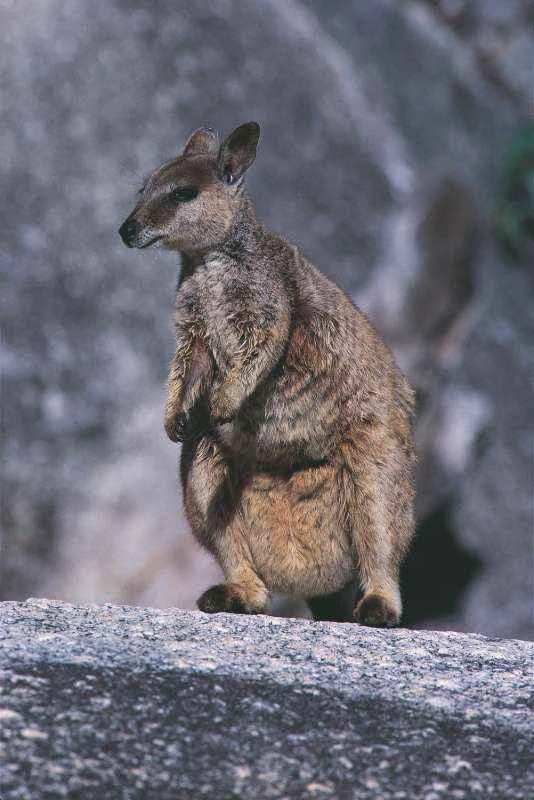
It is medium to small in size, with compact muscles, strong hind limbs, and rough feet for gripping rocks; the back is grayish-brown to brownish-gray, the belly is lighter, and light-colored stripes are common on the face; the tail is relatively long for balance, and the hair at the end of the tail is more fluffy, forming a distinct brush-like tail tuft.
Detailed introduction
The brush-tailed rock-wallaby ( Petrogale penicillata ) is a representative marsupial of the rocky cliffs and canyons of eastern Australia, belonging to the genus Petrogale in the family Coccinellidae. They are adept at leaping and climbing steep rock faces, navigating narrow crevices and quickly evading predators. Due to habitat fragmentation, invasive predators, and historical hunting, the brush-tailed rock-wallaby has declined in many areas, making it one of Australia's important conservation concerns.
Classification and nomenclature
The brush-tailed rock kangaroo belongs to the class Mammalia, superorder Marsupia, order Diprotodontia, family Macropodidae, and genus Petrogale . The genus Petrogale contains various kangaroos highly adapted to rocky environments, differing in size, coat color, and distribution. The English name "brush-tailed rock kangaroo" comes from the fluffy, brush-like tufts of hair at the tip of its tail; it is commonly translated into Chinese as "brush-tailed rock kangaroo."
Appearance features
Brushtail rock kangaroos are medium to small in size, with a compact, muscular body, strong hind limbs, and rough feet, which are well-suited for gripping and jumping on rock surfaces. Adults typically have a head-body length of about 50–60 cm and a tail length of 55–70 cm. The tail is used not only for balance but also provides stability when turning and landing. They generally weigh about 5–8 kg, with males often being slightly larger.
Its back and sides are mostly grayish-brown or brownish-gray, while its belly is lighter in color. Light-colored stripes or spots are commonly seen on its face, and the fur on its back is coarser and stiffer; the fur at the tip of its tail is more fluffy, forming a distinct "brush-like" tail tuft. Compared to plains or woodland kangaroos, rock wallabies are more agile overall, with limbs and torso proportions better suited for rapid movement in complex terrain.
Distribution range and habitat
Brushtail rock kangaroos are mainly distributed in the rocky mountains and canyon systems of eastern Australia, particularly along the Great Dividing Range, where steep cliffs, precipices, limestone cave entrances, boulder fields, and escarpment are highly associated. They typically choose areas that provide shelter in rock crevices, caves, and high vantage points to avoid predators and escape quickly in case of danger.
Their activity areas are often interspersed with surrounding forests, shrubs, and herbaceous vegetation. When foraging at night, they will feed in grasslands near rock faces, forest edges, or under forest canopies. For many populations, habitats are clearly fragmented: suitable cliff “islands” are separated by farmland, roads, or towns, making communication and dispersal between different groups more difficult.
Lifestyle Habits and Behaviors
Brushtail rock kangaroos are more active at dawn, dusk, and night. During the day, they often rest in rock crevices, caves, or shaded areas to conserve heat and avoid predators. They typically live in small, loosely organized groups, sharing caves and resting spots while maintaining a certain distance near food sources.
They have an excellent "route memory" for terrain, enabling them to quickly identify safe passages, jumping landing points, and escape routes. When disturbed, brushtail rock kangaroos often do not choose to flee over long distances, but instead quickly burrow into rock crevices or leap onto higher, more inaccessible rock platforms, using the terrain to their advantage to avoid danger.
feeding habits
Brushtail rock kangaroos primarily feed on plant matter, mainly consuming herbs, tender leaves, shrub leaves, buds, and some fruits. Their diet varies with the seasons and rainfall. They often leave the rock face at night to forage in areas with richer vegetation, returning to their rock shelter before dawn.
During dry or food-scarce seasons, they may rely more on drought-resistant plants and shrub leaves; water can be obtained from dew, plant water content, and nearby streams, so habitats near gullies or moist forest edges tend to be more stable.
Reproduction and life cycle
The brushtail rock kangaroo exhibits typical marsupial reproductive practices: after giving birth, the female places the young into her pouch to continue developing. In most cases, only one offspring is born per litter, and the pouch nursing period is relatively long. Afterward, the young will continue to depend on the mother for a period of time by clinging to her pouch. Reproduction can occur at multiple times throughout the year, but is influenced by regional climate and food conditions.
Juveniles need to learn rock face routes, jumping techniques, and hazard avoidance strategies as they grow. Their lifespan in the wild is typically around 10 years, and may be longer in less disturbed, well-protected areas. Because their reproductive rate is not as rapid as that of smaller rodents, population recovery usually takes a considerable amount of time.
Relationship with humans
Brushtail rockwallabies themselves pose no direct threat to humans, but their habitats are often adjacent to quarrying, road construction, tourism development, and agricultural expansion areas, making them susceptible to habitat destruction and disturbance. In some areas, they venture into grasslands or farmland edges at night to forage, occasionally causing minor conflicts with ranching operations, but they are generally not major agricultural pests.
In ecotourism, rocky canyons and cliff landscapes often attract tourists, and brushtail rock kangaroos may also become a popular subject of observation. Responsible observation involves avoiding feeding, chasing, or making loud noises at the entrance of caves, so as not to alter their activity rhythms or increase their risk of being preyed upon.
Protecting the status quo and threats
Brushtail rockwallales are generally assessed as Vulnerable (VU) or considered a species of high conservation concern globally; they may also be listed as threatened in some Australian states or territories. Their main threats include: predation by invasive predators (red foxes, wildcats), habitat fragmentation and vegetation degradation around cliffs, the legacy of historical hunting, competition with invasive herbivores (such as goats and rabbits) leading to food shortages, and fluctuations in shelter structures and food resources due to changes in the frequency and intensity of wildfires.
Conservation measures typically include: protection and restoration of key cliff habitats, establishment of ecological corridors or reduction of isolation, ongoing fox-cat control, reduction of grazing and alien herbivore stress on vegetation, restocking and genetic management in suitable areas, and long-term monitoring of population trends and habitat quality of isolated populations.
Frequently Asked Questions
Q1: What is the difference between brushtail rock kangaroos and regular kangaroos?
Brushtail rock kangaroos are better adapted to rocky terrain: they have a more compact body, are more agile in jumping, and have stronger grip on the ground. When in danger, they usually burrow into rock crevices or leap onto rock platforms rather than run long distances in open areas.
Q2: Why do they need cliffs and rock crevices?
Rock crevices, caves, and cliffs provide shade and resting places, and are also key "safe havens" to avoid predators such as foxes and wildcats. Terrain advantage is central to the rock wallaby's survival.
Q3: What do brushtail rock kangaroos mainly eat?
They mainly eat grass, tender leaves, shrub leaves, buds, and some fruits. They mostly leave the rock face at night to forage in areas with more vegetation, and return to the cave or crevices to rest before dawn.
Q4: What is the biggest threat they face?
The main threats include predation by invasive predators (red foxes, wildcats), habitat fragmentation leading to group isolation, competition from invasive herbivores due to degradation of surrounding vegetation, and fluctuations in shelter structure and food supply caused by changes in the frequency and intensity of wildfires.