Basic Information
Scientific classification
- Chinese name: Brown-bellied Pit Dog
- Scientific name: Ceryle torquata, Megaceryle torquata, Ringed Kingfisher
- Classification: Climbing birds
- Classification: Order Coraciiformes, Family Kingfisher, Genus Iguana
Vital signs data
- Body length: 38-42 cm
- Weight: 305-341g
- Lifespan: No verification data available.
Significant features
Distribution and Habitat
The brown-bellied kingfisher is distributed in Central America (located between North and South America, including Guatemala, Belize, Honduras, El Salvador, Nicaragua, Costa Rica, Panama, the Bahamas, Cuba, Haiti, Jamaica, Dominican Republic, Antigua and Barbuda, Saint Vincent and the Grenadines, Saint Lucia, Barbados, Grenada, Trinidad and Tobago, etc.) and South America (including Colombia, Venezuela, Guyana, Suriname, Ecuador, Peru, Bolivia, Paraguay, Brazil, Chile, Argentina, Uruguay, and the Falkland Islands).
Brown-bellied kingfishers are commonly found along riverbanks in coastal and inland areas. They inhabit mangrove forests, rice paddies, and the edges of cities in these regions. They spend most of their time inhabiting dead trees, rocks, rivers, and streams 5 to 10 meters above the water. Sometimes they perch on utility poles to hunt.
Appearance
The Brown-bellied Kingfisher measures 38-42 cm in length and weighs 305-341 g. Its main plumage is blue. A small, pointed crest stands upright on its head. It has a powerful bill that can reach 8 inches in length. The bird has predominantly greyish-blue plumage, a bluish-black head, and a white collar resembling a necklace. The male is almost entirely reddish-brown from the belly down, with a white vent area. The female has chestnut-colored underparts with less red, and a broad grey band on the breast. The bill and legs are dark brown.
The beak is thick, straight, long, and strong, with a rounded ridge; the nasal groove is indistinct; the wingtips are long, with the first primary flight feather being slightly shorter, and the third and fourth being the longest; the tail is short and rounded; the head is large, the neck is short, the wings are short and rounded, and the tail is also mostly short; the beak is large and pointed, with a blunt cusp; the legs are very short, the toes are thin and weak, the fourth toe is mostly fused with the third toe, and only fused with the second toe at the base. The preen gland is covered with (protruding feathers). Coracoid bones are present on both sides, and there are four notches on the posterior margin of the sternum; the manubrium of the sternum is simply formed by external spines.
Detailed introduction
The brown-bellied kingfisher, scientifically known as *Ceryle torquata* or *Megaceryle torquata*, has no subspecies.
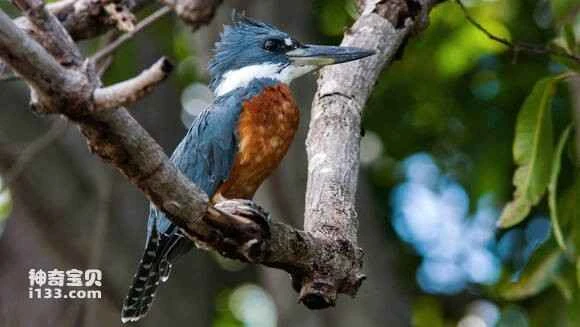
The brown-bellied kingfisher primarily feeds on small fish, supplemented by crustaceans, various aquatic insects and their larvae, as well as small frogs and a small amount of aquatic plants. Kingfishers, on the other hand, maintain excellent vision even after diving into the water because their eyes can quickly adjust to the visual contrast caused by light. Therefore, they are highly skilled at catching fish.
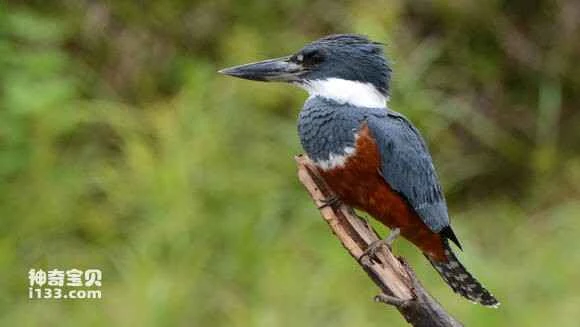
Brown-bellied kingfishers primarily nest on earthen cliffs, or on the banks of fields and streams, using their mouths to dig tunnel-like burrows, which are generally unlined. Eggs are laid directly on the ground inside the nest. Each clutch contains 4-5 eggs. The eggs are pure white, glossy, and slightly spotted, measuring approximately 28 mm × 18 mm. There are 1-2 clutches per year; the incubation period is approximately 34 to 37 days. Both parents feed the chicks, primarily with fish.
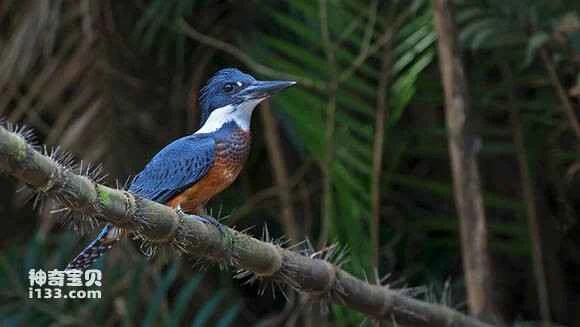
Listed in the IUCN Red List of Birds, ver 3.1: 2008.
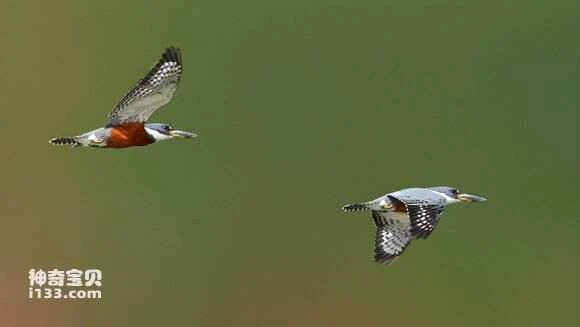
Protect wild animals and ban the consumption of wild game.
Maintaining ecological balance is everyone's responsibility!