Basic Information
Scientific classification
- Chinese name: Spotted Fish Dog
- Scientific name: Ceryle rudis, Pied kingfisher
- Classification: Climbing birds
- Classification: Order Coraciiformes, Family Kingfisher, Genus Iguana
Vital signs data
- Body length: 27.3-28.6 cm
- Weight: 100-130g
- Lifespan: No verification data available.
Significant features
It looks very similar to the crested dogfish, with a black and white mottled pattern all over its body, but it is smaller and has shorter crest feathers on its head.
Distribution and Habitat
The spotted dogfish is distributed across Eurasia and North Africa (including the whole of Europe, Africa north of the Tropic of Cancer, the Arabian Peninsula, and Asia north of the Himalayas-Hengduan Mountains-Minshan Mountains-Qinling Mountains-Huaihe River), Central and Southern Africa (including the southern Arabian Peninsula and the entire African continent south of the Tropic of Cancer in the Sahara Desert), the Indian subcontinent and Southwest China (including India, Bangladesh, Bhutan, Sikkim, Nepal, Pakistan, Sri Lanka, Maldives, and southeastern Tibet), the Indochina Peninsula and Southeastern coastal China (including Myanmar, Vietnam, Laos, Cambodia, Thailand, Southeastern coastal China, Hong Kong, and Hainan Island).
The spotted dogfish mainly inhabits the banks of open waters such as streams, rivers, lakes, and canals in low mountains and plains, and sometimes even appears on the banks of ponds and roadside ditches.
Appearance
The male spotted dogfish has a black forehead, crown, crest, and sides of the head, streaked with fine white lines; the lores and supercilium are white. The nape is mottled with black and white, with a large white patch on each side. The back, shoulders, and wing coverts are black with white tips, creating a black and white patchwork. The flight feathers are blackish-brown, with white bases on the primary feathers, forming prominent white wing patches. The inner secondary feathers have white bases and tips, and white edges. The rump and uppertail coverts are white with black subterminal patches. The tail is white with broad black subterminal patches. The underparts are white, with two black breast bands, the front one wider and the rear one narrower. The flanks and belly have black spots.
The female spotted dogfish is similar to the male, but has only one breast band, which is often broken in the middle, and only has large black spots on both sides of the breast.
The spotted dog has light brown irises, a black mouth, and dark brown feet and paws.
Size measurements: Weight ♂ 102 g, ♀ 100-130 g; Body length ♂ 273 mm, ♀ 280-286 mm; Bill length ♂ 40 mm, ♀ 50-52 mm; Wing length ♂ 136 mm, ♀ 139-140 mm; Tail length ♂ 74 mm, ♀ 74-75 mm; Tarsus length ♂ 10 mm, ♀ 10-11 mm (Yunnan subspecies).
Detailed introduction
The scientific name of the spotted kingfisher is Ceryle rudis, and its foreign name is Pied kingfisher. There are four subspecies (1. Common subspecies Ceryle rudis insignis; 2. Yunnan subspecies Ceryle rudis leucomelanurus; 3. Nominate subspecies Ceryle rudis rudis; 4. Indian subspecies Ceryle rudis travancoreensis).
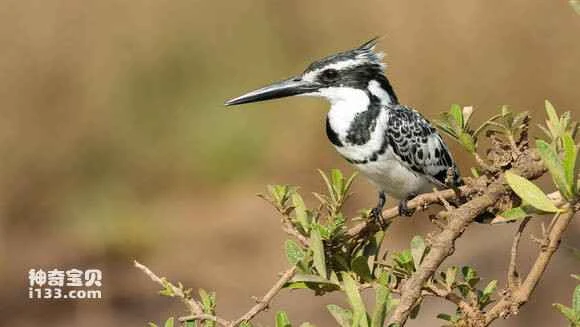
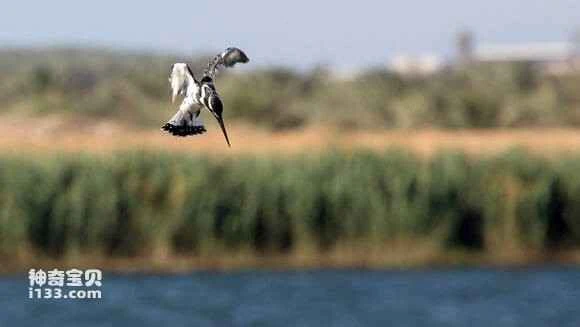
The spotted kingfisher lives in pairs or groups in larger bodies of water and mangroves. It is noisy and the only kingfisher that constantly hovers near the surface in search of food. It usually flies low, a few meters to a dozen meters above the water, sometimes skimming the surface, sometimes rising, flapping its wings back and forth. Upon spotting a school of fish, it immediately folds its wings, plunges into the water, and then rises sharply again. When resting, it often perches on trees near the water, especially dead trees and rocks, or on rocks and branches protruding from the water. It keeps a watchful eye on the water, and upon spotting fish, immediately plunges in to catch them. Its diet consists mainly of small fish, but it also eats crustaceans, various aquatic insects and their larvae, as well as small frogs and a small amount of aquatic plants. Its call is a sharp whistle.
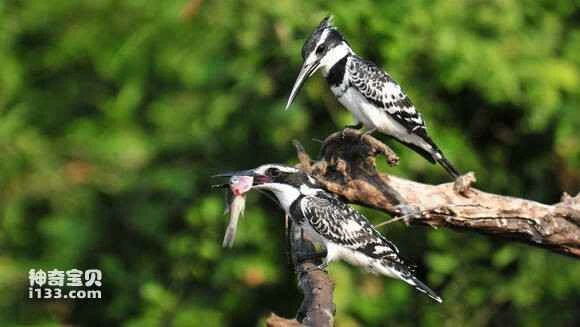
The breeding season for the spotted kingfisher is from March to July. During the breeding season, they will call incessantly and fiercely defend their nest and mate. They usually nest in sandstone burrows on riverbanks, without any lining. Each clutch contains 3-6 eggs, mostly 4-5. The eggs are white, oval or oblong-oval, measuring 28-32 × 23-25 mm, with an average of 30 × 24 mm. Both parents take turns incubating the eggs. The chicks are altricial; they are blind after hatching, but become sighted and feathered after 5 days.
Listed as Least Concern (LC) on the IUCN Red List of Threatened Species 2012 ver 3.1.
Protect wild animals and ban the consumption of wild game.
Maintaining ecological balance is everyone's responsibility!