Basic Information
Scientific classification
- Chinese name: Brown-chested Buddhist monk
- Scientific name: Coracias benghalensis, Indian Roller
- Classification: Climbing birds
- Classification and Genus: Order Coraciiformes, Family Coraciiformes, Genus Coraciiformes
Vital signs data
- Body length: 32-35 cm
- Weight: 160-180g
- Lifespan: No verification data available.
Significant features
Distribution and Habitat
Country of origin: Afghanistan, Bangladesh, Bhutan, Cambodia, China, India, Iran, Iraq, Kuwait, Laos, Malaysia, Myanmar, Nepal, Oman, Pakistan, Saudi Arabia, Sri Lanka, Thailand, United Arab Emirates, Vietnam.
Vagrant bird distribution areas: Maldives, Qatar, Syria, Türkiye.
In China, it is mainly distributed in southern Sichuan, southern Tibet, and Yunnan.
They inhabit lowland areas below 1200 meters, especially open planted plains or deciduous forests. They also appear in urban areas such as parks and towns, where they use overhead power lines as advantageous hunting locations.
Appearance
Black lores, pale brownish-white forehead, dark blue crown, glossy pale blue sides of the crown, with a narrow white eyebrow stripe tinged with blue; humps, shoulders, and inner flight feathers are oily green with brown streaks. Rump bluish-purple, inner flight feathers more tinged with blue, upper tail coverts glossy pale blue. Central tail feathers dark brown, with blue streaks at the base and on both sides of the tail shaft. Outer tail feathers deep blue at the base, blue at the tip, black shaft. Lesser wing coverts deep purplish-blue. Greater wing coverts pale blue-grey. Primary flight feathers deep blue at the base, gradually fading to pale blue towards the tip, brown at the tip. Secondary flight feathers deep blue, light blue at the base. Chin, throat, and upper breast grape-purple with pale blue longitudinal stripes; lower breast grape-brown, belly, flanks, and undertail coverts pale blue, wing edges, underwing coverts, and axillaries deep blue.
The iris is light brown, the mouth is dark brown, and the tarsus and toes are yellowish-brown.
Size measurements: Weight: ♂ 160-170 g, ♀ 160-180 g; Body length: ♂ 338-353 mm, ♀ 322-328 mm; Bill length: ♂ 37-42 mm, ♀ 41 mm; Wing length: ♂ 197-207 mm, ♀ 188-193 mm; Tail length: ♂ 130-147 mm, ♀ 129 mm; Tarsus length: ♂ 26-27 mm, ♀ 26 mm. (Note: ♂ male; ♀ female)
Detailed introduction
The brown-breasted monk, scientifically known as *Coracias benghalensis*, is also called the Indian Roller. Its specific habits are unknown.

The Brown-breasted Roller is usually found alone or in pairs, often perched on dead branches at the top of trees or on power lines in forest edges, near villages, or in farmland areas. Flocks are extremely rare; they may form family groups. When bathing, it swoops down into the water from a great height, a behavior that has been mistaken for fishing.
The brown-breasted roller primarily feeds on insects, especially beetles, crickets, and grasshoppers. It also frequently preys on flying insects such as wasps, flies, moths, and butterflies, and occasionally eats plant seeds. Amphibians also constitute a large part of its diet when conditions permit, although this food source is usually unavailable in drier regions. It primarily hunts by flying, but sometimes also on the ground.
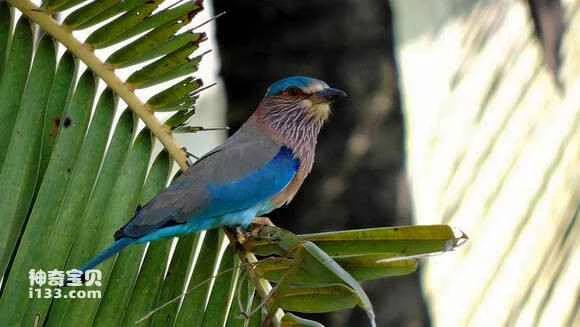
The Brown-breasted Roller (Trachidermus chinensis) is a resident bird in Tibet and Yunnan, China, and a summer visitor in Sichuan. Its call is a harsh, crow-like "whoosh." When threatened, the call becomes sharper and more frequent.
The breeding season for the Brown-breasted Roller is from spring to early summer (April to July). Males begin courtship displays as early as February. The display pattern is exceptionally complex; the male first flies to a high place, then tumbles down while displaying a series of flight techniques, screaming and rapidly flapping its wings, flashing the bright colors on its wings and tail.

Protect wild animals and ban the consumption of wild game.
Maintaining ecological balance is everyone's responsibility!