Basic Information
Scientific classification
- Chinese name: Gorgeous Spider
- Scientific name: Ordgarius magnificus
- Classification: Arthropoda
- Family: Ordgarius
Vital signs data
- Body length: Female spiders are about 10–14 mm long, while male spiders are only about 1–2 mm long.
- Weight: Relatively light, mostly in the tens to hundreds of milligrams range, depending on the individual.
- Lifespan: Estimated to be about 1 year, with an individual potentially spanning one breeding season.
Significant features
Typical meteor spider; uses silk threads with sticky balls and pheromones to lure moths; males and females differ greatly in size.
Distribution and Habitat
Limited to the forests and shrublands of the east coast of Australia, they mostly inhabit trees and tall shrubs, often more than 2 meters above the ground.
Appearance
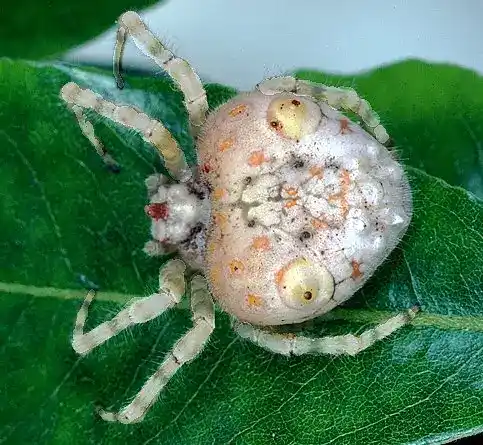
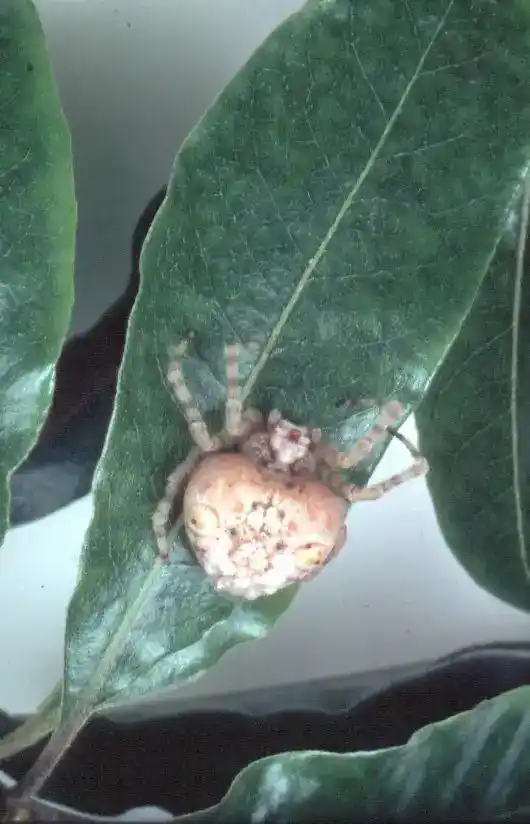
The female spider has a milky white body with pink and yellow spots, a head with white and reddish-brown nodules, and a full, almost round abdomen.
Detailed introduction
The Magnificent Spider, usually referring to *Ordgarius magnificus* , is a unique bolas spider belonging to the family Araneidae , found in the forests of the east coast of Australia. Instead of weaving a traditional, complete circular web, it uses a single silk thread with a sticky ball, like a "bola," to capture moths, making it quite unique among spiders.
Basic Information
Scientific name: Ordgarius magnificus
Family: Araneidae; Genus: Ordgarius
Size: Female spiders can reach a length of about 10–14 mm, almost equal to their body width; male spiders are only about 1–2 mm long, showing significant sexual dimorphism.
Lifespan: Estimated to be around 1 year, with an individual potentially spanning one breeding season.
External features
The female spider has a pale milky-white body, with pink to yellow spots and patterns covering her abdomen. Her cephalothorax has a ring of white and reddish-brown raised nodules, giving her a very "magnificent" appearance, hence the name Magnificent Spider. Her body is almost as wide as her body, slightly plump, and her legs are relatively short, making her suitable for lying still among the branches and leaves rather than running at high speed.
Distribution and Habitat
The ornate spider is currently known to be found only in forest environments along the east coast of Australia , including shrublands, sclerophyllous forests, and near-natural green spaces in suburban areas of New South Wales and Queensland. They typically perch on trees or tall shrubs, rarely below 2 meters from the ground , and during the day often hide in concealed resting places made of rolled leaves and spider silk.
Unique "bombardment" hunting method
As a member of the meteor spider family, the ornate spider has a very unique hunting method: at night, the female spider pulls out a "horizontal bar" of silk between branches, hangs upside down on the silk, and then suspends a large sticky ball (i.e., "bolas") from the end of a short silk.
It releases sex pheromones that mimic those of certain female noctuid moths, attracting male moths from afar. When the spider senses the moth's approach through sensitive vibrating hairs on its legs, it swings a sticky ball of silk, like wielding a flail, towards the moth. Once it hits, the prey is firmly stuck. The spider then pulls it back, bites it, and wraps it in silk. Some of the prey is eaten that night, while the rest is temporarily suspended for preservation.
Reproduction and egg sacs
The ornate spider lays multiple large egg sacs among the surrounding branches and leaves. Each egg sac can be several centimeters long, spindle-shaped or slender "sausage-like," and brownish in color, resembling a string of dried dates or small eggplants from a distance. A female spider can lay multiple egg sacs during a breeding season, with each sac containing hundreds of eggs, which is an important way for it to maintain its population size.
Toxicity and Effects on Humans
Like most members of the garden spider family, the ornate spider possesses venom glands to paralyze its insect prey. However, it is relatively small and its activities mostly take place at night in the tree canopy, minimizing opportunities for contact with humans. There are currently no reports of serious bites to humans, and it is generally considered to pose very little danger to healthy adults. If accidentally discovered in the wild or in a garden, simply observe it from a distance; there is no need to panic or deliberately remove it.
Frequently Asked Questions
Q1: Are ornate spiders dangerous?
There is currently no evidence that the ornate spider poses a serious threat to humans; bite cases are extremely rare, and it is generally considered to pose a very low risk to healthy adults.
Q2: Why is it called "Magnificent Spider"?
Its striking features mainly come from the pink and yellow spots on the female spider's milky-white body, the orbicularis oculi on her head, and her unique hunting methods.
Q3: Will it weave a normal circular net?
As a meteor spider, it does not weave a complete, large, circular web, but instead uses only a single "meteor hammer" thread with a sticky ball to catch moths.
Q4: Should I deal with the ornate spider if I see it in the wild in Australia?
Normally, this is not necessary. It is a local species and plays a role in controlling some noctuid moth populations; simply avoid touching it.


