Basic Information
Scientific classification
- Chinese name: Chestnut-necked Jade
- Scientific name: Actenoides concretus, Chestnut-collared Kingfisher
- Classification: Climbing birds
- Genus and family: Order Coraciiformes, Family Aldehydeidae, Genus Aldehyde
Vital signs data
- Body length: Approximately 24 centimeters
- Weight: 70-90g
- Lifespan: No verification data available.
Significant features
Distribution and Habitat
Distributed in the Indochina Peninsula and southeastern coastal areas of China (including Myanmar, Vietnam, Laos, Cambodia, Thailand, and the southeastern coastal areas of China, Hong Kong, and Hainan Island), and Pacific islands (including Taiwan, the Dongsha Islands, Xisha Islands, Zhongsha Islands, Nansha Islands, as well as the Philippines, Brunei, Malaysia, Singapore, Sumatra and Java in Indonesia, and Papua New Guinea).
Chestnut-necked kingfishers live on the Asian continent, ranging in activity from sea level to altitudes of 800 meters. However, they have also been found in Borneo at altitudes of up to 1,700 meters, and they typically inhabit dense forests and near water.
Appearance
The Chestnut-collared Kingfisher is 24 cm long and weighs 70-90g. The male has a dark green cap. It has a black forehead, a green nape, and a large, long, dark blue patch running from the cheeks to the neck on both sides. The eyebrows are reddish-brown. There is a pale yellow-orange tinge on the cheeks, chin, and throat. Thin bluish-purple bristles extend to the chin. The neck and breast are red, the upper back is a beautiful black coat, and the wings are bluish-purple. The rump and hips are a beautiful bright blue. The tail is bluish-purple. The wings, tail edges, and wingtips are red. The bill is yellow. The iris is dark brown, and the legs are yellowish-green.
The female differs from the male, with a slightly larger eye stripe. The upper back, shoulder blades, and wings are a deep olive green. The wings and back feathers have a scaly pattern. Juveniles resemble adults. They possess a strong, mottled greyish-brown beak. The beak is thick and long, like a chisel, wider at the base, with a straight apex and a rounded ridge, lacking nasal grooves on either side; the wings are rounded, with the first and seventh primary flight feathers being equal in length or slightly shorter, while the second, third, and fourth are nearly equal in length; the primary flight feathers have white spots at their base; the tail is rounded; the beak is red.
Detailed introduction
The scientific name of the Chestnut-collared Kingfisher is Actenoides concretus, and it has three subspecies.
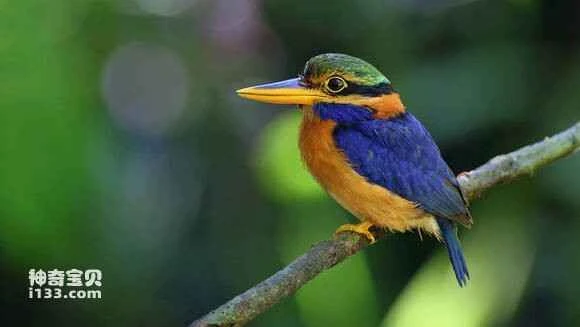
When hunting, the Chestnut-necked Kingfisher typically hunts alone or in pairs. Like most forest kingfishers, it is entirely carnivorous, often searching for prey in leaves or mud. Its main diet consists of invertebrates such as crickets, spiders, scorpions, and snails. It also eats small vertebrates such as small fish, small snakes, and lizards.
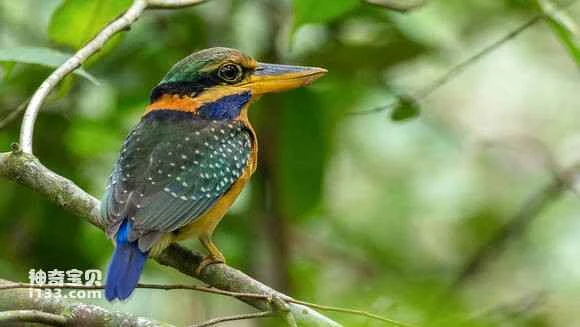
The Chestnut-necked Emerald nests on earthen cliffs or river embankments, using its beak to dig tunnel-like burrows, oval in shape, 10 cm deep, 20 cm wide, and 60 cm in diameter. These burrows are generally unlined. Eggs are laid directly on the ground inside the nest. Some also burrow into tree trunks. They lay two eggs at a time. Breeding season is from April to June in Malaysia, from December to March in Borneo, and in March in Sumatra. Chicks remain in the nest for about 22 days.
Listed in the IUCN Red List of Birds, ver 3.1: 2008.
Protect wild animals and ban the consumption of wild game.
Maintaining ecological balance is everyone's responsibility!