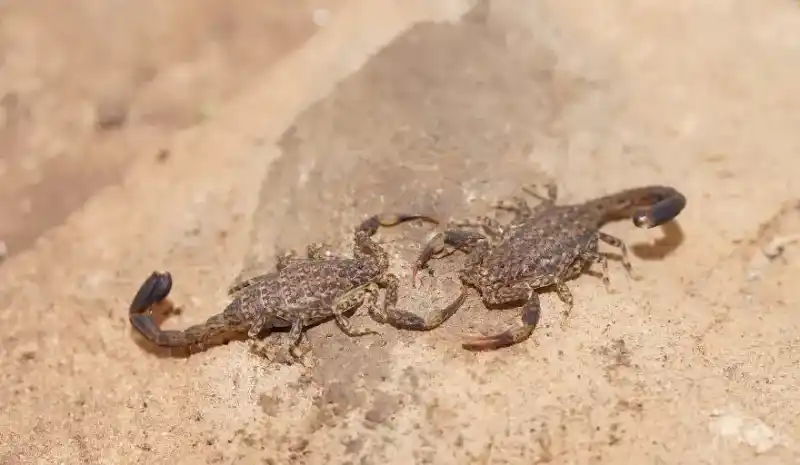
Basic Information
Scientific classification
- Chinese name: Marble Scorpion
- Scientific name: Lychas marmoreus
- Classification: Arthropoda
- Family: Lychas (Scorpion family)
Vital signs data
- Body length: Adults are approximately 30–40 mm in total length (including the tail), classifying them as small scorpions.
- Weight: Weight typically ranges from several hundred milligrams to approximately 1 gram, depending on the individual.
- Lifespan: Approximately 4–8 years
Significant features
Its body surface has marble-like patterns of varying shades; it is a nocturnal predator; it is commonly found under rocks, under tree bark, and around dwellings.
Distribution and Habitat
Native to Australia, it is widely distributed in the south and east; it mainly inhabits eucalyptus forests, shrublands, leaf litter, and green spaces around cities, and occasionally enters indoors.
Appearance
It has a light brown or yellowish-brown base color with dark brown cloud-like markings; the tail is long and thick, with darker tail spines and the tip.
Detailed introduction
Marble scorpions generally refer to several small patterned scorpions distributed in Australia, with the small marble scorpion (Lychas marmoreus) being the most typical, and also including some closely related species called "marbled scorpion". They are small in size but have alternating light and dark marble-like patterns and relatively long tails, and are one of the most common small scorpions found around Australian homes and in forests.
Basic Information
Representative scientific name: Lychas marmoreus
Family and genus: Scorpiones (order Scorpioni), Buthidae (family Scorpionidae), Lychas (genus Lychas )
Size: Adults are about 30–40 mm in total length (including tail), which is small.
Lifespan: Captive and wild observations show that it can live for about 4–8 years.
Appearance features
Marble scorpions are typically light brown or yellowish-brown in color, with their backs, legs, and tails covered in dark brown to nearly black cloud-like or marble-like markings . The telson is often thicker than the body, and the stinger (venomous needle) and tail tip are darker in color, sometimes with a small protrusion visible at the base of the stinger. Overall, they appear both inconspicuous and easily recognizable.
Distribution and Habitat
Marble scorpions are native to Australia and are known to be widely distributed in the south, east, and parts of the north, including eucalyptus forests, shrublands, grassland edges, and green spaces and gardens around cities. They often hide in small groups under rocks, decaying wood, and bark , and can also be found in leaf litter and ground crevices. Occasionally, they enter houses to forage or escape drought and high temperatures.
Lifestyle and Diet
Marble scorpions are typical nocturnal predators , hiding in concealed places during the day and venturing out at night to hunt. They primarily prey on various small invertebrates, such as termites, cockroaches, small beetles, ants, and other arthropods. They rely on their keen sense of touch and chemoreception to locate their prey, injecting venom into their stinger to paralyze it before feeding.
Toxicity and Effects on Humans
Like all scorpions, the marbled scorpion possesses venom glands and a stinger for defense and prey. Its venom is highly effective against small arthropods, but for healthy adults, the sting typically resembles a severe bee sting : causing immediate, intense pain, localized redness and swelling, and discomfort for several hours. A small number of people may experience allergic reactions and should seek medical attention as needed.
In most known cases in Australia, marble scorpion stings are not considered fatal and usually do not cause long-term damage. However, caution is still advised for children, the elderly, or those with a history of allergies.
Ecological role
Marble scorpions play an important role as small predators in the ecosystem, helping to regulate invertebrate populations by preying on termites, cockroaches, and other terrestrial insects. In home backyards and farms, they serve a dual role as both "potential dangers" and "natural insect controllers." Understanding and protecting them is more beneficial to the overall ecological balance than simply eliminating them.
Frequently Asked Questions
Q1: How dangerous are marble scorpions to humans?
For healthy adults, a sting usually causes severe pain and several hours of redness and swelling, but it is generally not fatal.
If you experience difficulty breathing, widespread hives, or persistent severe pain, seek medical attention immediately.
Q2: What should I do if I find a marble scorpion in my home?
Wearing thick gloves, gently cover the object with a glass or box, then slide it onto a piece of cardboard and move it to a safe outdoor location.
It is not recommended to pat it with bare hands, as this may provoke it and cause it to sting.
Q3: Where do marble scorpions hide during the day?
They often hide in dark, damp places with many crevices, such as under rocks, wooden boards, tree bark, or at the bottom of flower pots.
Q4: Will they attack people on their own initiative?
They usually do not attack proactively; they may only stab defensively when cornered, squeezed, or accidentally grabbed.