Basic Information
Scientific classification
- Chinese name: Northern Sand Dune Frog
- Scientific name: Arenophryne rotunda
- Order: Anura
- Family: Myobatrachidae Arenophryne rotunda Northern sandhill frog Sandhill frog
Vital signs data
- Body length: Adults are generally about 2.6–3.3 cm in length, belonging to the small and round-bodied burrowing frogs.
- Weight: Individual body weight is typically only around 2–8 grams, varying depending on individual size and nutritional status.
- Lifespan: It is estimated that they can survive for several years in the wild, and can participate in reproduction multiple times in suitable dune habitats.
Significant features
The unique burrowing frog of the White Coast dunes in Shack Bay, Western Australia, has a round body, a small head and short legs. It is adept at digging burrows with its head facing forward and can reproduce in the sand dune environment where there is almost no surface water by digging underground wet sand.
Distribution and Habitat
Found only in the white coastal dunes around Shack Bay in Western Australia, such as the Eder Peninsula and Dick Hart Island, they inhabit coarse-grained coastal dunes, maintaining their moisture balance and avoiding high temperatures and dryness by burrowing into deep, damp sand containing a small amount of water.
Appearance
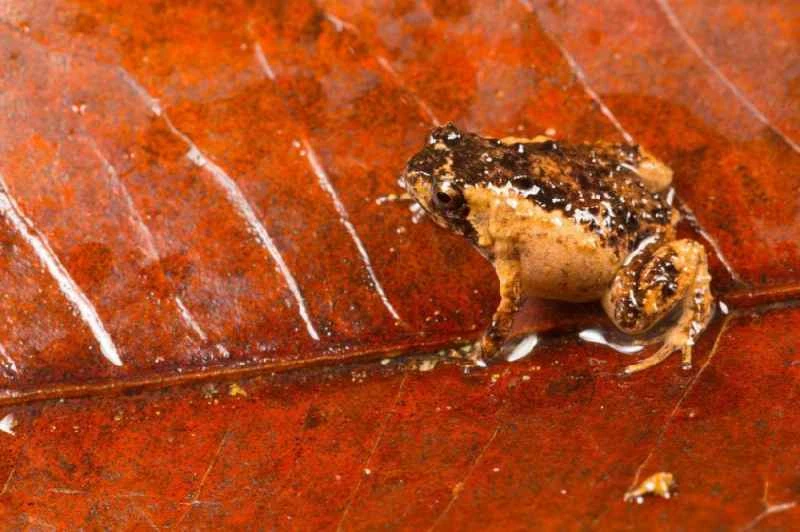
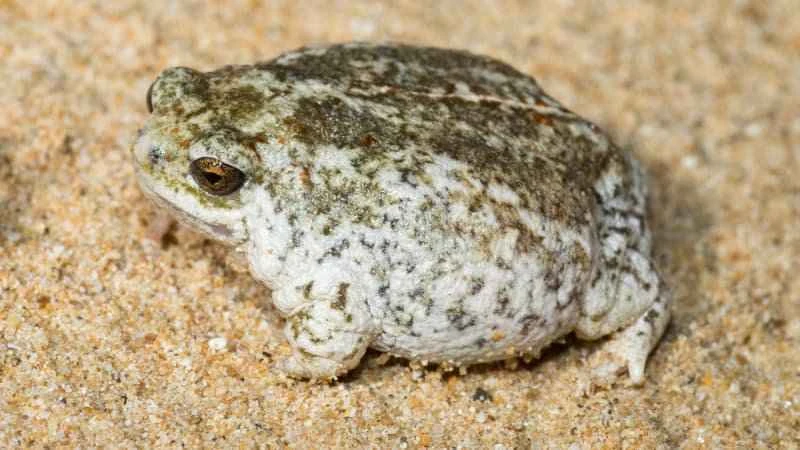
Its body is short and round, its head is small but wide, its forelimbs are strong, its fingers are short and thick, its back is colored from cream to light gray and light brown, and it is dotted with small reddish-brown or green spots. Its skin is slightly loose and has warts, and its belly is dark white. Overall, it looks like a "dust dungeon frog".
Detailed introduction
The Northern Sandhill Frog ( Arenophryne rotunda ) is a small, round-bodied native Australian frog. Belonging to the family Myobatrachidae, it is one of the few frogs adapted to the arid coastal dune environment, digging its burrows head-first. It primarily inhabits the white coastal dunes of Shark Bay in Western Australia.
Classification and nomenclature
Common Chinese name: Northern Sand Dune Frog (based on a direct translation of the English name; there is no completely unified Chinese name yet)
English name: Northern Sandhill Frog, often abbreviated as Sandhill Frog
Scientific name: Arenophryne rotunda
Family: Myobatrachidae → Genus: Arenophryne
Appearance and Identification Features
The northern sand dune frog is small in size, but has a very distinctive appearance:
Size: Adults are generally about 2.6–3.3 cm in length, with short and round bodies;
Body shape: The body is round and drum-shaped, the head is small but wide, and the limbs are short and thick. Overall, it looks like a "small dumpling frog".
Back color: The back color can range from pale white and cream to light gray and light brown, and is decorated with irregular brown, reddish-brown or green spots;
Skin texture: The skin is slightly loose, especially around the hind legs where there are some wrinkles, and the back has small warts and low ridges;
Abdomen: The abdomen is mostly dark white or grayish white and relatively uniform;
Limbs: The forelimbs are strong and powerful with short, thick fingers, which facilitates digging forward; the hind limbs are relatively short, unlike typical frogs that are good at jumping, and are more like a body shape specifically adapted to digging.
Tympanic membrane: The tympanic membrane is not obvious or difficult to see on the surface.
Having adapted to a life of digging in the sand dunes, the northern dune frog has a round body, a small head, and strong forelimbs, making its overall appearance significantly different from that of common tree frogs or pond frogs.
Distribution range and habitat
The northern dune frog is a very small, endemic species along the coast of Western Australia .
They are mainly distributed in the Shark Bay area and the nearby White Coast dunes, including the Edel Land and Dirk Hartog Island.
The elevation ranges roughly from sea level to about 150 meters.
Highly specialized habitats:
They mainly live on coarse-grained coastal dunes where water seeps in very quickly and there is a lack of long-term surface water.
They rely on a layer of moist sand that is kept deep within the sand layer, and avoid the dryness and high temperature during the day by drilling into this moist layer;
Their habitat is generally arid, but there is still some residual moisture in the sand, making them a typical "dust-lurking" frog.
Lifestyle
The northern sand dune frog is a burrowing, nocturnal frog .
During the day, they mostly hide deep in the sand, usually tens of centimeters below the surface, close to the moist sand.
As the dry season deepens during the day, they gradually burrow deeper to maintain contact with the wet sand layer.
When the temperature is low and the humidity is high at night, they emerge from the sand and move around and forage on the surface of the dunes.
Unlike most frogs that "dig backwards," the northern dune frog is one of the few frogs that "digs head-forward," propelling itself forward with its small, wide head and powerful forelimbs.
Characteristics of adaptation to arid environments
The northern dune frog lives in areas with unstable rainfall and very little surface water, but it copes with drought through several characteristics:
By contacting the skin with the moist sand layer, moisture is absorbed from the sand through osmosis;
During the day, they are buried deep in the sand to reduce evaporation and loss of body water;
They are mostly active during the cooler, wetter winter months and at night;
They avoid dependence on surface water bodies by using underground spawning and direct development models.
feeding habits
Northern sand dune frogs primarily feed on small invertebrates:
A large number of ants are an important food source for them;
They also prey on other small insects and arthropods that live on the surface of the dunes;
Emerging from their burrows at night, they move slowly across the sand, searching for passing prey.
Reproduction and Development
The northern sand dune frog has a very unique reproductive method, being a typical example of direct underground development :
The breeding season usually occurs during the wettest season in the local area (such as winter or after rainfall).
Male frogs emit short, sharp calls on or under the sand to attract female frogs;
After pairing up, the male and female will dig together down to a deeper, more moist sand layer;
The female frog lays her eggs at a depth of about several tens of centimeters to nearly one meter underground. Each clutch contains a small number of eggs, but the eggs are relatively large.
The eggs develop directly underground, skipping the free-living tadpole stage, and hatch into miniature frogs.
Adult frogs and tadpoles can remain underground for months until conditions are suitable before they become more active on the surface.
Protecting the status quo and threats
According to the IUCN Red List assessment, the northern sand dune frog is currently listed as Least Concern (LC) , and its overall population is considered relatively stable within its limited distribution area.
Potential threats include:
Its distribution range is extremely limited, and it is highly sensitive to changes in the local environment.
Coastal development, off-road vehicles, and tourism activities may damage dune microhabitats;
Climate change is causing changes in rainfall patterns, affecting dune humidity and the stability of underground wet sand layers.
Currently, its main distribution area is partly located within protected areas and World Heritage sites, which helps maintain the long-term stability of the population.
Frequently Asked Questions
Q1: Why do northern sand dune frogs dig burrows with their heads facing forward?
Most frogs dig burrows backward using their hind legs, but the northern sand dune frog and a few other species have evolved to dig "head-forward."
Its wide head and strong forelimbs make it suitable for propelling itself forward like a "drill" through coarse sand, which helps it quickly burrow into the sand to escape the heat and retain moisture.
Q2: Do northern sand dune frogs need ponds or water pits to reproduce?
No. They lay their eggs and complete their direct development in damp underground sand, without a swimming tadpole stage, and therefore do not depend on surface water.
This is one of the key adaptations that enable them to survive and reproduce in arid coastal dune environments.
Q3: Why does the body of the northern sand dune frog look so round?
The rounded shape is advantageous for squeezing and propelling through loose sand and can also store a certain amount of water and energy underground;
Meanwhile, the short, stubby limbs are suited for digging rather than long-distance jumping, which is a result of long-term adaptation to burrowing life in sand dunes.
Q4: Under what circumstances might humans see the northern dune frog?
They spend most of their time underground, only emerging from the sand to forage on cooler, wetter nights.
In the white coastal dunes of Shak Bay, after rain or on winter nights, by searching the sand with a flashlight, one can sometimes see them moving slowly.